My 2 Cents on the Dollar

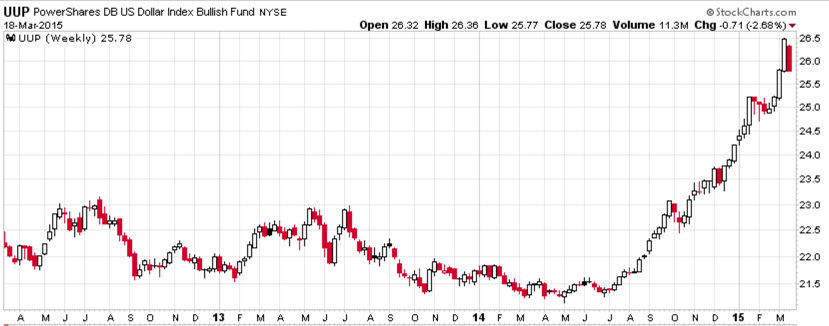
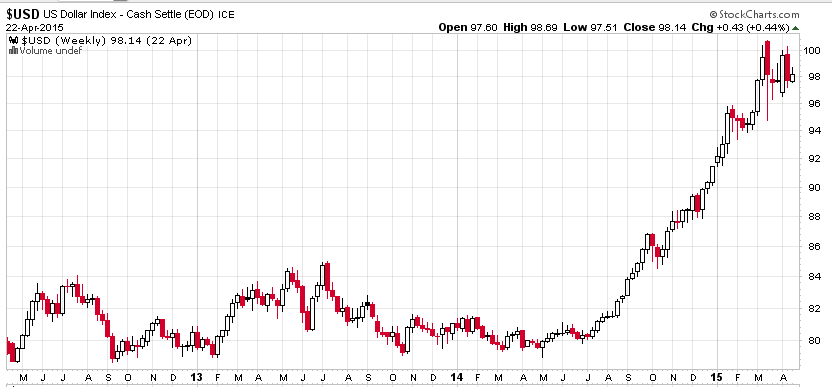
The U.S. Dollar ($USD) has gained about 20% in less than a year. We observe it first in the weekly below. The U.S. Dollar is a significant driver of returns of other markets. For example, when the U.S. Dollar is rising, commodities like gold, oil, and foreign currencies like the Euro are usually falling. A rising U.S. Dollar also impacts international stocks priced in U.S. Dollar. When the U.S. Dollar trends up, many international markets priced in U.S. Dollars may trend down (reflecting the exchange rate). The U.S. Dollar may be trending up in anticipation of rising interest rates.

dollar trend weekly 2015-04-23_16-04-40

Chart created by Shell Capital with: http://www.stockcharts.com

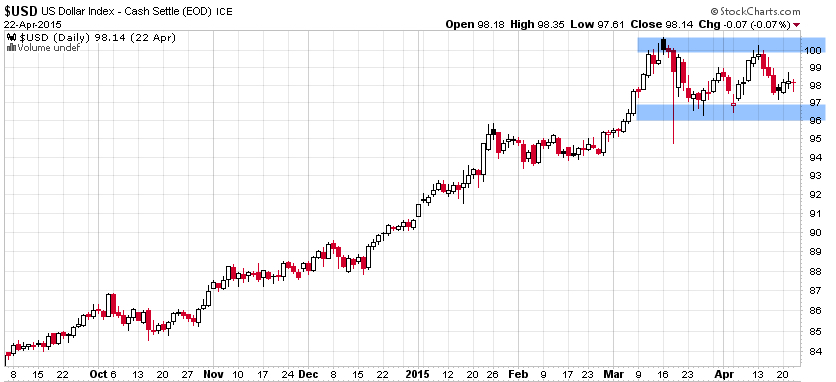
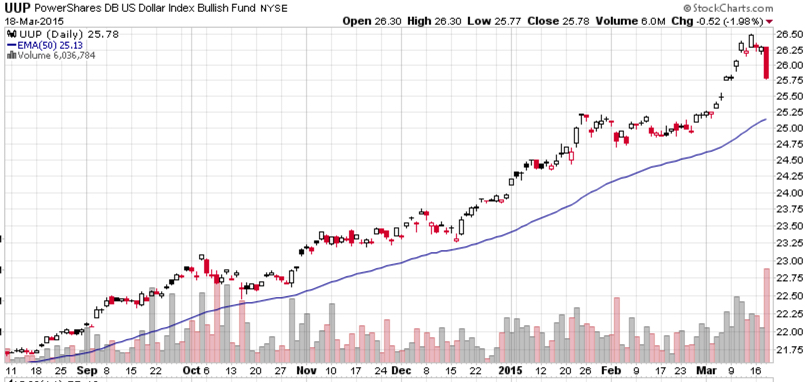
Now, let’s observe a shorter time frame- the daily chart. Here we see an impressive uptrend and since March a non-trending indecisive period. Many trend followers and global macro traders are likely “long the U.S. Dollar” by being long and short other markets like commodities, international stocks, or currencies.

dollar trend daily 2015-04-23_16-05-04

Chart created by Shell Capital with: http://www.stockcharts.com

This is a good example of understanding what drives returns and risk/reward. I consider how long the U.S. Dollar I am and how that may impact my positions if this uptrend were to reverse. It’s a good time to pay attention to it to see if it breaks back out to the upside to resume the uptrend, or if it instead breaks down to end it. Such a continuation or reversal often occurs from a point like the blue areas I highlighted above.

That’s my two cents on the Dollar…

How long are you? Do you know?

Improvise, Adapt and Overcome

Over the years I’ve heard many sports analogies applied to trading and investment management like “playing offense vs. defense”. Some of them can be useful to help make a point. However, Marine Corps combat training is even more realistic. Many of the unknown (and unknowable) factors of combat are more similar to tactical trading and investment management.

Improvise, Adapt and Overcome

From the U.S. Marine Corps A Concept for Functional Fitness:

“Marines are athletes. Their preparation for combat is not 
unlike a collegiate or professional athlete’s preparation 
for his of her sport. There are some key differences of course. Marines do not know the exact game they will be playing and they do not know the climate for the game. They do not know the rules. Marines do not even know when they will be “playing.” However, these factors only make preparation more difficult for combat as compared to preparing for a season of sports.”

Asymmetric Returns of World Markets YTD

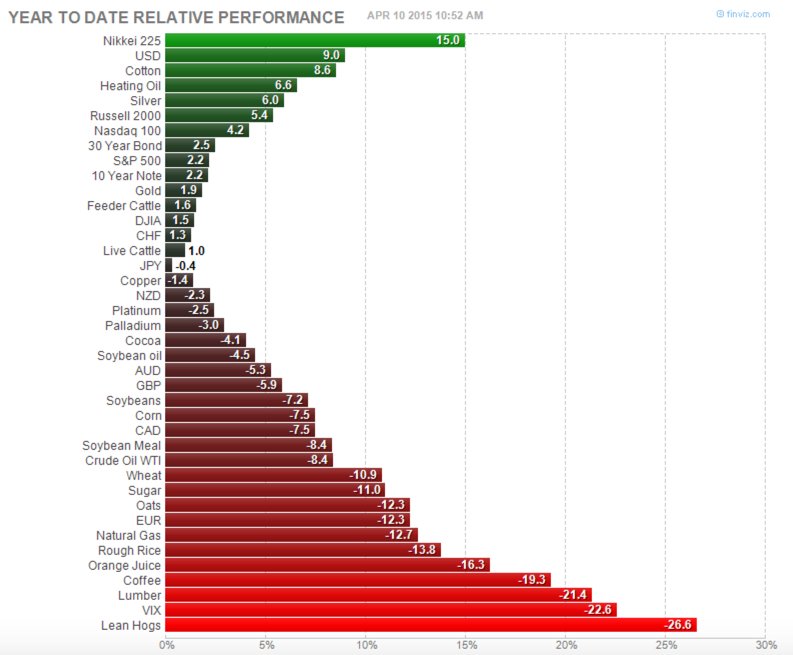
As of today, global stock, bond, commodity markets are generating asymmetric returns year to date. The graph below illustrates the asymmetry is negative for those who need these markets to go “up”.

Asymmetric Returns of World Markets 2015-04-10_10-52-47

source: http://finviz.com


Asymmetric Nature of Losses and Loss Aversion

Loss Aversion:

“In prospect theory, loss aversion refers to the tendency for people to strongly prefer avoiding losses than acquiring gains. Some studies suggest that losses are as much as twice as psychologically powerful as gains. Loss aversion was first convincingly demonstrated by Amos Tversky and Daniel Kahneman.”

For most people, losing $100 is not the same as not winning $100. From a rational point of view are the two things the same or different?

Most economists say the two are the same. They are symmetrical. But I think that ignores some key issues.

If we have only $10 to eat on today and that’s all we have, if we lose it, we’ll be in trouble: hungry.

But if we have $10 to eat on and flip a coin in a bet and double it to $20, we may just eat a little better. We’ll still eat. The base rate: survival.

They say rationally the two are the same, but that isn’t true. They aren’t the same. The loss makes us worse off than we started and it may be totally rational to feel worse when we go backward than we feel good about getting better off. I don’t like to go backward, I prefer to move forward to stay the same.

Prospect Theory, which found people experience a loss more than 2 X greater than an equal gain, discovered the experience of losses are asymmetric.

Actually, the math agrees.

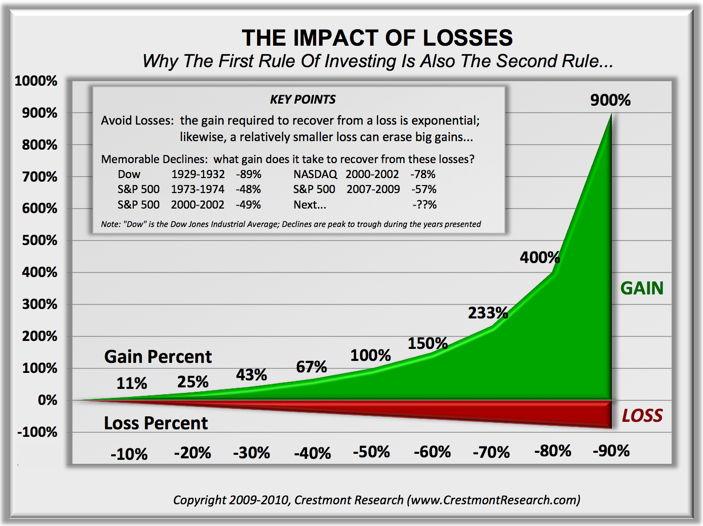
You see, losing 50% requires a 100% gain to get it back. Losing it all is even worse. Losses are indeed asymmetric and exponential on the downside so it may be completely rational and logical to feel the pain of losses asymmetrically. Experience the feeling of loss aversions seems to be the reason a few of us manage investment risk and generate a smoother return stream rather than blow up.

To see what the actual application of asymmetry to portfolio management looks like, see: Shell Capital Management, LLC.


asymmetry impact of loss

“We like what’s familiar, and we dislike change. So, we push the familiar until it starts working against us big-time—a crisis. Then, MAYBE we can accept change.”

—Kevin Cameron (Journalist, Cycle World April 2013)

Confirmation Bias: The tendency to search for, interpret, focus on and remember information in a way that confirms one’s preconceptions.

A Tale of Two Conditions for U.S. and International Stocks: Before and After 2008

In recent conversations with investment advisors, I notice their sentiment has shifted from “cautious and concerned” about world equity markets to “why have they underperformed”. Prior to 2013, most investors and investment advisors were concerned about another 2007 to 2009 level bear market. Now, it seems that caution has faded. Today, many of them seem to be focused on the strong trend of U.S. stocks since mid-2013 and comparing everything else to it.

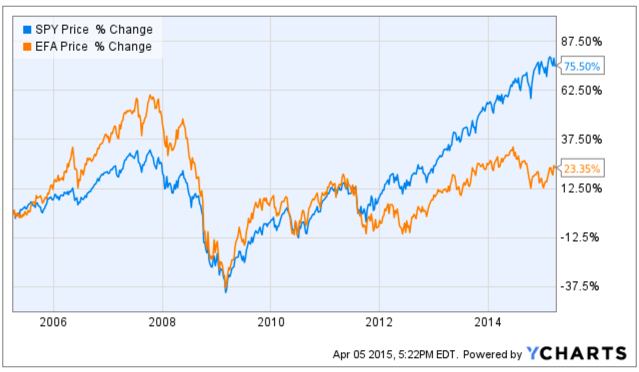
Prior to October 2007, International stocks were in significantly stronger positive directional trends than U.S. Stocks. I’ll compare the S&P 500 stock index (SPY) to Developed International Countries (EFA). We can visually observe a material change between these markets before 2008 and after, but especially after 2013. That one large divergence since 2013 has changed sentiment.

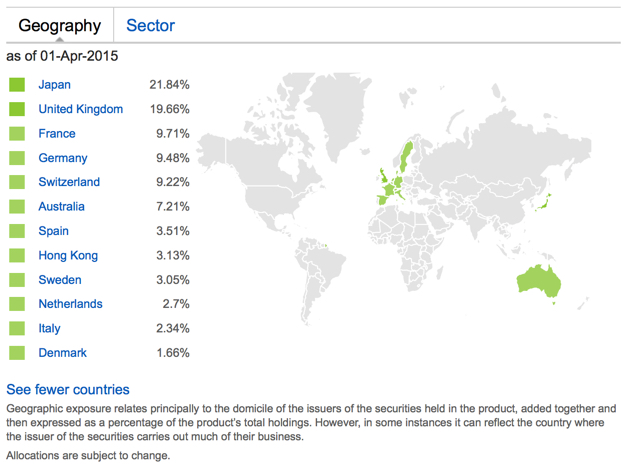
The MSCI EAFE Index is recognized as the pre-eminent benchmark in the United States to measure international equity performance. It comprises the MSCI country indices that represent developed markets outside of North America: Europe, Australasia and the Far East. For a “real life” example of its price trend, I use the iShares MSCI EAFE ETF (EFA). Below are the country holdings, to get an idea of what is considered “developed markets”.

iShares MSCI EAFE ETF Developed Markets exposure 2015-04-05_17-14-43

Source: https://www.ishares.com/us/products/239623/EFA

Below are the price trends of the popular S&P 500 U.S. stock index and the MSCI Developed Countries Index over the past 10 years. Many investors may have forgotten how strong international markets were prior to 2008. Starting around 2012, the U.S. stock market continued to trend up stronger than international stocks. It’s a tale of two markets, pre-2008 and post-2008.

Developed Markets International stocks trend 2015-04-05_17-22-22

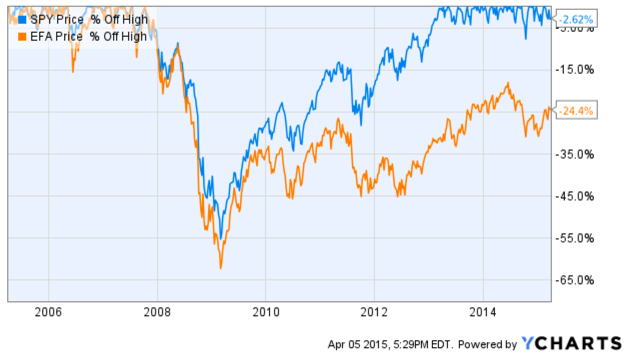
No analysis of a trend % change is complete without also examining its drawdowns along the way. A drawdown measures a drop from peak to bottom in the value of a market or portfolio (before a new peak is achieved). The chart below shows these indexes % off their prior highs to understand their historical losses over the period. For example, these indexes declined -55% or more. The International stock index nearly declined -65%. The S&P 500 U.S. stock index didn’t recover from its decline that started in October 2007 until mid-2012, 5 years later. The MSCI Developed Countries index is still in a drawdown! As you can see, EFA is -24% off it’s high reached in 2007. Including these international countries in a global portfolio is important as such exposure has historically provided greater potential for profits than just U.S. stocks, but more recently they have been a drag.

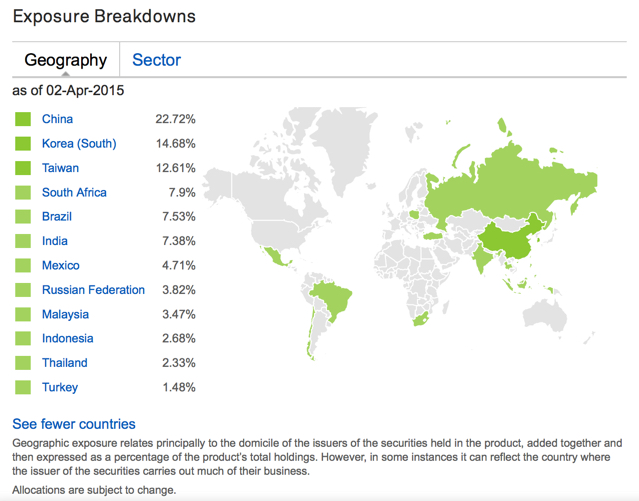
international markets drawdown 2015-04-05_17-30-00The International stock markets are divided broadly into Developed Markets we just reviewed and Emerging Countries. The iShares MSCI Emerging Markets ETF (EEM) tracks this index. To get an idea of which countries are considered “Emerging Markets’, you can see the actual exposure below.

emerging countries markets 2015-04-05_17-13-31

https://www.ishares.com/us/products/239637/EEM?referrer=tickerSearch

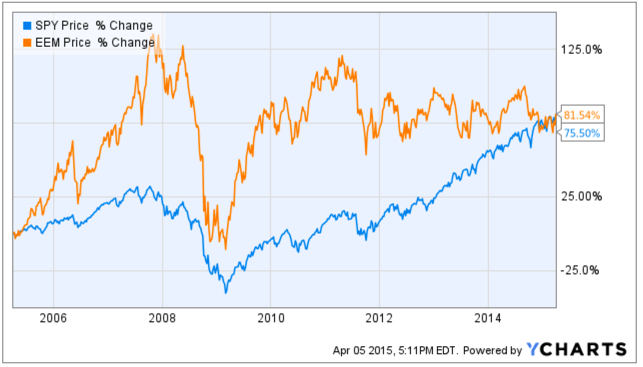
The Emerging Countries index has reached the same % change over the past decade, but they have clearly taken very different paths to get there. Prior to the “global crisis” that started late 2007, many investors may have forgotten that Emerging Markets countries like China and Brazil were in very strong uptrends. I remember this very well; as a global tactical trader I had exposure to these countries which lead to even stronger profits than U.S. markets during that period. Since 2009, however, Emerging Markets recovered sharply but as with U.S. stocks: they have trended up with great volatility. Since Emerging Markets peaked around 2011 they have traded in a range since. However, keep in mind, these are 10-year charts, so those swings up and down are 3 to 6 months. We’ll call that “choppy”. Or, 4 years of a non-trending and volatile state.

Emerging Markets trend 10 years 2015-04-05_17-21-06

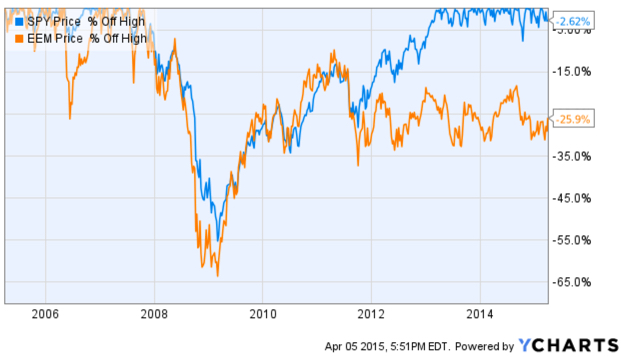
Once again, no analysis of a trend % change is complete without also examining its drawdowns along the way. A drawdown measures a drop from peak to bottom in the value of a market or portfolio (before a new peak is achieved). The chart below shows these indexes % off their prior highs to understand their historical losses over the period. For example, these indexes declined -55% or more. The Emerging Market stock index declined -65%. The S&P 500 U.S. stock index didn’t recover from its decline that started in October 2007 until mid-2012, 5 years later. The MSCI Emerging Countries index is still in a drawdown! As you can see, EFA is -26% off it’s high reached in 2007. As I mentioned before, it recovered sharply up to 2011 but has been unable to move higher in 4 years. Including these Emerging Markets countries in a global portfolio is important as such exposure has historically provided greater potential for profits than just U.S. stocks, but more recently they have been a drag.

emerging markets drawdown 2015-04-05_17-52-19

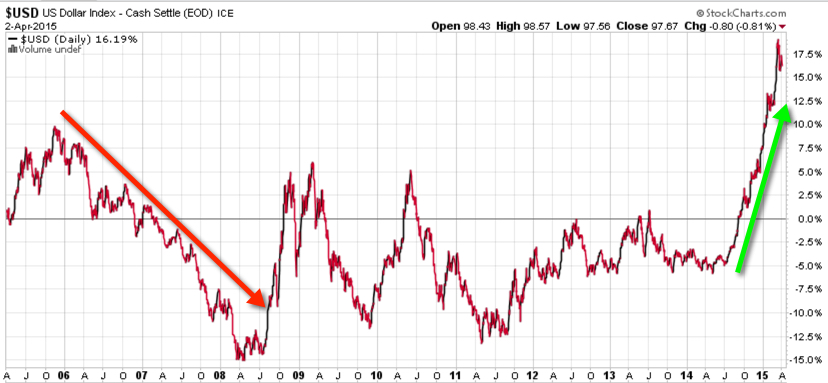
Wondering why the tale of two markets before and after 2008? The are many reasons and return drivers. One of them can be seen visually in the trend of the U.S. Dollar. Below is a 10-year price chart of the U.S. Dollar index. Before 2008, the U.S. Dollar was falling, so foreign currencies were rising as were foreign stocks priced in Dollars. As with most world markets, even the U.S. Dollar was very volatile from 2008 through 2011. After 2011 it drifted in a tighter range through last year and has since increased sharply.

Dollar impact on international stocks 2015-04-05_18-05-02

The funny thing is, I’ve noticed there are a lot of inflows into currency-hedged ETFs recently. Investors seem to do the wrong thing at the wrong time. For example, they’ll want to hedge their currency risk after it already happened, not before… It’s just like with options hedging: Investors want protection after a loss, not before it happens. Or, people will buy that 20 KW generator for their home after they lose power a few days, not before, and may not need it again for 5 years after they’ve stopped servicing it. So, it doesn’t start when they need it again.

You can probably see why I think it’s an advantage to understand how world markets interact with each other and it’s an edge for me.

Mike Shell is the Founder and Chief Investment Officer of Shell Capital Management, LLC, and the portfolio manager of ASYMMETRY® Global Tactical.

The observations shared on this website are for general information only and are not specific advice, research, or buy or sell recommendations for any individual. Investing involves risk including the potential loss of principal an investor must be willing to bear. Past performance is no guarantee of future results. The presence of this website on the Internet shall in no direct or indirect way raise an implication that Shell Capital Management, LLC is offering to sell or soliciting to sell advisory services to residents of any state in which the firm is not registered as an investment advisor. Use of this website is subject to its terms and conditions.

Asymmetric Sector Exposure in Stock Indexes

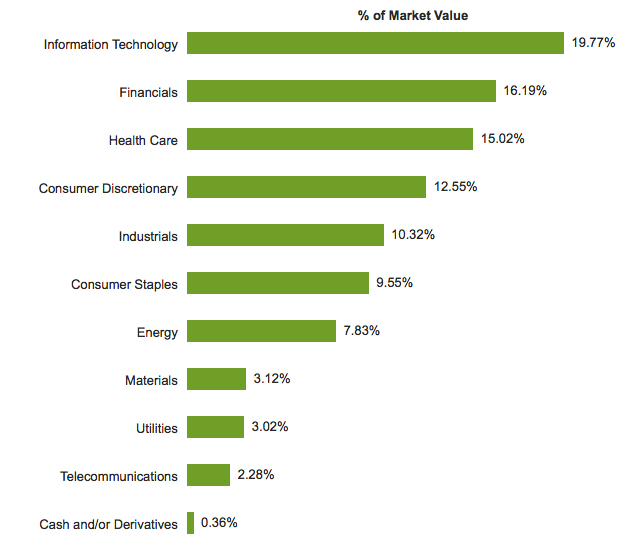
When you look at the table below and see the sector exposure percents, what do you observe? Do these allocations make sense?

asymmetric sector ETF expsoure S&P 500 2015-03-24_16-39-11

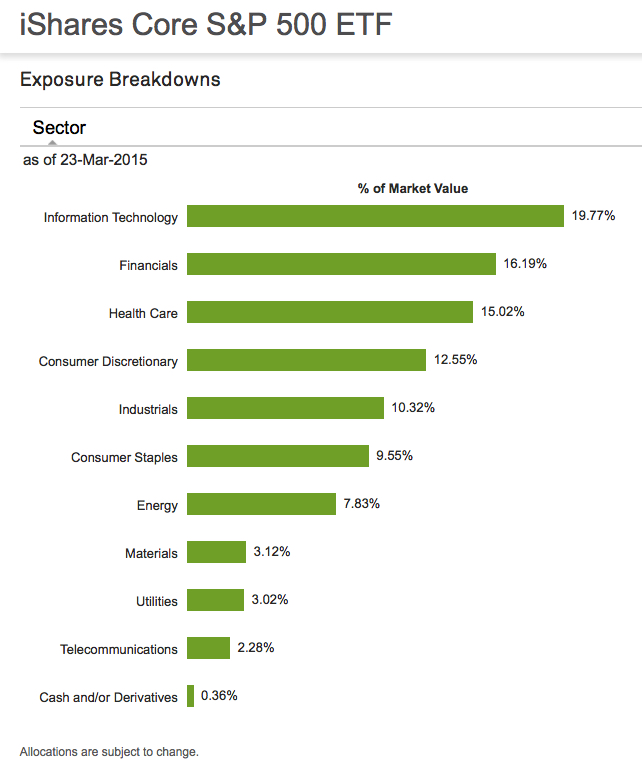
That is the sector exposure of the S&P 500 stock index: I used the iShares S&P 500 ETF for a real-world proxy. The source of each image is the index website on iShares, which you can see by clicking on the name of the index ETF.

  • Asymmetric is an imbalance. That is, more of one thing, less of another.
  • A sector is a specific industry, like Energy (Exxon Mobil) or Telecom (Verizon).
  • Exposure is the amount of the position size or allocation.

Most of the sector exposure in the S&P 500 large company stock index is Technology, Financials, Healthcare, and Consumer Discretionary. Consumer Staples, Energy, Materials, Utilities, and Telecommunications have less than 10% exposure each. Exposure to Materials, Utilities, and Telecommunications are almost non-existent. Combined, those three sectors are less than 10% of the index. Industrial has 10% exposure by itself.  But this index is 500 large companies, what about mid size and small companies?

asymmetric sector expsoure S&P 500 2015-03-24_16-39-11

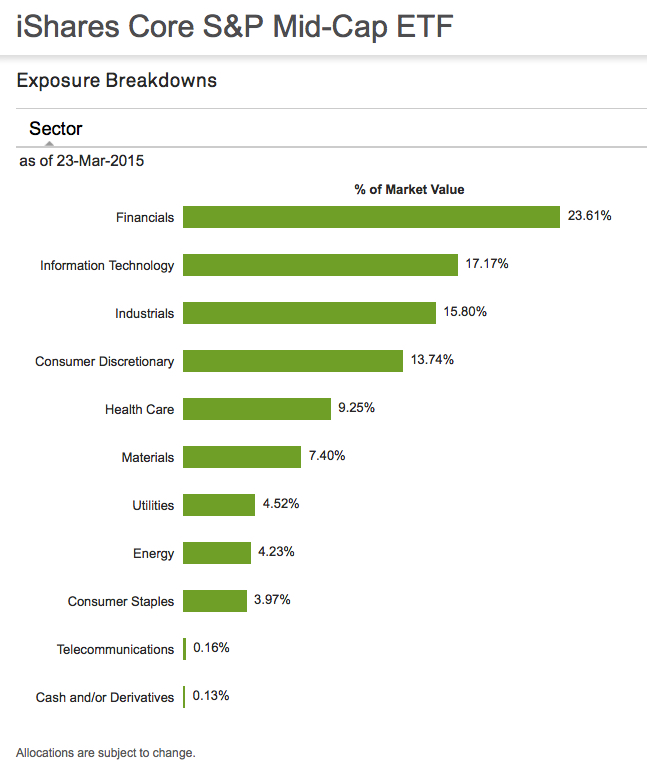
Below is the iShares Core S&P Mid-Cap ETF. Most of the sector exposure in the S&P Mid size stock index is Technology, Financials, Industrial. Healthcare, and Consumer Discretionary. Consumer Staples, Energy, Materials, Utilities, and Telecommunications have less than 10% exposure each. Exposure to Materials, Utilities, and Telecommunications are almost non-existent.

asymmetric sector exposure  S&P Mid-Cap ETF

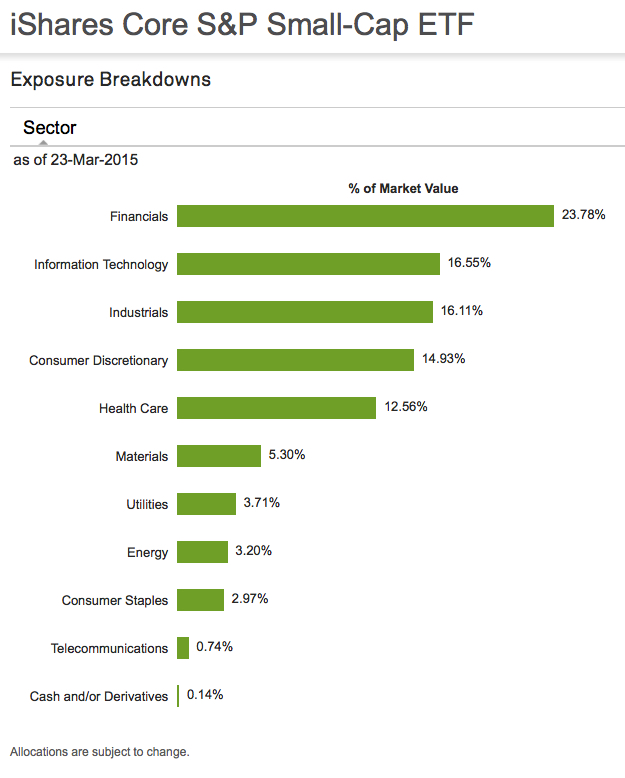
We see this same asymmetric sector exposure theme repeat in the iShares S&P Small Cap index. Half of the sectors are make up most of the exposure, the other very little.

asymmetric sector exposure S&P small cap

This is just another asymmetric observation… the next time you hear someone speak of the return of a stock index, consider they are really speaking about the return profile of certain sectors. And, these sector weightings may change over time.

US Government Bonds Rise on Fed Rate Outlook?

I saw the following headline this morning:

US Government Bonds Rise on Fed Rate Outlook

Wall Street Journal –

“U.S. government bonds strengthened on Monday after posing the biggest price rally in more than three months last week, as investors expect the Federal Reserve to take its time in raising interest rates.”

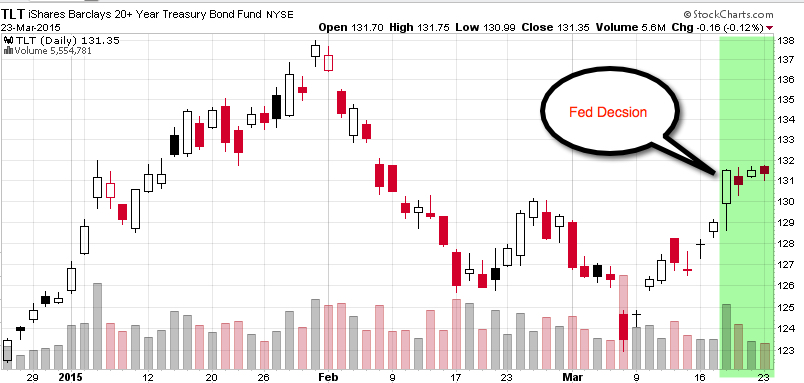
My focus is on directional price trends, not the news. I focus on what is actually happening, not what people think will happen. Below I drew a 3 month price chart of the 20+ Year Treasury Bond ETF (TLT), I highlighted in green the time period since the Fed decision last week. You may agree that most of price action and directional trend changes happened before that date. In fact, the long-term bond index declined nearly 2 months before the decision, increased a few weeks prior, and has since drifted what I call “sideways”.

fed decision impact on bonds
Charts created with http://www.stockcharts.com

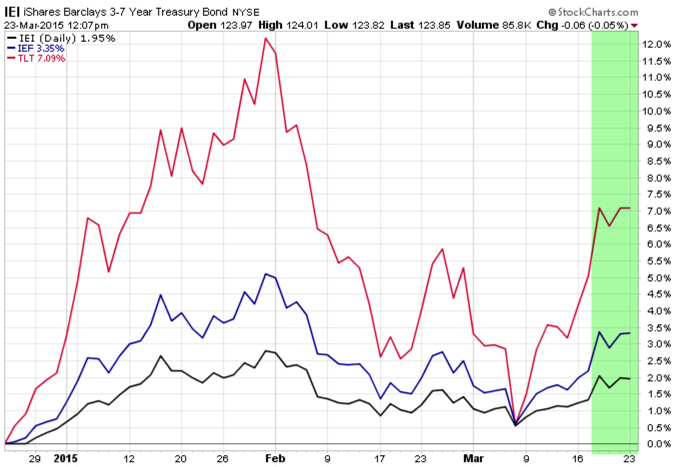
To be sure, in the next chart I included an analog chart including the shorter durations of maturity. iShares 3-7 Year Treasury Bond ETF (IEI) and iShares 7-10 Year Treasury Bond ETF (IEF). Maybe there is some overreaction and under-reaction going on before the big “news”, if anything.

Government bonds Fed decision reaction
Do you still think the Fed news was “new information“?

Dazed and Confused?

Many investors must be dazed and confused by the global markets reaction to the Fed. I’m guessing most people would expect if the Fed signaled they are closer to a rate hike the stock and bond markets would fall. Rising interest rates typically drive down stocks along with bonds. Just the opposite has happened, so far.

Markets seems to have moved opposite of expectations, those people have to get on board (increasing demand).

A few things I wrote before and after the Fed decision:

A One-Chart Preview of Today’s Fed Decision: This is what economists are expecting

Fed Decision and Market Reaction: Stocks and Bonds

Trends, Countertrends, in the U.S. Dollar, Gold, Currencies

Trends, Countertrends, in the U.S. Dollar, Gold, Currencies

Trend is a direction that something is moving, developing, evolving, or changing. A trend is a directional drift, one way or another. When I speak of price trends, the directional drift of a price trend can be up, down, or sideways.

Trends trend to continue and are even more likely to continue than to reverse, because of inertia. Inertia is the resistance to change, including a resistance to change in direction. It’s an important physics concept to understand to understand price trends because inertia relates to momentum and velocity. A directional price trend that continues, or doesn’t change or reverse, has inertia. To understand directional price trends, we necessarily need to understand how a trend in motion is affected by external forces. For example, if a price trend is up and continues even with negative external news, in inertia or momentum is even more significant. Inertia is the amount of resistance to change in velocity. We can say that a directional price trend will continue moving at its current velocity until some force causes its speed or direction to change. A directional trend follower, then, wants keep exposure to that trend until its speed or direction does change. When a change happens, we call it a countertrend. A countertrend is a move against the prior or prevailing trend. A countertrend strategy tries to profit from a trend reversal in a directional trend that has moved to such a magnitude it comes more likely to reverse, at least briefly, than to continent. Even the best long-term trends have smaller reversals along the way, so countertrend systems try to profit from the shorter time frame oscillations.

“The one fact pertaining to all conditions is that they will change.”

                                    —Charles Dow, 1900

One significant global macro trend I noticed that did show some “change” yesterday is the U.S. Dollar. The U.S. Dollar has been in a smooth drift up for nearly a year. I use the PowerShares DB US Dollar Index Bullish (UUP). Below, I start with a weekly chart showing a few years so you can see it was non-trending up until last summer. Clearly, the U.S. Dollar has been trending strongly since.

u.s. dollar longer trend UPP

Next, we zoom in for a closer look. The the PowerShares DB US Dollar Index Bullish (UUP) was down about -2% yesterday after the Fed Decision. Notice that I included a 50 day moving average, just to smooth out the price data to help illustrate its path. One day isn’t nearly enough to change a trend, but that one day red bar is greater in magnitude and had heavy volume. On the one hand, it could be the emotional reaction to non trend following traders. On the other, we’ll see over time if that markets a real change that becomes a reversal of this fine trend. The U.S. Dollar may move right back up and resume it’s trend…

U.S. Dollar Trend 2015-03-19_08-21-35

chart source for the following charts: http://www.stockcharts.com

I am using actual ETFs only to illustrate their trends. One unique note about  PowerShares DB US Dollar Index Bullish Fund (Symbol: UUP) is the tax implications for currency limited partnership ETFs are subject to a 60 percent/40 percent blend, regardless of how long the shares are held. They also report on a K-1 instead of a 1099.

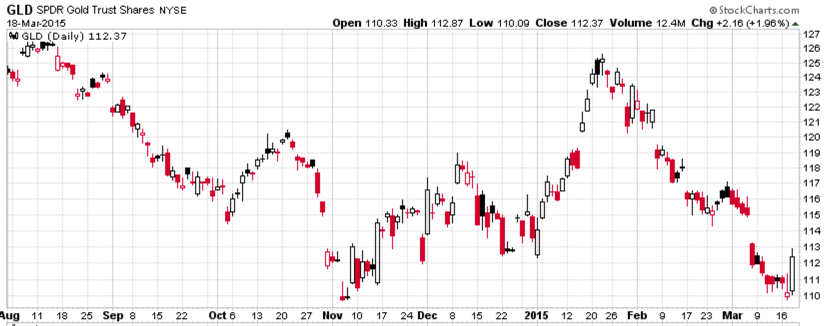
Why does the direction of the U.S. Dollar matter? It drives other markets. Understanding how global markets interact is an edge in global tactical trading. Below is a chart of Gold. I used the SPDR Gold Trust ETF as a proxy. Gold tends to trade the opposite of the U.S. Dollar.

gold trend 2015-03-19_08-22-41

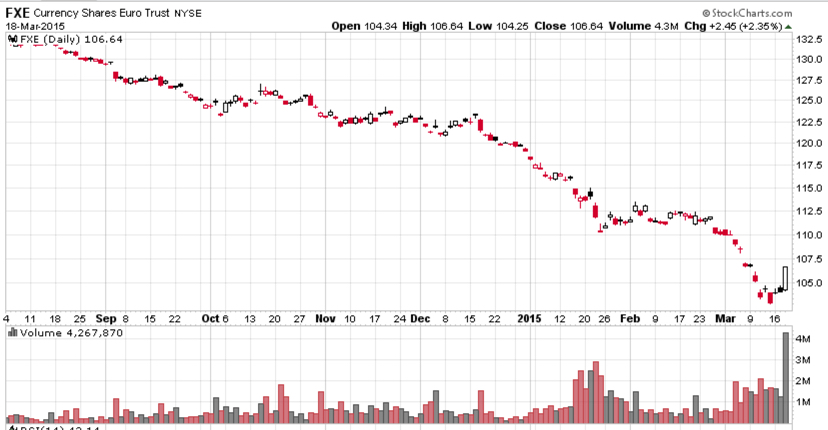
When the U.S. Dollar is trending up, it also has an inverse correlation to foreign currencies priced in dollars. Below is the CurrencyShares Euro ETF.

Euro currency trend 2015-03-19_08-23-03

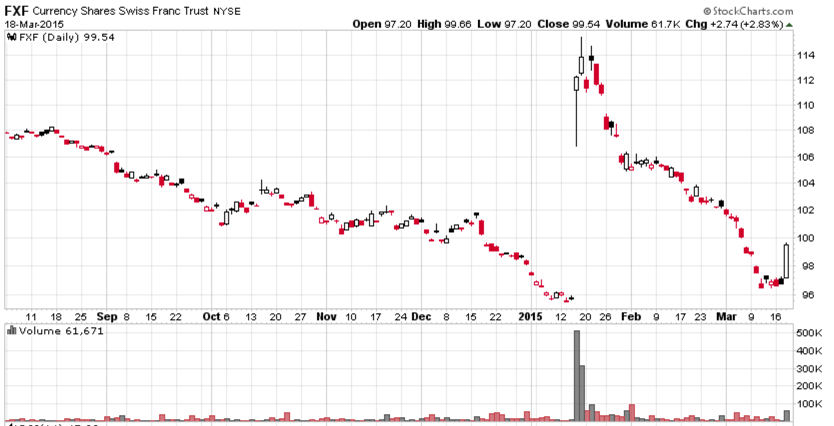
Foreign currencies can have some risk. In January, the Swiss Franc gaped up sharply, but has since drifted back to where it was. Maybe that was an over-reaction? Markets aren’t so efficient. Below is a chart of the CurrencyShares Swiss Franc to illustrate its trend and countertrend moves.

swiss franc trend 2015-03-19_08-23-23

None of this is a suggestion to buy or sell any of these, just an observation about directional trends, how they interact with each other, and countertrend moves (whether short term or long term). Clearly, there are trends…

To see how tactical decisions and understand how markets interacts results in my real performance, visit : ASYMMETRY® Managed Accounts

“The one fact pertaining to all conditions is that they will change.”

—Charles Dow, 1900

Fed Decision and Market Reaction: Stocks and Bonds

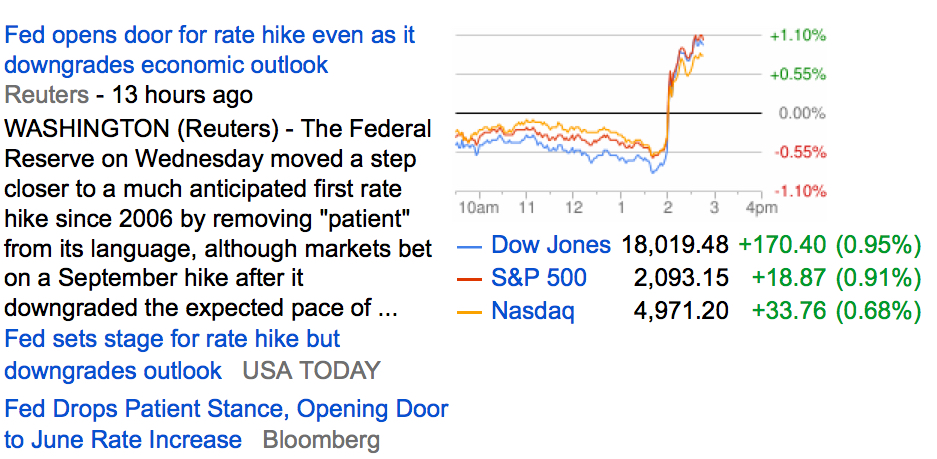
So, I’m guessing most people would expect if the Fed signaled they are closer to a rate hike the stock and bond markets would fall. Rising interest rates typically drive down stocks along with bonds. Not the case as of 3pm today. Stocks were down about -1% prior to the announcement, reversed, and are now positive 1%. Even bonds are positive. Even the iShares Barclays 20+ Yr Treas.Bond (ETF) is up 1.4% today.

So much for expectations…

Below is snapshot of the headlines and stock price charts from Google Finance:

Fed Decision and Reaction March 18 2015

Source: https://www.google.com/finance?authuser=2

Bear Markets Happen

WSJ has a nice chart of “Bear Markets” as defined as -20% drops in the Dow Jones Industrial Average. Click to enlarge.

Bear Markets Happen average bull bear market

Source: http://www.wsj.com/articles/how-to-prepare-for-a-bear-market-in-stocks-1425870192

Diversification Alone is No Longer Sufficient to Temper Risk…

That was the lesson you learned the last time stocks became overvalued and the stock market entered into a bear market.

In a Kiplinger article by Fred W. Frailey interviewed Mohamed El-Erian, the PIMCO’s boss, (PIMCO is one of the largest mutual fund companies in the world) he says “he tells how to reduce risk and reap rewards in a fast-changing world.” This article “Shaking up the Investment Mix” was written in March 2009, which turned out the be “the low” of the global market collapse.

It is useful to revisit such writing and thoughts, especially since the U.S. stock market has since been overall rising for 5 years and 10 months. It’s one of the longest uptrends recorded and the S&P 500 stock index is well in “overvalued” territory at 27 times EPS. At the same time, bonds have also been rising in value, which could change quickly when rates eventually rise. At this stage of a trend, asset allocation investors could need a reminder. I can’t think of a better one that this:

Why are you telling investors they need to diversify differently these days?

The traditional approach to diversification, which served us very well, went like this: Adopt a diversified portfolio, be disciplined about rebalancing the asset mix, own very well-defined types of asset classes and favor the home team because the minute you invest outside the U.S., you take on additional risk. A typical mix would then be 60% stocks and 40% bonds, and most of the stocks would be part of Standard & Poor’s 500-stock index.

This approach is fatigued for several reasons. First of all, diversification alone is no longer sufficient to temper risk. In the past year, we saw virtually every asset class hammered. You need something more to manage risk well.

But, you know, they say a picture is worth a thousand words.

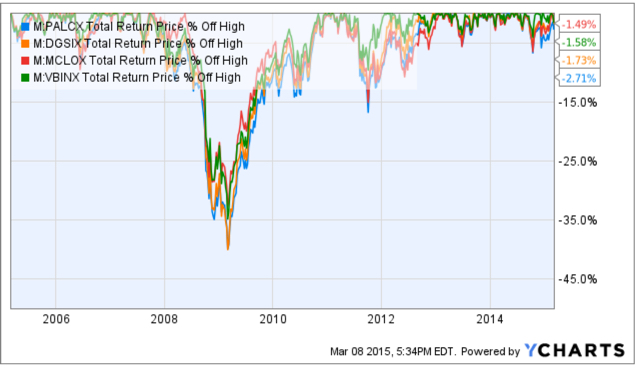
Since we are talking about downside risk, something that is commonly hidden when only “average returns” are presented, below is a drawdown chart. I created the drawdown chart using YCharts which uses total return data and the “% off high”. The decline you see from late 2007 to 2010 is a dradown: it’s when the investment value is under water. Think of this like a lake. You can see how the average of the data wouldn’t properly inform you of what happens in between.

First, I show PIMCO’s own allocation fund: PALCX: Allianz Global Allocation Fund. I include an actively managed asset allocation that is very large and popular with $55 billion invested in it: MALOX: BlackRock Global Allocation. Since there are many who instead believe in passive indexing and allocation, I have also included DGSIX: DFA Global Allocation 60/40 and VBINX: Vanguard Balanced Fund. As you can see, they have all done about the same thing. They declined about -30% to -40% from October 2007 to March 2009. They also declined up to -15% in 2011.

Vanguard DFA BlackRock PIMCO Asset Allcation

Charts are courtesy of http://ycharts.com/ drawn by Mike Shell

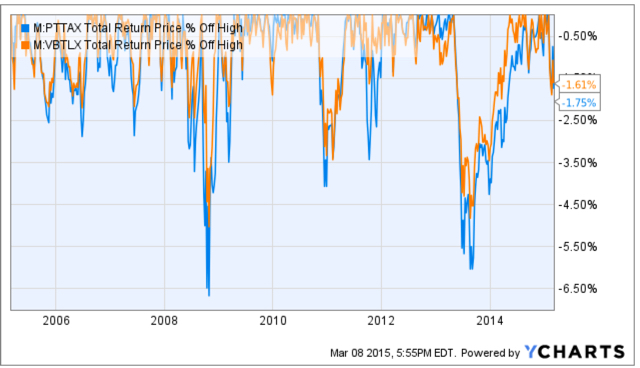
Going forward, the next bear market may be very different. Historically, investors consider bond holdings to be a buffer or an anchor to a portfolio. When stock prices fall, bonds haven’t been falling nearly as much. To be sure, I show below a “drawdown chart” for the famous actively managed bond fund PIMCO Total Return and for the passive crowd I have included the Vanguard Total Bond Market fund. Keep in mind, about 40% of the allocation of the funds above are invested in bonds. As you see, bonds dropped about -5% to -7% in the past 10 years.

PIMCO Total Return Bond Vanguard Total Bond

Charts are courtesy of http://ycharts.com/ drawn by Mike Shell

You may have noticed the end of the chart is a drop of nearly -2%. Based on the past 10 years, that’s just a minor decline. The trouble going forward is that interest rates have been in an overall downtrend for 30 years, so bond values have been rising. If you rely on bonds being a crutch, as on diversification alone, I agree with Mohamed El-Erian the Chief of the worlds largest bond manager:

“…diversification alone is no longer sufficient to temper risk. In the past year, we saw virtually every asset class hammered. You need something more to manage risk well.”

But, don’t wait until AFTER markets have fallen to believe it.

Instead, I apply active risk management and directional trend systems to a global universe of exchange traded securities (like ETFs). To see what that looks like, click: ASYMMETRY® Managed Accounts

This is When MPT and VaR Get Asset Allocation and Risk Measurement Wrong

This is When MPT and VaR Get Asset Allocation and Risk Measurement Wrong

I was talking to an investment analyst at an investment advisory firm about my ASYMMETRY® Global Tactical and he asked me what the standard deviation was for the portfolio. I thought I would share with you how the industry gets “asset allocation” and risk measurement and management wrong.

Most people have poor results over a full market cycle that includes both rising and falling price trends, like global bull and bear markets, recessions, and expansions. Quantitative Analysis of Investor Behavior, SPIVA, Morningstar and many academic papers have provided empirical evidence that most investors (including professionals) have poor results over the long periods. For example, they may earn gains in rising conditions but lose their gains when prices decline. I believe one reason is they get too aggressive at peaks and then sell in panic after losses get too large, rather than properly predefine and manage risk.

You may consider, then, to have good results over a long period, I necessarily have to believe and do things very differently than most people.

On the “risk measurement” topic, I will share with you a very important concept that is absolutely essential for truly actively controlling loss. The worst drawdown “is” the only risk metric that really matters. The risk is not the loss itself. Once we have a loss, it’s a loss. It’s beyond the realm of risk. Since risk is the possibility of a loss, how often it has happened in the past and the magnitude of the historical loss is the expectation. Beyond that, we must assume it could be even worse some day. For example, if the S&P 500 stock index price decline was -56% from 2007 to 2009, then we should expect -56% is the loss potential (or worse). When something has happened before, it suggests it is possible again, and we may have not yet observed the worst decline in the past that we will see in the future.

The use of standard deviation is one of the very serious flaws of investors attempting to measure, direct, and control risk. The problem with standard deviation is that the equation was intentionally created to simplify data. The way it is used draws a straight line through a group of data points, which necessarily ignores how far the data actually spreads out. That is, the standard deviation is intended to measure how far the data spreads out, but it actually fails to absolutely highlight the true high point and low point. Instead, it’s more of an average of those points. However, for risk management, it’s the worst-case loss that we really need to focus on. I believe in order to direct and control risk, I must focus on “how bad can it really get”. Not just “on average” how bad it can get. The risk in any investment position is at least how much it has declined in the past. And realizing it could be even worse some day. Standard deviation fails to reflect that in the way it is used.

Consider that as prices trend up for years, investors become more and more complacent. As investors become complacent, they also become less indecisive as they believe the recent past upward trend will continue, making them feel more confident. On the other hand, when investors feel unsure about the future, their fear and indecisiveness is reflected as volatility as the price swings up and down more. We are always unsure about the future, but investors feel more confident the past will continue after trends have been rising and volatility gets lower and lower. That is what the peak of a market looks like. As it turns out, that’s just when asset allocation models like Modern Portfolio Theory (MPT) and portfolio risk measures like Value at Risk (VaR) tell them to invest more in that market – right as it reaches its peak. They invest more, complacently, because their allocation model and risk measures tell them to. An example of a period like this was October 2007 as global stock markets had been rising since 2003. At that peak, the standard deviation was low and the historical return was at its highest point, so their expected return was high and their expected risk (improperly measured as historical volatility) was low. Volatility reverses the other way at some point

What happens next is that the market eventually peaks and then begins to decline. At the lowest point of the decline, like March 2009, the global stock markets had declined over -50%. My expertise is directional price trends and volatility so I can tell you from empirical observation that prices drift up slowly, but crash down quickly. The below chart of the S&P 500 is an example of this asymmetric risk.
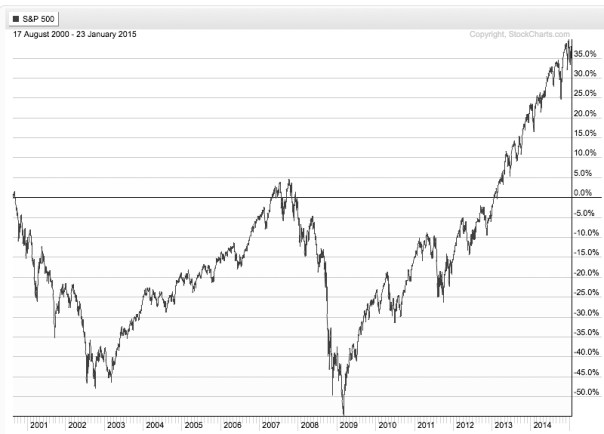
stock index asymmetric distribution and losses

At the lowest point after prices had fallen over -50%, in March 2009, the standard deviation was dramatically higher than it was in 2007 after prices had been drifting up. At the lowest point, volatility is very high and past return is very low, telling MPT and VaR to invest less in that asset. This is a form of volatility targeting: investing more at lower levels or historical volatility and less at higher levels.

In the 2007 – 2009 decline in global markets, you may recall some advisors calling it a “6 sigma event”. That’s because the market index losses were much larger than predicted by a standard deviation. For example, if an advisors growth allocation had an average return of 10% in 2007 based on its past returns looking back from the peak and a standard deviation of 12% expected volatility, they only expected the portfolio would decline -26% (3 standard deviations) within a 99.7% confidence level – but the allocation actually lost -40 or -50%. Even if that advisor properly informed his or her client the allocation could decline -26% worse case and the client provided informed consent and acceptance of that risk, their loss was likely much greater than their risk tolerance. When they reach their risk tolerance, they “tap out”. Once they tap out, when do they ever get back in? do they feel better after it falls another -20%? or after it rises 20%? There is no good answer. I want to avoid that situation. I prefer to reduce my exposure to loss in well advance.

You can see in the chart below, 3 standard deviations is supposed to capture 99.7% of all of the data if the data is a normal distribution. The trouble is, market returns are not a normal distribution. Instead, stock market gains and losses present an asymmetrical return distribution. Market returns experience much larger gains and losses than expected from a normal distribution – the outliers are critical. However, those outliers don’t occur very often: historically it’s maybe every 4 or 5 years, so people have time to forget about the last one and become complacent.
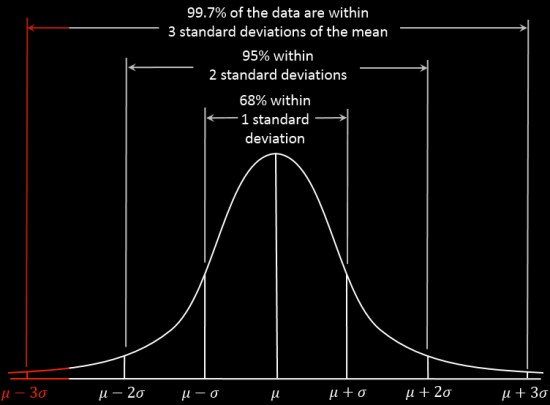
symmetry normal distribution bell curve black

Source: http://en.wikipedia.org/wiki/68%E2%80%9395%E2%80%9399.7_rule

My friends, this is where traditional asset allocation like Modern Portfolio Theory (MPT) and risk measures like Value at Risk (VaR) get it wrong.

These methods are the most widely believed and used . You can probably see why most investors do poorly and only a very few do well – an anomaly.

I can tell you that I measure risk by how much I can lose and I control my risk by predefining my absolute risk at the point of entry and my exit point evolves as the positions are held. That is an absolute price point, not some equation that intentionally ignores the outlier losses.

As the stock indexes have now been overall trending up for 5 years and 9 months, the trend is getting aged. In fact, according to my friend Ed Easterling at Crestmont Research, at around 27 times EPS the stock index seems to be in the range of overvalued. In his latest report, he says:

“The stock market surged over the past quarter, adding to gains during 2014 that far exceed underlying economic growth. As a result, normalized P/E increased to 27.2—well above the levels justified by low inflation and interest rates. The current status is approaching “significantly overvalued.”

At the same time, we shouldn’t be surprised to eventually see rising interest rates drive down bond values at some point. It seems from this starting point that simply allocating to stocks and bonds doesn’t have an attractive expected return.

I believe a different strategy is needed, especially form this point forward.

In ASYMMETRY® Global Tactical, I actively manage risk and shift between markets to find profitable directional price trends rather than just allocate to them.


Mike Shell is the Founder and Chief Investment Officer of Shell Capital Management, LLC, and the portfolio manager of ASYMMETRY® Global Tactical.

The observations shared on this website are for general information only and are not specific advice, research, or buy or sell recommendations for any individual. Investing involves risk including the potential loss of principal an investor must be willing to bear. Past performance is no guarantee of future results. The presence of this website on the Internet shall in no direct or indirect way raise an implication that Shell Capital Management, LLC is offering to sell or soliciting to sell advisory services to residents of any state in which the firm is not registered as an investment advisor. Use of this website is subject to its terms and conditions.
 

Asymmetric Alpha? Completely Different Measures and Objectives

Asymmetric Alpha

I was talking to an investment advisor about ASYMMETRY® Global Tactical and the objective of asymmetric returns when he mentioned “asymmetric alpha”. I explained the two words don’t go together.

Asymmetric is an imbalance, or unequal. Asymmetric returns. For example, is an asymmetric risk/reward profile: one that is imbalanced or skewed toward the upside than the downside. I believe that some investors prefer to capture more of the upside, less of the downside. Others seem to mistakenly prefer symmetry: to balance their risk and reward. When they balance their risk and reward it results to periods of gains followed by periods off losses that results in no real progress over time. If that has been your experience the past decade or so, you may consider what I mean by ASYMMETRY® .

Alpha is the excess return of the fund relative to the return of the benchmark index or an abnormal rate of return. The term alpha was derived by  the academic theory “Capital Asset Pricing Model (CAPM). I believe CAPM has many flaws and is incapable of actively managing risk as necessary to produce asymmetric returns.

The two terms, asymmetric and alpha, are very different and probably should not be used together. The first is about absolute returns. The later is about relative returns. So, I believe we have to pick one of the other, rather than use them together. Asymmetric returns and alpha are completely different measures and objectives.

For information about the application of absolute and asymmetric returns visit http://www.asymmetrymanagedaccounts.com/

The State of the Union: What You Need to Read First

Image source: here

atlas

Before you listen to the State of the Union address tonight, consider reading this very closely:

“Happiness is not to be achieved at the command of emotional whims. Happiness is not the satisfaction of whatever irrational wishes you might blindly attempt to indulge. Happiness is a state of non-contradictory joy—a joy without penalty or guilt, a joy that does not clash with any of your values and does not work for your own destruction, not the joy of escaping from your mind, but of using your mind’s fullest power, not the joy of faking reality, but of achieving values that are real, not the joy of a drunkard, but of a producer. Happiness is possible only to a rational man, the man who desires nothing but rational goals, seeks nothing but rational values and finds his joy in nothing but rational actions.

Just as I support my life, neither by robbery nor alms, but by my own effort, so I do not seek to derive my happiness from the injury of the favor of others, but earn it by my own achievement. Just as I do not consider the pleasure of others as the goal of my life, so I do not consider my pleasure as the goal of the lives of others. Just as there are no contradictions in my values and no conflicts among my desires—so there are no victims and no conflicts of interest among rational men, men who do not desire the unearned and do not view one another with a cannibal’s lust, men who neither make sacrifices nor accept them.

The symbol of all relationships among such men, the moral symbol of respect for human beings, is the trader. We, who live by values, not by loot are traders, both in manner and spirit. A trader is a man who earns what he gets and does not give or take the undeserved. A trader does not ask to be paid for his failures, nor does he ask to be loved for his flaws. A trader does not squander his body as fodder, or his soul as alms. Just as he does not give his work except in trade for material values, so he does not give the values of his spirit—his love, his friendship, his esteem—except in payment and in trade for human virtue, in payment for his own selfish pleasure, which he receives from men he can respect. The mystic parasites who have, throughout the ages, reviled the trader and held him in contempt, while honoring the beggars and the looters, have known the secret motive of the sneers: a trader is the entity they dread—a man of justice.”


Atlas Shrugged
by Ayn Rand

This is John Galt Speaking
Chapter VII

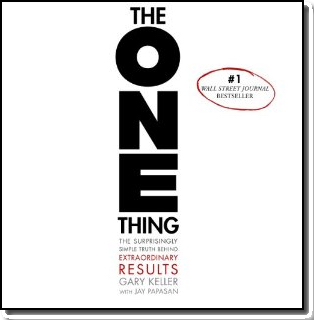
The One Thing: The Surprisingly Simple Truth Behind Extraordinary Results

I had a two-hour interview with someone yesterday (that will be available soon) about my firm and investment programs and found myself sharing a few of the same thoughts, over and over.

“Managing the ASYMMETRY® investment programs is all we do. I am fully committed and focused on this one thing: buying, selling, and managing risk in global markets to generate the positive asymmetry needed to compound capital positively within our risk tolerance”.

In a recent letter to our investors to reflect on the 10-year anniversary of my founding Shell Capital Management, LLC, I described the evolution of the firm, ASYMMETRY®, and myself over 10 pages. I called it “10 years of Shell Capital Management”; Christi called it “10 pages of 10 years of Shell Capital Management”! (When talking about these things, I have no short version!)

That’s because I’m fully committed and focused on this one thing we do. In that letter, I went so far as to say: it’s all I have, all I am, and all I ever will be. As I reflected on the past 10 years, it occurred to me that my whole life has revolved around this one thing. Without it, none of the other things, the lifestyle we enjoy, would exist. I believe my priorities are in line with reality. That has been a tremendous advantage for us.

Then this morning, I get an email from getAbstract: “Top 10 Summaries”, the 10 most downloaded getAbstract summaries in 2014.

The first on the list?

“Achieving great success in all aspects of your life calls for devotion to one single thing.”

The One Thing
The Surprisingly Simple Truth Behind Extraordinary Results

Gary Keller and Jay Papasan
Bard Press, 2013

the one thing The Surprisingly Simple Truth Behind Extraordinary Results

getAbstract goes on to describe it: (I highlighted a key part in bold)

“Gary Keller, co-founder of Keller Williams Realty and a best-selling author, overcame his own issues about focus, which makes his claims about cultivating better habits even more compelling. Multitasking isn’t fruitful, he says, since success requires long periods of laser-like concentration, not scattershot swats. If you find your “ONE Thing,” Keller says, everything else will fall into place. Keller, writing with co-author Jay Papasan, breaks his approach down into manageable steps based on research and experience. With an engaging writing style and plenty of bullet points, this reads much faster than its 200-plus pages”

It says the ONE Thing will bring your life and your work into focus. I obviously don’t need a book to tell me that, but it may help me understand myself better. I’ll be reading the abstract, but also listening to the audiobook version on Audible during my long walks in sunny Florida.

The Holiday Party: Mindset of the Active Risk Manager

holiday parties

I keep hearing of symptoms of this awful virus going around. I’ll spare you of the details, but it involves both ends around the porcelain bowl. We’ve all been there, done that, and probably consider it a “bad outcome”.

Then, we have all these holiday party plans to spend time with friends and family, knowing this ‘bug’ is contagious and spreading. Hearing about it, the natural mindset of the active risk manager is to ask:

“Has anyone at the party had the flu recently?”

You wonder if you’re entering into a high risk of a bad outcome. Most people may not even consider it, and it’s those people who will probably be there spreading it around! I know people who never consider the possibility of a bad outcome; they tend to be the ones who have the worst outcomes, more often. Others may be overly afraid of things that may never happen, so they miss out on life. Some even worry about things they fear so much they experience those things, even when they don’t happen.

The active risk manager internally thinks of risk.

Let’s first use the dictionary to better understand the meaning of “active”:

1. engaged in action; characterized by energetic work, participation, etc.; busy: an active life.

2. being in a state of existence, progress, or motion:

3. involving physical effort and action :active sports.

4. having the power of quick motion; nimble: active as a gazelle.

5. characterized by action, motion, volume, use, participation, etc.

So, let’s say that to be active is to be engaged in action, participate, an active life, progress, nimble, motion, and even a state of existence.

Risk is exposure to the possibility of a bad outcome. When we are speaking of money, risk is the exposure to the possibility of loss. If we incur a loss, that isn’t a risk, that’s an actual loss. Some people believe that uncertainty is risk, but we always have uncertainty. So, risk is the exposure to a chance or possibility of loss. It’s the exposure that is the risk, the chance or possibility is always there. So, your risk of loss is your choice. We decide it in advance.

To manage is to take charge of, handle, direct, govern, or control through action.

A bad outcome in money management may be losing money, or in life it may be anything we perceive as unwanted. We can’t be certain about an outcome. Uncertainty is something we live with every day and in all things, so we may as well embrace it and enjoy not knowing the outcome of things in advance. So, risk is the exposure to a chance or possibility of loss. It’s the exposure that is the risk, the chance or possibility is always there. So, your risk of loss is your choice. We decide it in advance.

So, an active risk manager, like me, is someone who engages in the action of actively and intentionally directing and controlling the exposure to a bad outcome. Because I actively management my risks, I am able to trade and invest in things other people perceive as risky, but they aren’t to me because I define my risk exposure and control it. Because active risk management is not only a learned skill I have advanced for myself but also something that is a natural part of me and who I am, I am also able to live my life enjoying and even embracing change and uncertainty. Yet, I do that initially and naturally thinking of what my risk is. Once I understand my risk, I manage it, and then accept it for what I’ve decided it will be, and then I let it all unfold as it will. I control what I can and let the rest do what it’s going to do.

You see, it’s also a big risk to not experience life. Studies show that happiness is more driven by new experiences than any other thing. Hedonic Adaptation means that we tend to get used to things and adapt, good or bad. Broadening our horizons makes and keeps us happy, doing the same old things leads to a dull and less happy life. Much of our happiness comes from new experiences and change, because we get used to even the finest and fastest new car and eventually it becomes our new normal.

Although I feel a strong obligation to keep myself well, I’m not going to miss spending time with people I enjoy. Instead, I’ll take my chances and deal with, and actively manage, any bad outcome that arises from it. So, consider your risks, then get out there and enjoy yourself with new experiences. Even if you get sick for a few days, that too shall eventually pass.

Merry Christmas!

Tony Robbins on Asymmetrical Risk Reward

Just last week I posted my article Asymmetrical Risk Definition and Symmetry: Do you Really Want Balance? about asymmetric risk reward and how we want imbalance between profit and loss, not balance. That is, we want asymmetry, not symmetry. Tony Robbins has a new book out, mentioning the very concept of asymmetric risk and asymmetric payoffs. I’ve always been a big fan of Tony.

Richard Feloni interviews Tony Robbins about his first new book in over 20 years, “MONEY Master the Game: 7 Simple Steps to Financial Freedom,”. In an article in Business Insider titled “Tony Robbins Reveals What He’s Learned From Financial Power Players Like Carl Icahn And Ray Dalio”.

Below is a piece of the interview of Robbins explaining he learned about asymmetric risk reward, which used a link to ASYMMETRY® Observations for the definition of asymmetrical risk reward.

“You’ve gotta be obsessed because you know when you lose 50%, you have to make 100% to get even.

[Warren Buffett’s advice mentioned in the book] came from Ben [Graham], his teacher. It’s, “What’s rule number one in investing? Never lose money. What’s rule number two? Don’t forget rule number one.”

That would be boring if that was the only universal piece besides the other one, which I find fascinating, was that they’re not giant risk takers, most of them. They believe in asymmetrical risk reward. It simply means they take the smallest risk possible for the largest return possible.

The average person goes out and invests a dollar hoping to make 10% or 20%, if they’re lucky — so if they’re wrong they’re in the hole majorly. Paul Tudor Jones [had a principle he used to use] called 5:1. And 5:1 is this: If he invests a dollar, he doesn’t part with that dollar he’s investing unless he feels certain he’s going to make five. He knows — he’s not stupid — he knows he’s going to be wrong [sometimes] so if he loses a dollar and has to spend another dollar, spending two to make five, he’s still up $3. He can be wrong four out of five times and still be in great shape.

Most everybody thinks that if I want to get big rewards I need to take huge risks. But if you keep thinking that, you’re gonna be broke.”

Stock Investors Even More Bullish While Japan Falls into Surprise Recession

Following up with Are investors getting overly optimistic again? I pointed out that investor sentiment as measured by the AAII Investor Sentiment Survey had shifted to a point of unusually high bullishness.

After prices trend up, investors get more optimistic as they extrapolate higher prices into the future, assuming that existing trends will continue. Interestingly, they get more bullish as prices are more “overvalued”. As more and more investors become optimistic about stocks in the months ahead, you have to wonder who will continue the buying needed to push stocks higher. A good trend follower knows that trends do indeed often continue, until the demand runs out. Since supply and demand is the driver of all things traded in an auction market, we can observe demand shifts and how it drives prices.

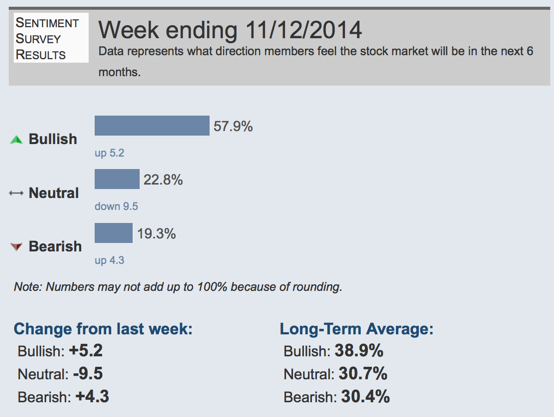
Since I wrote Are investors getting overly optimistic again? less than two weeks ago, the latest AAII Investor Sentiment Survey shows bullishness is even higher.

investor sentiment and asymmetric risk

source: http://www.aaii.com/sentimentsurvey?adv=yes

In the mean time, Fox Business reports this morning “Japan’s economy unexpectedly slipped into recession in the third quarter”. That shouldn’t be a big surprise. If you take a look at the weekly chart of the Japan stock index (priced in Dollars) below, it’s been suggesting something for the past year. I am seeing similar trends (or choppy non-trends) in many global stock markets.

Japan stock market recession

Courtesy of http://www.stockcharts.com

It will be interesting to watch how it all unfolds.

Asymmetrical Risk Definition and Symmetry: Do you Really Want Balance?

Asymmetric is imbalance, uneven, or not the same on both sides.

Risk is the possibility of losing something of value, or a bad outcome. The risk is the chance or potential for a loss, not the loss itself. Once we have a loss, the risk has shifted beyond a possibility to a real loss. The investment or position itself isn’t the risk either, risk is the possibility we may lose money in how we manage and deal with it.

Asymmetrical Risk, then, is the potential for gains and losses on an investment or trade are uneven.

When I speak of asymmetric risk, I may also refer to the probability for gains and losses that are imbalanced, for those of us who can determine probability. If the probability of losing something or a bad outcome is asymmetric, it means the risk isn’t the same as the reward.

Asymmetric risk can also refer to the outcome for profits and losses that are imbalanced, after we have sold a position, asset, or investment.

Some examples:

If we risk $10, but earn $10, the risk was symmetrical.

  • We risked $10
  • We earned $10 – we just broke even (symmetry).

Symmetry is the outcome when you balance risk and reward.

If we risk $10, but earn $20, the risk was positively asymmetric.

  • We risked $10
  • We earned $20

If we risk $10, but lose $10, the risk was symmetrical.

  • We risked $10
  • We lost $10 – we lost the same as we risked.

If we risk $10, but lose $20, the risk was an asymmetric risk.

  • We risked $10
  • We lost $20 – we lost even more than we though we risked.

Strangely, I often hear investment advisers say they want to balance risk and reward through their asset allocation.

Do you?

It was when I noticed my objective of imbalancing profit and loss, risk and reward, was so different from others that I knew I have a unique understanding and perception of the math and I could apply it to portfolio management.

You can probably see how some investors earn gains for years, then lose those gains in the following years, then earn gains again, then lose them again.

That’s a result of symmetry and its uncontrolled asymmetrical risk.

You can probably see why my focus is ASYMMETRY® so deeply that the word is my trademark.

Small vs. Large Stocks: A Tale of Two Markets (Continued)

A quick follow up to my recent comments about the down trend in smaller company stocks in Playing with Relative Strength and Stock Market Peak? A Tale of Two Markets below is a chart and a few observations:

Rusell 2000 Small Caps vs S&P 500 large caps

Source: Bloomberg/KCG

A few observations of the trend direction, momentum, and relative strength.

  • The S&P 500 index (the orange line) of large company stocks has been  in a rising trend of higher highs and higher lows (though that will not continue forever).
  • The white line is the Russell 2000 small company index has been in a downtrend of lower highs and lower lows, though just recently you may observe in the price chart that it is at least slightly higher than its August high. But it remains below the prior two peaks over the past year. From the time frame in the chart, we could also consider it a “non-trending” and volatile period, but its the lower highs make it a downtrend.
  • The green chart at the bottom shows the relative strength between S&P 500 index of large company stocks and the Russell 2000 small company index. Clearly, it hasn’t taken all year to figure out which was trending up and the stronger trend.
  • Such periods take different tactical trading skills to be able to shift profitability. When markets get choppy, you find out who really knows what they’re doing and has an edge. I shared this changing trend back in May in Stock Market Peak? A Tale of Two Markets.

If you are unsure about the relevance of the big picture regarding these things, read Playing with Relative Strength and Stock Market Trend: reverse back down or continuation? and Stock Market Peak? A Tale of Two Markets.


Stock Market Trend: reverse back down or continuation?

I normally don’t comment here on my daily observations of very short-term directional trends, though as a fund manager I’m monitoring them every day. The current bull market in stocks is aged, it’s lasted much longer than normal, and it’s been largely driven by actions of the Fed. I can say the same for the upward trend in bond prices. As the Fed has kept interest rates low, that’s kept bond prices higher.

Some day all of that will end.

But that’s the big picture. We may be witnessing the peaking process now, but it may take months for it all to play out. The only thing for certain is that we will only know after it has happened. Until then, we can only assess the probabilities. Some of us have been, and will be, much better at identifying the trend changes early than others.

With that said, I thought I would share my observations of the very short-term directional trends in the stock market since I’ve had several inquiring about it.

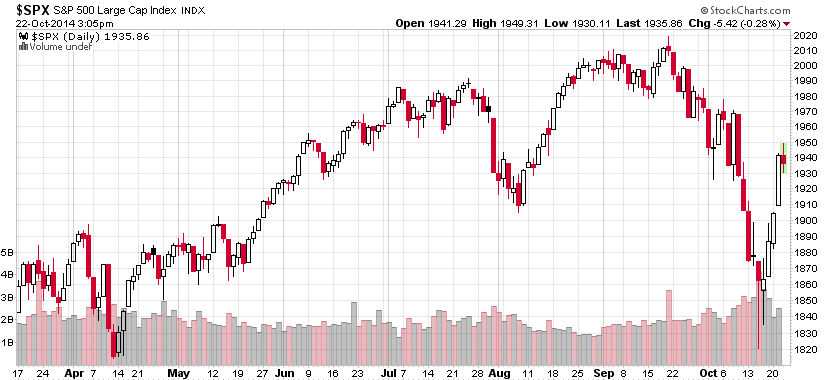
First, the large company stock index, the S&P 500, is now at a point where it likely stalls for maybe a few days before it either continues to trend up or it reverses back down. In “Today Was the Kind of Panic Selling I Was Looking For” I pointed out that the magnitude of selling that day may be enough panic selling to put in at least a short-term low. In other words, prices may have fallen down enough to bring in some buying interest. As we can see in the chart below, that was the case: the day I wrote that was the low point in October so far. We’ve since seen a few positive days in the stock index.

stock index 2014-10-22_15-06-14

All charts in this article are courtesy of http://www.stockcharts.com and created by Mike Shell

Larger declines don’t trend straight down. Instead, large declines move down maybe -10%, then go up 5%, then they go down another -10%, and then back up 7%, etc. That’s what makes tactical trading very challenging and it’s what causes most tactical traders to create poor results. Only the most experienced and skilled tactical decision makers know this. Today there are many more people trying to make tactical decisions to manage risk and capture profits, so they’ll figure this out the hard way. There isn’t a perfect ON/OFF switch, it instead requires assessing the probabilities, trends, and controlling risk.

Right now, the index above is at the point, statistically, that it will either stall for maybe a few days before it either continues to trend up or it reverses back down. As it all unfolds over time, my observations and understanding of the “current trend” will evolve based on the price action. If it consolidates by moving up and down a little for a few days and then drifts back up sharply one day, it is likely to continue up and may eventually make a new high. If it reversed down sharply from here, it will likely decline to at least the price low of last week. If it does drift back to last weeks low, it will be at another big crossroads. It may reverse up again, or it may trend down. Either way, if it does decline below low of last week, I think we’ll probably see even lower prices in the weeks and months ahead.

Though I wouldn’t be surprised if the stock index does make a new high in the coming months, one of my empirical observations that I think is most concerning about the stage of the general direction of the stock market is that small company stocks are already in a downtrend. Below is a chart of the Russell 2000 Small Cap Stock Index over the same time frame as the S&P 500 Large Cap Stock Index above. Clearly, smaller companies have already made a lower low and lower highs. That’s a downtrend.

small company stocks 2014 bear market

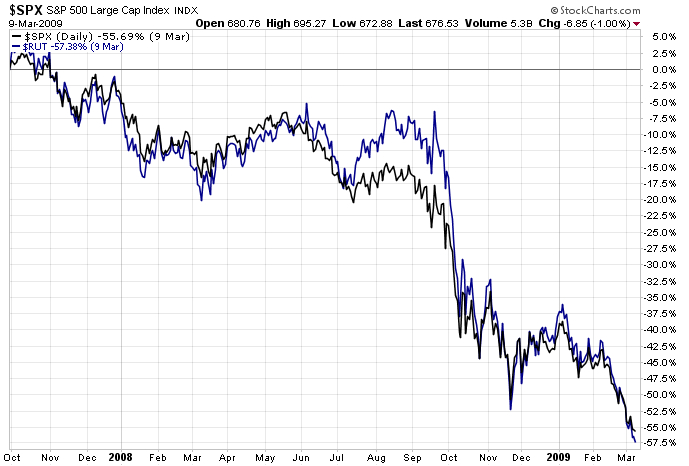
Smaller company stocks usually lead in the early stage of bear markets. There is a basic economic explanation for why that may be. In the early stage of an economic expansion when the economy is growing strong, it makes sense that smaller companies realize it first. The new business growth probably impacts them in a more quickly and noticeable way. When things slow down, they may also be the first to notice the decline in their earnings and income. I’m not saying that economic growth is the only direct driver of price trends, it isn’t, but price trends unfold the same way. As stocks become full valued at the end of a bull market, skilled investors begin to sell them or stop investing their cash in those same stocks. Smaller companies tend to be the first. That isn’t always the case, but you can see in the chart below, it was so during the early states of the stock market peak in 2007 as prices drifted down into mid 2008. Below is a comparison of the two indexes above. The blue line is the small stock index. In October 2007, it didn’t exceed its prior high in June. Instead, it started drifting down into a series of lower lows and lower highs. It did that as the S&P 500 stock index did make a prior high.

small stocks fall first in bear market

But as you see, both indexes eventually trended down together.

As a reminder to those who may have forgotten, I drew the chart below to show how both of these indexes eventually went on to lower lows and lower highs all the way down to losses greater than -50%. I’m not suggesting that will happen again (though it could) but instead I am pointing out how these things look in the early stages of their decline.

2008 bear market

If you don’t have a real track record evidencing your own skill and experience dealing with these things, right now is a great time to get in touch. By “real”, I’m talking about an actual performance history, not a model, hypothetical, or backtest. I’m not going to be telling you how I’m trading on this website. The only people who will experience that are our investors.


Markets don’t always react the way investors expect, so I focus on what is actually happening

hedge fund market wizards

I noted the below question and answer between Jack Schwager and Ray Dalio in Jack’s book “Hedge Fund Market Wizards: How Winning Traders Win” (2012). Ray Dalio is the founder of Bridgewater, the largest hedge fund in the world and one of the most successful. I saved it when I read the book as a fine example that markets don’t always react the way people expect, and that is why I focus instead on what is actually happening rather than what could or should happen – but may not. Everything is very transient, coming and going, and it’s funny how some of the same kinds of things happen over and over again. As you read comments below you’ll hear it’s always a similar story, different day. 1982 was the end of a 20 year secular bear market made up of huge swings similar to the past decade and the beginning of the largest bull market on record up to 2000.

Below is Jack Schwager asking a question to Ray Dalio:

Any other early experiences stand out where the market behaved very differently from what you expected?

In 1982, we had worse economic conditions than we do right now. The unemployment rate was over 11 percent. It also seemed clear to me that Latin America was going to default on its debt. Since I knew that the money center banks had large amounts of their capital in Latin American debt, I assumed that a default would be terrible for the stock market. Then boom—in August, Mexico defaulted. The market responded with a big rally. In fact, that was the exact bottom of the stock market and the beginning of an 18-year bull market. That is certainly not what I would have expected to happen. That rally occurred because the Fed eased massively. I learned not to fight the Fed unless I had very good reasons to believe that their moves wouldn’t work. The Fed and other central banks have tremendous power. In both the abandonment of the gold standard in 1971 and in the Mexico default in 1982, I learned that a crisis development that leads to central banks easing and coming to the rescue can swamp the impact of the crisis itself.

Source: Schwager, Jack D. (2012-04-25). Hedge Fund Market Wizards (pp. 54-55). John Wiley and Sons. Kindle Edition.

All of this, everything that is happening and expected to happen, will be reflected in the directional trend and volatility of price. The directional price and range of prices (volatility) will overreact at times and under-react at others, but it will reflect what is actually going on. Because the direction and volatility of price “is” what matters.

Interest Rates and Dollar Rising, Commodities Falling

I believe an edge I have developed as a global tactical investment manager over the past two decades is a strong understanding how markets interact with each other and their return drivers, but most important is the directional trend. Below I show that interest rates are rising. $FVX is the 5 year Treasury Yield and $UST2Y is the 2 year yield. If we define an uptrend as higher highs and higher lows, both are trending up.

source: http://www.stockcharts.com

You can probably see how when interest rates rise on U.S. Dollar bonds, that may also increase the yield on the U.S. Dollar. For U.S. investors, the rising rates are eventually reflected in money markets, CDs, and new bond issues. Below is a chart of the U.S. Dollar so you can see how it is trending up sharply since July.

When the U.S. Dollar rises, that usually drives just the oppose in Gold. Below is the directional drift of gold.

A rising U.S. Dollar (from rising interest rates) also drives down the price of some commodities. Below we see the price trend a broad based commodity index that includes a basket of many different commodities.

Looking closer at commodities, below we see that wheat, sugar, corn, cotton, and agriculture are trending down. So much for inflation! Those who have believed the U.S. would see strong inflation have been wrong. These commodity trends suggest prices have been falling the past year, not rising.

Finally, I’ll add that the direction of the U.S. Dollar also drives foreign currency relative to the U.S. Dollar. For example, the British Pound and Euro and drifting down as the Dollar is rising. Investors around the world have choices about where to invest their cash. When one currency yields more than another, or is expected to, it could attract demand for that currency. Demand leads to rising price trends.

You can probably see how these global markets are interconnected and driven by the same things. A strong understanding of how global markets interact with each other is an edge in global tactical trading and allocation. Of course, something that may be of concern for traditional stock and bond investors may be how rising rates drive their positions. If rates continue to rise, bond prices will eventually fall.


What’s the Fed Going to Do Next?

The talk about what the Federal Reserve Open Market Committee (“the Fed”) will do next is a fascinating example of investor behavior. The days leading up the Fed meeting and decision announcement is filled with speculations about what’s going to happen next. The Fed has been so involved in driving capital markets these past several years that some of the talk about it is ridiculous. One Fed watcher at the Wall Street Journal says everyone is waiting to see if they continue to use the words “considerable time”, or not. Another article argued it’s not about “considerable time”, but something else.

None of it matters.

None of the people talking about what the Fed will do next know what they will do. They also don’t know how markets will respond to it.

That’s all that matters.

The only thing that matters is the directional trend. There are an infinite number of time frames for a trend. For example, I’ve drawn a chart below for the popular large company stock index, the S&P 500. Over this period, it’s trend is up. It has moved up and down over shorter time frames, but overall the recent trend is up. Stock investors should focus on the direction of the trend, and identify and react when it changes.

S&P 500 Stock Index 2014-09-17_14-55-54

source: http://www.stockcharts.com

We can say the same for other markets. The Fed decisions drive certain interest rates that impact global markets. That necessarily means their actions may impact currency (the Dollar), bonds, commodities, and alternatives like volatility and real estate.

I focus on the directional trend. I’m never trying to figure out what’s going to happen next. Instead, I know exactly what I’ll do at certain prices. I’ll exit to cut a loss here, enter a new trend there, or take a profit.

I don’t need to know what they’ll do. I only need to know how the trend will respond to it and how I’ll respond to any change in that trend.

Flaw of Averages

In Declining (Low) Volatility = Rising (High) Complacency I said:

“The VIX has a long-term average of about 20 since its inception. At this moment, it is 11.82. It’s important to realize the flaw of averages here, because the VIX doesn’t actually stay around 20 – it instead averages 20 as it swings higher and lower.”

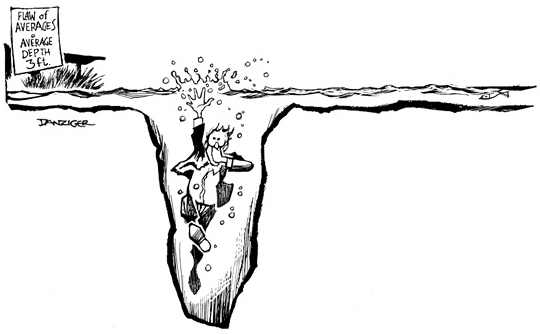
The flaw of averages is the term used by Sam L. Savage to describe the fallacies that arise when single numbers (usually averages) are used to represent uncertain outcomes.

A fine example of the flaw of averages involves a 6 ft. tall statistician who drowns while crossing a river that is 3 ft. deep on average.


DanzigerCoverArtSavage

Source: http://www.danzigercartoons.com/

You can probably see how assumptions using averages can get us in trouble. It only takes a little to be “too much”… and that is mostly likely a problem when we expect the average and the possible range is much wider.

Asymmetric Volatility

Asymmetric Volatility is an observed phenomenon that volatility is higher in declining markets than in rising markets.

Asymmetric Volatility Phenomenon


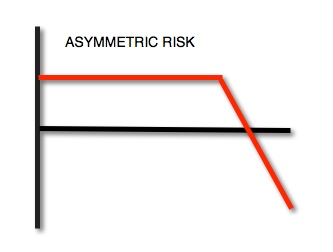
You can probably see how we can relate this as asymmetric risk: the downside risk is higher than upside reward.

Asymmetric Risk

The VIX, as I see it…

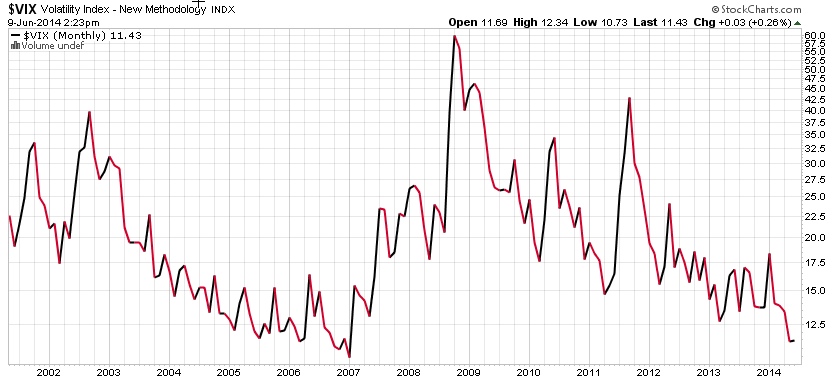
The CBOE Volatility Index (VIX) reached a low point last week not seen since 2007 as evidenced by the chart below.

CBOE VOLATILITY INDEX HISTORY

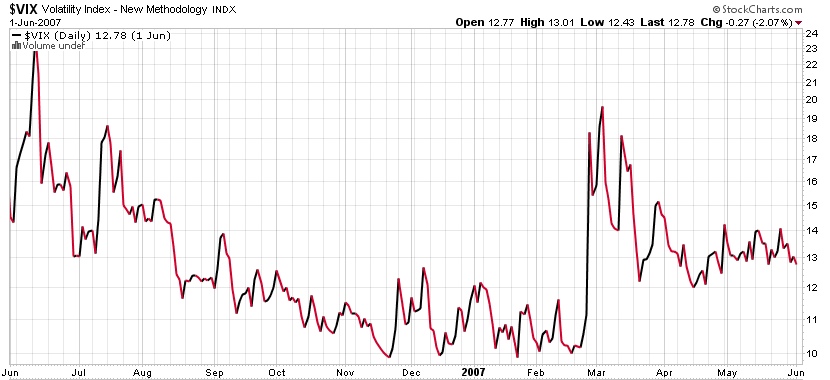
To see a closer view of the last period, below I included the last time the VIX was at such a low value. I show this to point out that the VIX oscillated between 9% and 12% for about 4 months before it finally spiked up to 20. Such a trend reversal (or mean reversion if you prefer) can take time. Imagine if the VIX stays this low for the next 4 months before a spike. Or, it could happen very soon. You may notice the VIX reached the level it is now at its lowest level in early 2007. If we believed these trends repeat perfectly, that absolute level would matter. Trends are more like snowflakes: no two are exactly the same. But in relative terms, the fact that today’s level is as low as the lowest point in early 2007 is meaningful if you care about the risk level in stocks and the stage of the market cycle.

CBOE VOLATILITY INDEX VIX Low levels

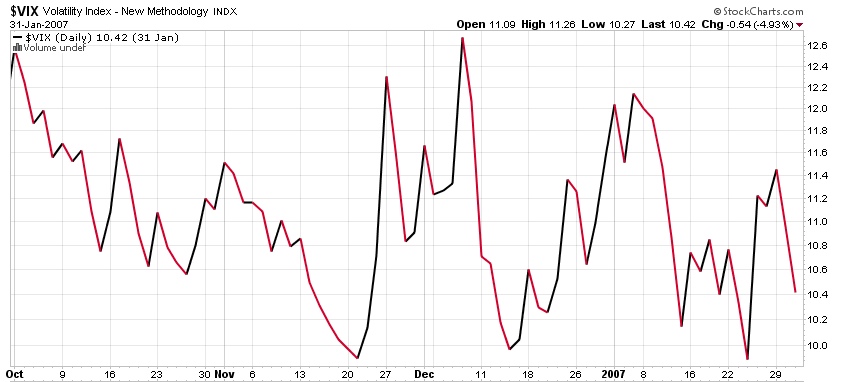
The best way to examine a trend is to zoom in. Start with a broader view to see the big picture, then zoom in closer and closer. When people focus too much on the short-term, they miss the forest for the trees. Below is the last time the VIX was below 12. You may notice that is does oscillate up and down in a range.

VIX BELOW 12

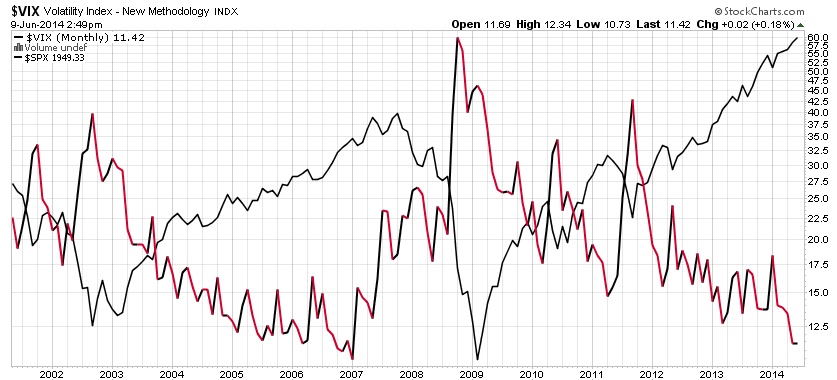
The level and directional trend of the VIX matters because of the next chart. You may see a trend if you look closely. The black line is the S&P 500 stock index. The black and red line is the VIX CBOE Volatility Index. You may notice the two tend to drift in opposite directions. Not necessarily on a daily basis, but overall they are “negatively correlated”. When the stock index is rising, the volatility is often falling or already at a low level. When the stock index is falling, volatility rises sharply. It isn’t a perfect opposite, but it’s there.

VIX and S&P 500 correlation and trend

If you are interested in stock trends and the trend in volatility, and specifically the current state of those cycles,  you may want to follow along in the coming days. I plan to publish a series on this topic about the VIX, as I see it. Over the last week or so I have written several ideas that I intended to publish as one large piece. Since I haven’t had time to tie it together that way, I thought I would instead publish a series.

When a trend reaches an extreme level like this, it may be useful to spend some time with it.

Stay tuned…

if you haven’t already, you may want to click on “Follow” to the right to get updates by email to follow along. This will likely be several informal notes in the coming days.


Global Macro: Russia was already a bear market

On Monday, the Russia stock market, as measured by the MSCI Russia Capped Index, declined over -8% with the headlines filled with news about their military actions. Based on that index of stocks, the Russian stock market was already in a bear market. Big down days often occur when selling pressure is already present. That’s how good price trend systems can avoid waterfall declines. Selling pressure causes prices to fall and falling prices lead to “serial correlation”. That is, prices decline because people are selling because prices are falling. There isn’t a requirement for a fundamental or economic reason. The reason is behavior: people who experience the decline you see in the chart below get to a point that they “tap out”. They tap out just because they are losing money and they have reached their “Uncle!” point. On Monday, the decline didn’t just stop at -4% because people wanted to cut their losses and that selling pressure pushes the price even lower.

russia stock market bear market

How do I qualify?

Someone passed along one of those passionate political videos with a thought-provoking title, so I watched. It started out with

You want to see something really disturbing? Go to any search engine and type in “how do I qualify” and see what comes up.

I was a surprised by what he said I would find, so I stopped and did just that.

What do you think of when you ponder “How do I qualify”? For college? for a certain job? for a home loan? for medical school? business school? law school? the military? for a private investment program?

According to the Yahoo! search engine, below are the top things Americans want to know when searching  “How do I qualify”.

how do I qualify

Source: https://www.yahoo.com/

Wow… that is a shocker. I would have lost that bet.

Maybe they’re right. Some of us must be out of touch with the world as it really is.

Is the Bull Topping Process Starting?

There are several things that unfold as a market begins the topping process. While large cap indexes may continue to make new highs, the market becomes more and more selective. We’ll see that in breadth indicators like bullish percent indexes, Advance Decline Lines, etc. As the market finds fewer and fewer stocks attractive, it becomes more selective, so fewer stocks remain in positive trends.

The current bull market in stocks is about 58 months old. As I explained in The REAL Length of the Average Bull Market the bull markets have averaged about 39 months and bear markets about 17 months. A full market cycle (average bull + bear) is 56 months. The current bull market, then, is longer than the historical average full market cycle. So, it makes a lot of sense to start watching for signs the topping process has started. It’s important to understand a bull markets end with a process of churning up and down and with fewer stocks participating in the last stage of advances.

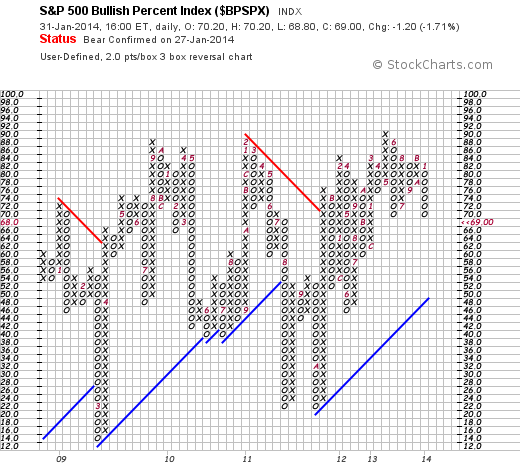
Below is an example of fewer stocks participating. The S&P 500 Bullish Percent Index shows a composite of the 500 stocks in the S&P 500 index that are in a positive trend. The lower highs made over the past year is beginning to show fewer of those stocks are making buy signals as the S&P 500 index has made new highs. It appears the selectivity is in its early stage as the percent of stocks on a buy signal is still around 70%, but it’s falling. This is just one example of the kind of things I observe when watching for a topping process.

NYSE Bullish Percent

Source: https://stockcharts.com/def/servlet/SC.pnf?c=$BPSPX,P

Below I list a table of several other bullish percent’s for stock indexes. Using Point & Figure terminology,  they are either a Bull Top (the chart is falling (in a column of Os) but above 70%) or Bear Confirmed (chart is falling (column of O’s) below 70% and has generated a P&F sell signal). I wouldn’t be surprised to see these get a lot lower in the months ahead. However, what makes it difficult for most people is the process is made up of advances and declines, not usually just a straight down move. The whipsaws up and down is what causes the most trouble.

Index Bullish% Status Status Change
Russell 2000 64.03% Bear Alert 30-Aug-13
Dow Industrials 63.33% Bear Confirmed 31-Jan-14
NASDAQ 100 65.00% Bear Confirmed 29-Jan-14
NYSE 61.55% Bear Confirmed 27-Jan-14
Optionable Stocks 67.60% Bear Confirmed 31-Jan-14
S&P SmallCap 600 67.55% Bear Confirmed 31-Jan-14
AMEX 63.31% Bull Confirmed 2-Jan-13
NASDAQ Composite 62.68% Bull Confirmed 2-Jan-13
Wilshire 5000 66.29% Bull Confirmed 2-Aug-13
S&P 100 70.71% Bull Top 13-Dec-13
S&P 500 68.41% Bull Top 24-Jan-14
S&P Composite 1500 70.30% Bull Top 28-Jan-14
S&P MidCap 400 72.64% Bull Top 27-Jan-14

Getting Technical about Supply and Demand

I will first warn that for most investors, zooming in and watching it too closely will more likely lead to a bad outcome. I’ve observed over the years that one of the most common problems of poor investor decisions is watching it too closely – as if it changes the outcome. They end up experiencing every move and reacting to them emotionally. They oscillate between the fear of missing out and the fear of losing money. Since most markets like the stock market can easily swing 5% or more up or down 3 or 4 times a year, they ride an emotional roller coaster. Ultimately, most investors should focus on the primary trend, which I define as a period of 3 – 12 months or more, and that necessarily means accepting some swings.

With that said, I wanted to share a very simple illustration of how I observe the battle of buying and selling pressure (supply and demand) play out visually using charts. We can consider this a continuation of my last post. I have communication with a very wide range of investors, traders, and portfolio managers. Let’s first define those titles. An investor is someone who invests in something; it could be a position they’ll hold for income like commercial real estate or it may be an investment program that is traded on their behalf. An investor is probably looking at 5, 10, or 20-year time frames. A portfolio manager is a person who makes buy and sell decisions within a fund or investment program. A portfolio managers’ time frame depends on their strategy. A portfolio manager can also be seen as a trader, because a trader makes trades, but my traders execute my decisions by executing the trades for me. Then, a trader trying to get the very best price at that moment is focused on tick-by-tick price trends; seconds, not days.

It’s fascinating how different the views of all of these people can be, whether it’s a market maker trading options, a veteran long-term trend follower whose been doing it for decades, or an individual investor who spends some time in the evening reading the headlines. How well their activities help them depends on their true level of expertise and experience – and it takes a lot more of it than people think.

I find that those of us with a very strong understand of how supply and demand is reflected in price action have a better sense of the current conditions and understanding of the market state. Those without it seem to be sitting around trying to figure out what’s going on and what to do next. Sitting around trying to figure out what’s going on and what to do next is like someone handing you the keys to a yacht on the Tennessee River and asking you to take it to the Gulf Coast of Florida and on to the Bahamas. If you are a skilled Captain with a plan of how you’ll time getting through the locks and where you’ll stay overnight, it will be the trip of a lifetime. If not, then I guess you’ll spend a lot of time sitting around trying to figure out what’s going on and what to do next and that’s going to be a gut-wrenching few weeks. And, it could be very costly.

You can probably see my line of thinking as I show you this simple illustration of supply and demand playing out in price action. It gives us a glimpse of how we view what is going on. In the image, you can see the “Candlestick Formation” of a price action of a single day. We borrowed this image from our friends at www.stockcharts.com and if you click that link later it will take you directly to their “Introduction to Candlesticks”. The thin lines are the “shadow” and the larger box is the “Real Body”. If the color is white or green, it closed higher than it opened. Take a close look at the high, close, open, and low of the day to see how they are marked on the “candle”.

candle1-formation

I am going to point out a very simple explanation of what this means. To understand what it means, thinking about what it represents. We see the opening price is marked, then the high of the day, then the low it traded that day, and then the price it closed. That is the full range of the days price action. If we looked at the chart in seconds, weeks, or months, it would be the range over that time frame.

Below is the last 10 days of the S&P 500 stock index price action represented by the  SPDR® S&P 500® ETF, which is a fund that, before expenses, generally corresponds to the price and yield performance of the S&P 500® Index. That is, the ETF is tradeable while the index itself is not.

S&P 500 2013-10-24_08-00-42

Source: https://stockcharts.com/h-sc/ui

As you can see in the chart, these are candlesticks and they have real body’s and the thin line shadows. Yesterday is the last candlestick – the one with a red body with more line below the body than the top. candlesticks with long lower shadows and short upper shadows indicate that sellers dominated during the first part of the session, driving prices lower. You can see some other days with upper and lower shadows (the thin line) that are about the same, so buyers and sellers moved the price high and low and then settled about where it opened. Sometimes we see candlesticks with a longer upper shadow and shorter lower which indicates that buyers dominated during the first part of the day, driving prices higher. You can probably begin to see how a deep understanding price action can help us define the current trend direction and identify reversals. It gets far more involved when we start thinking about how the days interact with each other and requires more than reading a book and looking at charts a few years to gain some skill at using it to understand what is going on, but this may give you something to ponder. Of course, creating information is one thing, the ability to make it useful is another. But the basics really isn’t that complicated though people often get too caught up in requiring patterns and outcomes to be perfect.

At the end of the day, you can probably see how this tells us want actually happened that day…

What in the World is Really Going on, Part 2: Kicking the Can Down the Road

Jim Rogers says it best.

What in the World is Really Going on

I find that people don’t know what in the world is really going on or understand the big picture beyond what has happened most recently. They don’t really understand the aggressive Fed policies the past five years or the long-term debt cycle of the United States. If you really want to understand what is really going on in the big picture, I encourage you to watch this 30-minute video How The Economic Machine Works by Ray Dalio. After you watch it, you’ll understand how debt cycles work, how the Fed operates, and the current cycle the U.S. is in today. That is, you’ll begin to understand what in the world is going on in a way that only a few people do. It’s the kind of information and understanding you’ve previously never had access to.

And, you won’t be so surprised by what happens next…

Asymmetric Payoff: The Price of College Sports

Schooled- The Price of College Sports

Not all asymmetric payoffs are fair. As the college football season gets into full speed, college sports gets some unwanted publicity. It was sickening to hear Arian Foster say:

“I called my coach and I said, ‘Coach, we don’t have no food. We don’t have no money. We’re hungry. Either you give us some food, or I’m gonna go do something stupid.’ He came down and he brought like 50 tacos for like four or five of us. Which is an NCAA violation. [laughs] But then, I walk up to the facility and I see my coach pull up in a brand new Lexus.” — Arian Foster

It’s sickening not so much because the coach broke the rules by feeding a player, but instead that someone who works as hard as a student athlete is sitting there hungry in the United States of America. And, while the college sports “industry” earns billions of dollars in profits. You surely don’t have to be a hardcore Libertarian to see the problem with that. It’s no surprise that many college athletes don’t have financial support from their family. It’s time for universities to focus on how to at least be sure student athletes have food and decent living conditions. I think they earn it.
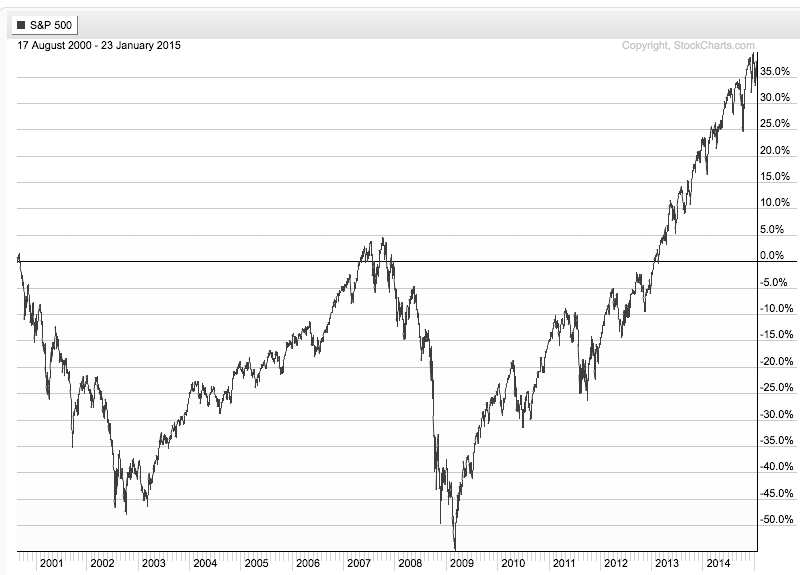
 

The conversation will get started when the documentary Schooled: The Price of College Sports premieres Wednesday October 16th 8PM on EPIX:

“The EPIX Original Documentary Schooled: The Price of College Sports is a comprehensive look at the business, history and culture of big-time college football and basketball in America. It is an adaptation of “The Cartel” by Pulitzer Prize Winning civil rights scholar Taylor Branch, and his October 2011 article in The Atlantic, “The Shame of College Sports.” Schooled presents a hard-hitting examination of the NCAA’s treatment of its athletes and amateurism in collegiate athletics; weaving interviews, archival and verité footage to tell a story of how college sports became a billion dollar industry built on the backs of athletes who are deprived of numerous rights.”

Read more: Schooled: The Price of College Sports

Game Changing Asymmetry

ORACLE Team USA

Source: ORACLE® Team USA

If things actually worked they way we are taught in school, all you need to do it get a “college degree” and you’ll be successful.

The reality is, learning the essentials like reading, writing, and arithmetic are basic requirements like eating, sleeping, and you know what.

To be great at something, we have to do a lot more than the basics.

You may consider that many of the greatest game-changers in America didn’t need anyone to tell them what to do next. They instead charted their own course and it was one that didn’t exist before.

Our society wants us to fit into the middle of the bell curve like the average person, but for some of us it’s a lot more fun to be an outlier,

Congratulations! To Larry Ellison and his ORACLE® Team USA for completing an improbable comeback to win Race 19 to successfully defend the 34th America’s Cup on Wednesday in San Francisco.

It’s a fine example of a game-changing asymmetry.

Before the huge win, Larry Ellison, who is co-founder and CEO of ORACLE®, was criticized for skipping a keynote address at a company conference to instead watch the comeback of his regatta team. It was a once in a lifetime moment only a few will ever experience by a man who has earned his freedom.

It’s a fine example of knowing when to get off the treadmill…

And, if you know the story, this unlikely outcome came from an unlikely team to start with. The combination of a billionaire CEO and a car radiator mechanic. The story is in The Billionaire and the Mechanic by Julian Guthrie. (I’ve been listening to the Audible version). It’s about how an unlikely duo won the sport’s oldest trophy – before this one. From Amazon:

“The America’s Cup, first awarded in 1851, is the oldest trophy in international sports, and one of the most hotly contested. In 2000, Larry Ellison, co-founder and billionaire CEO of Oracle Corporation, decided to run for the coveted prize and found an unlikely partner in Norbert Bajurin, a car radiator mechanic who had recently been named Commodore of the blue collar Golden Gate Yacht Club.

Julian Guthrie’s The Billionaire and the Mechanic tells the incredible story of the partnership between Larry and Norbert, their unsuccessful runs for the Cup in 2003 and 2007, and their victory in 2010. With unparalleled access to Ellison and his team, Guthrie takes readers inside the design and building process of these astonishing boats, and the management of the passionate athletes who race them. She traces the bitter rivalries between Oracle and their competitors, including Swiss billionaire Ernesto Bertarelli’s Team Alinghi, and throws readers into exhilarating races from Australia and New Zealand to Valencia, Spain.

With new television coverage and huge media, the America’s Cup is poised to be bigger than ever, and The Billionaire and the Mechanic is a must-read for anyone interested in the race or this remarkable story.”

Do you choose the blue pill or the red pill?

Red-Pill-Blue-Pill

The “red pill” and “blue pill” refer to a choice between the willingness to learn a potentially unsettling or life-changing truth by taking the red pill or remaining in contented ignorance with the blue pill. It refers to a scene in the 1999 film The Matrix.

I have been talking to a financial planner recently who is struggling between the red pill and the blue pill.

On the one hand, the poor performance of stock and bond indexes over the past decade or so, particularly the losses in bear markets, led him to study long-term market cycles.

An understanding that markets don’t always go up over long periods is the reality of the red pill.

On the other hand, much of the investment industry still believes in getting “market returns” and that a simple plan of “asset allocation” and occasional re-balancing is prudent enough, so a financial planner can choose to keep his practice simple by continuing that plan.

Some investment advisers even consider re-balancing and an occasional change “tactical”.

It isn’t.

The blue pill and the red pill are opposites, representing the choice between the blissful ignorance of illusion (blue) and embracing the painful truth of reality (red).

On the one hand, after understanding the trends of global markets based on simply looking at their history, he realizes the probable outcome of stocks and bonds based on trends I discuss in The S&P 500 Stock Index at Inflection Points and 133 Years of Long Term Interest Rates. Though price trends can continue far more than you expect, the stock and bond markets are at a point where their trends could reverse. The financial planner realizes if he takes the red pill of reality, he’ll have to embrace these facts and do something rather than sit there. He’ll have to change his long-held beliefs that markets are efficient and the best you can do is allocate to them. He’ll have to do extra assignments and homework to find alternative investment managers whose track record suggests they may have the experience and expertise to operate through challenging market conditions.
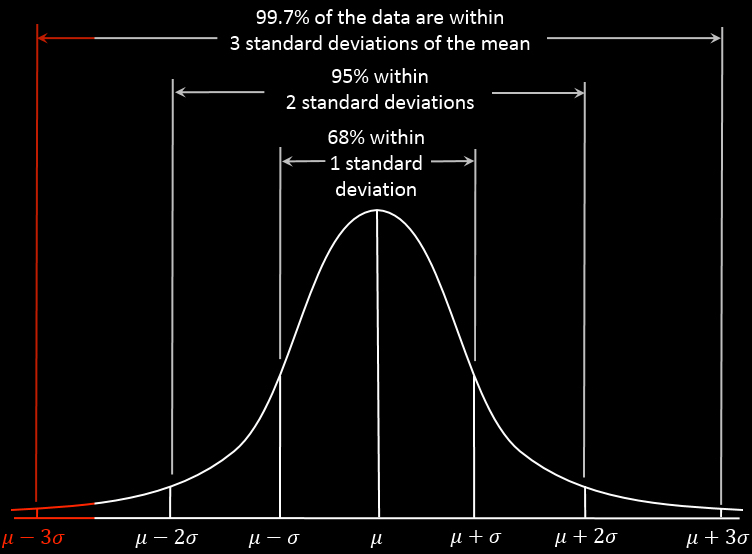
On the other hand, changing one’s beliefs and taking a different approach can be extra work and have risks. If he continues the static asset allocation to stocks and bonds he’s always done, he says he won’t be doing something so different from the majority of advisers. He knows his career and his life will be easier. When the markets go up, his clients make market returns (minus his fees). When the markets go down, other people are losing money too, and he certainly can’t control what the market does, so: it’s the market. I can see how this is an enticing business model, especially for a busy person who has a life outside the office. That’s probably why it’s so popular.

A similar theme of duality happens in the movie The Matrix.

Morpheus offers Neo either a blue pill (to forget about The Matrix and continue to live in the world of illusion) or a red pill (to enter the sometimes painful world of reality).

Duality is something consisting of two parts: a thing that has two states that may be complementary or opposed to each other. We all get to choose what we believe and our choices shape the world we individually live in.

I can’t say that I can totally relate to the financial adviser because it is my nature to be more tactical and active in decision-making. I believe we should actively pursue what we want. And, I believe what we want from the markets is in there, I just have to extract it from the parts we don’t want. I once explained my investment strategy to a lifelong friend and he replied “you have always been tactical” and reminded me of my background. Though it’s different from me, I can truly appreciate the struggle advisers and investors face choosing between the red or blue pill. Investors and advisers like “market returns” when they are positive, which is what we experience most of the time. It’s when those markets decline that they don’t want what the market dishes out. The markets don’t spend as much time in declines. I pointed out in The Real Length of the Average Bull Market the average upward trend for stocks (bull market) lasts 39 months while the average decline ( bear market) is about 17 months. Investors eventually forget and become complacent about the time they need a reminder. Though the stock markets trend up about 3 times longer than they trend down, it’s the magnitude of the losses that cause long-term investors a problem. For example, the bull market from 2003 through October 2007 gained over 105% but the -56% decline afterward wiped out those gains. You can see that picture in The S&P 500 Stock Index at Inflection Points.

The risk for the financial adviser who has historically focused on “market returns” is that a new strategy for them that applies some type of active risk management is likely to be uncorrelated and maybe even disconnected at times from “market returns”. For example, I discussed that in Understanding Hedge Fund Index Performance. Investors who are used to “market returns” but need a more absolute return strategy with risk management may require behavior modification. If they want an investment program that compounds capital positively by avoiding large losses and capturing some gains along the way they have to be able to stick with it. That requires the adviser to spend more time educating his or her investors about the reality of the red pill. Kind of like I am doing now. Some people have more difficulty doing something different, so they need more help. Others are better able to see the big picture. Some financial advisers would rather deal with explaining the losses when markets decline. For them, it can be as simple as forwarding clients some articles about the market going down with a message something like “We’re all in this together – let’s just hunker down”. That doesn’t require a great deal of independent thinking or doing.

While most individual investors probably do lose money when the stock and bond markets do, that isn’t necessarily the case for those who direct and control downside risk.

It isn’t enough to have a good investment program with a strong performance history.

Just as important is the ability to help investors modify their beliefs and behavior.

That’s the reality of the red pill.

By definition, active is more work than passive. Investors and advisers alike get to choose which pill they take: the blissful ignorance of illusion (blue) and embracing the painful truth of reality (red).

I believe in individual liberty and personal responsibility, so the choice is your own.

My thoughts on the subject are directional – I am the red pill.

Morpheus: “You have to understand, most of these people are not ready to be unplugged. And many of them are so inured, so hopelessly dependent on the system, that they will fight to protect it.”

“Unfortunately, no one can be told what the Matrix is.

You have to see it for yourself.”

Like The Matrix, this is going to be a sequel.

To be continued…

The Dow Jones Industrial Average is a Black Box

The black box:

In science and engineering, a black box is a device, system or object which can be viewed in terms of its input and output but without any knowledge of its internal workings. Its implementation is “opaque” (black). Almost anything might be referred to as a black box: a transistor, an algorithm, or the human brain.

Blackbox.svg

The opposite of a black box is a system where the inner components or logic are available for inspection, which is sometimes known as a clear box, a glass box, or a white box.

Almost all investment programs are actually a black box. That is, the investment manager may allow the investor to see the holdings, but most investment strategies have many parts and parameters that are undisclosed to the public or even its investors. There is strong logic behind not disclosing ones intellectual property beyond the obvious. And, it isn’t just about intellectual property, it may be a fiduciary issue, too. When the public knows what a portfolio manager is going to do in advance, other portfolio managers can front-run the trade. Just ask Russell whose indexes are more transparent and we believe they’ve had issues because of it. I think a portfolio manager has an obligation to avoid that. And,  it just makes sense.

We can say the same for stock indexes like the Dow Jones Industrial Average or other Standard & Poors indexes. By now, it is public knowledge that the committee that oversees the Dow Jones Industrial Average has made 6 significant changes to the 30 stocks that make up the index. The Index Committee dropped Alcoa, Hewlett-Packard, and Bank of America, and added Goldman Sachs, Nike and Visa. Did you know in advance they would do that? We didn’t know until after they announced it. Why? because it’s something a committee decided. As we defined above, what is going on in the human brain is a black box. When people are going to make decisions, we can’t determine for sure in advance what the output will be.

Though we can’t actually invest in an index directly, index investors and traders gain exposure to indexes through index funds like exchange traded funds (ETFs). We say that ETFs allow us to gain exposure to a market, sector, country, etc. in a low-cost, transparent, and efficient format. But, the transparency is in regard to the index holdings and maybe the universe they select from, but not necessarily how they decide to add and delete holdings (causing the index ETF we may own to buy and sell the underlying stocks, bonds, etc.).

Is that process a black box? Yes, it is.

We know only parts of the input, we know the output, but we don’t actually know in advance the inner workings of the decision. An index like the Dow Jones Industrial Average is a system that can be understood in terms of its input and output, but not necessarily any knowledge of its internal workings. In the recent case of the Dow Jones Industrial Average, the changes will take effect with the close of trading on Sept. 20th. According to the Wall Street Journal, it was explained in a statement:

“we were prompted by the low stock price of the three companies slated for removal and the Index Committee’s desire to diversify the sector and industry group representation of the index,” S&P Dow Jones Indices LLC, the company that oversees the Dow”

Only the “low price” part of that is rules-based. The Index Committee made the decisions to reflect their desire. That doesn’t seem different from an “Investment” Committee that makes such decisions for a fund or other investment program. It isn’t.

What do you really know about indexes? We know the Dow is a price-weighted index, meaning the bigger the stock price, the larger the position for the stock, and vice versa. That is different from indexes such as the Standard & Poor’s 500, which are weighted by components’ market capitalization. But, we don’t know enough about how the Index Committee makes its decisions to have known in advance what stocks they will change. If we did know that, we could buy the new stocks and sell the outgoing stocks in advance of their announcement. That’s one reason they don’t publish it. However, the black box index goes beyond that. They couldn’t publish it before they decide the changes – they didn’t know either what the output would be until the committee members gave their input. Though many indexes may appear more quantitative (systematic decisions based on predefined rules) they are just as qualitative based on judgement and opinion (an Index Committee makes the decisions, so you don’t actually know what they’ll decide – it isn’t so “rules-based”). My point is: we couldn’t have known the outcome in advance because there was an internal meeting involved to decide.

But an index fund investor doesn’t really need to know this information in advance. Neither does an investor in any investment program. That’s why they are an “investor”. If they are a “portfolio manager” or “trader” they can do it themselves and make their own decisions deciding every little detail. When we choose to invest in any fund, index or not, we necessarily leave part of the process to the deemed expert. In the case of the index, the expert is the index provider like S&P Dow Jones Indices.

The Dow Jones Industrial Average index is totally transparent in regard to its holdings, but a black box in regard to how the additions and deletions are decided.

Stay tuned: I’ll get into this more next week…

Enter your email address to subscribe to this blog and receive notifications of new posts by email.

To learn more about the Dow Jones Industrial Average, visit its learning center which shows the Ins & Outs of the Dow since 1896 and read Dow Jones Industrial Average Historical Components.

Understanding Hedge Fund Index Performance

I am often fascinated by investor perception and behavior. I notice it everywhere and study it always. What a person believes makes their world what it is and how they see things. It can also explain their own poor results. You see, if the majority of individual investors and professional investors actually have poor performance over long periods (as evidenced by Dalbar and SPIVA®)  they necessarily must be doing and believing the wrong things.

I just came across something that said “Why are hedge fund indexes performing so poorly?”. My first thought was “Are they?”. There are a few different hedge fund indexes, but I use the Barclay Hedge Fund Indices because it can include more than 1,000 funds each month across a wide range of strategies.

The Barclay Hedge Fund Index is a measure of the average return of all hedge funds (excepting Funds of Funds) in the Barclay database. The index is simply the arithmetic average of the net returns of all the funds that have reported that month.

As you can see below, the Barclay Hedge Fund Index, which is the average return of all hedge funds in the Barclay database, has gained 5.22% year to date through August. Is 5.22% a “poor” return when the risk free rate on short-term T-Bills, money markets, and CD’s are near zero? I don’t think so. But, if you compare it to the highest returning index you can find maybe you’ll perceive it as “poor”. For example, the stock market indexes are so far “up” double digits this year, but they can reverse back down and end the year in the red. Stock indexes are long-only exposure to stocks so their results reflect a risk premium earned for owning stocks with no risk management to limit the downside. I don’t know anyone who thinks the stock indexes have created the kind of risk adjusted return they want after declining more than -50% twice the past several years. If they want to compare “hedge funds” to a long-only stock index they should consider focusing on hedge funds that focus on stocks.

As you can see below, the hedge fund index includes a wide range of alpha strategies. The Equity Short Bias is one of only two that are down year to date and that is expected: they are short stocks and stocks have gained this year, so these strategist that short stocks  have lost money. Emerging Markets is the other that is down, which is not terribly surprising since most emerging markets are down. They have still managed risk: through August the Emerging Markets Hedge Fund Index is down -1.73% while the iShares MSCI Emerging Markets ETF is down -13.17%. I’m sure any of those hedge fund managers who are down don’t think that’s “good”, but its just a short period of time.

Barclay Hedge Fund Indices

Source: http://www.barclayhedge.com/

Investment managers are to compare their performance to something to illustrate the general market and economic conditions over a period. Since my investment programs don’t intend to benchmark any indexes, we often use the Barclay Hedge Fund Index as a comparison of this “alpha index” to our programs.

In the chart below, we have compared over a full market cycle the Barclay Hedge Fund Index, Dow Jones Global Moderate (a monthly rebalanced index of an allocation across 14 global indexes that are 60% global stocks, 40% global bonds), and the S&P 500 stock index The blue line is the Barclay Hedge Fund Index. Keep in mind that the hedge fund index is net of hedge fund fees while the S&P 500 stock index and Dow Jones Global Moderate does not reflect any fees.  If an investor used an adviser, they would pay a management fee, index fund fees, and trading cost, so the net return would be less. Recently, it has “lagged” the other two, but over the full cycle, its risk/reward profile is significantly superior. Though they all ended with about the same total return, the Barclay Hedge Fund Index declined -24% peak to trough during the 2007 – 2009 bear market. That -24% is compared to -38% for the Dow Jones Global Balanced 60/40 index and -55% for the S&P 500 total return (including dividends). That is the advantage of “active risk management” many hedge funds attempt to apply. Look closely at the chart below and decide which experience you would have rather had. And then, consider that it’s important to view the full picture over a full market cycle rather than focus on short-term periods.

Hedge Funds vs. Asset Allocation and Stock index

As to why the Barclay Hedge Fund Index has lagged stocks lately?

They are supposed to. Hedge funds as a group, as measured by a composite index, are investing and trading long and short multiple strategies across multiple markets: bonds, stocks, currency, commodities, and alternatives like volatility, real estate, etc.

You may also consider that hedge funds are generally risk managers (though not all have that objective). If you look at the end of the last bull market in stocks (late 2007) the hedge fund index lagged 100% stock indexes then, too. You may consider that risk managers are actively managing risk and they could be right in doing it now considering the stage in the cycle.  It’s probabilistic, never a sure thing. It worked the last time. Some hedge fund strategies begin to reduce their exposure to high risk markets like stocks after they have moved up to avoid even the early stage of the decline. By doing that, they “miss out” on both the final gains but also the initial decline after a peak. Others wait until stocks actually reverse their trend, which means they’ll participate in some of the initial decline when it happens.

You may also consider that people bragging about the gains to long-only stock indexes that have no downside protection may be another sentiment indicator. Historically, it seems that about they time they get to bragging and become complacent the trend turns against them…

Note: you cannot invest directly in any of these indexes.

Volatility Index VIX Shows Implied Volatility is Lower In September

Although September is often the worst month of the entire year for the stock market, so far, August was worse. And, The term structure for VIX shows that implied (or expected) volatility was actually higher in August than September. We’ll see how it all unfolds…

VIX-VXN1

Source: http://www.cboeoptionshub.com/wp-content/uploads/2013/09/VIX-VXN1.jpg

Using September to Understand Probability and Expectation.

probabilty coin flip

From 1928-2012 the S&P 500 was up 39 months and down 46 months. It’s down 55% of the time in September…

Dow Jones Industrial Average 1886-2004 (116 years) 49 years the Dow was down, in 67 years the Dow was up. It’s down 58% of the time in September…

Those are probability statements. First, let’s define probability.

Probability is likelihood. It is a measure or estimation of how likely it is that something will happen or that a statement is true. Probabilities are given a value between 0 (0% chance or will not happen) and 1 (100% chance or will happen). The higher the degree of probability, the more likely the event is to happen, or, in a longer series of samples, the greater the number of times such event is expected to happen.

But that says nothing about how to calculate probability and apply it. One thing to realize about probability it that is the math for dealing with uncertainty. When we don’t know an outcome, it is uncertain. It is probabilistic, not a sure thing.

As I see it, there are two ways to calculate probability: subjective and objective.

Subjective Probability: assigns a likelihood based on opinions and confidence (degree of belief) in those opinions. It may include “expert” knowledge as well as experimental data. For example, the majority of the research and news is based on “expert opinion”. They may state their belief and then assign a probability: “I believe the stock market has a X% chance of going down.” They may go on to add a good sounding story to support their hypothesis. You can probably see how that is subjective.
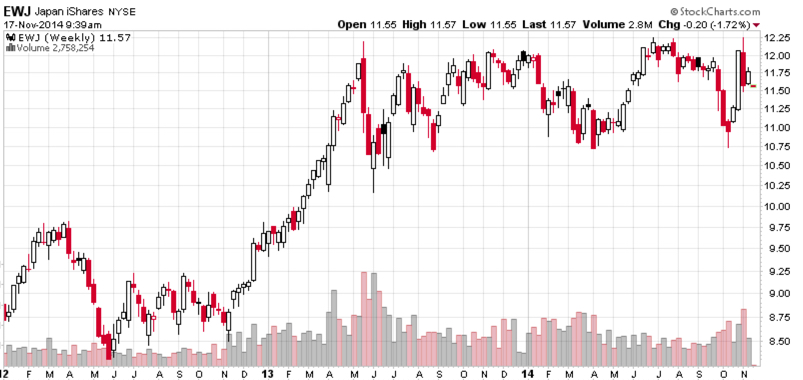
Objective Probability: assigns a likelihood based on numbers. Objective probability is data-driven. The popular method is frequentist probability: the probability of a random event means the relative frequency of occurrence of an experiment’s outcome when the experiment is repeated. This method believes probability is the relative frequency of outcomes over the long run. We can think of it as the tendency of the outcome. For example, if you flip a fair coin, its probability of landing on head is 50% and tail is 50%. If you flip it 10 times, it could land on head 7 and tail 3. That outcome implies 70%/30%. To prove the coin is “fair” (balanced on both sides), we would need to flip it more times. If we flip it 30 times or more it is likely to get closer and closer to 50%/50%. The more frequency, the closer it gets to its probability. You can probably see why I say this is more objective: it’s based on historical data.

If you are a math person and logical thinker, you probably get this. I have a hunch many people don’t like math, so they’d rather hear a good story. Rather than checking the stats on a game, they’d rather hear some guru opinion about who will win.

Which has more predictive power? An expert opinion or the fact that historically the month of September has been down more often than it’s up? Predictive ability needs to be quantified by math to determine if it exists and opinions are often far too subjective to do that. We can do the math based on historical data and determine if it is probable, or not.

As I said in September is statistically the worst month for the stock market the data shows it is indeed statistically significant and does indeed have predictive ability, but not necessarily enough to act on it. Instead, I suggest it be used to set expectations: the month of September has historically been the worst performance month for the stock indexes. So, we shouldn’t be surprised if it ends in the red. It’s that simple.

Theory-driven researchers want a cause and effect story to go with their beliefs. If they can’t figure out a good reason behind the phenomenon, they may reject it even though the data is what it is. One person commented to me that he didn’t believe the September data has predictive value. But, it does.

I previously stated a few different probabilities about September: what percentage of time the month is down. In September is statistically the worst month for the stock market I didn’t mention the percent of time the month is negative, only that on average it’s down X% since Y. It occurred to me that most people don’t seem to understand probably and more importantly, the more complete equation of expectation.

Expectation

There are many different ways to define expectation. We probably think of it as “what we expect to happen”. In many ways, it’s best not to have expectations about the future. Our expectations may not play out as we’d hoped. If you base your investment decisions on opinion and expectations don’t pan out, you may stick with your opinion anyway and eventually lose money. The expectation I’m talking about is the kind I apply: mathematical expectation.

We have determined above the probability of September based on how many months it’s down or up. However, probability alone isn’t enough information to make a logical decision. First of all, going back to 1950 using the S&P 500 stock index, the month of September is down about 53% of the time and ends the month positive about 47% of the time. That alone isn’t a huge difference, but what makes it more significant is the expectation. When it’s down 53% of the time, it’s down -3.8% and when it’s up 47% of the time it’s up an average of 3.3%. That results in an expected value of -0.50% for the month of September. If we go back further to 1928, which includes the Great Depression, it’s about  -1.12%.

The bottom line is the data says “based on historical data, September has been the worst month for the stock market”. We could then say “it can be expected to be”. But as I said before, it may not be! And, another point I have made is the use of multiple time frames for looking at the data, which is a reminder that by intention: probability is not exact. It can’t be, isn’t supposed to be, and doesn’t need to be. Probability and expectation are the maths of uncertainty. We don’t know in advance many outcomes in life, but we can estimate them mathematically and that provides a sound logic for believing.

We’ve made a whole lot of the month of September, but I think it made for a good opportunity to explain probability and expectation that are the essence of portfolio management. It doesn’t matter so much how often you are right or wrong, but instead the magnitude. Asymmetric returns are created by more profit, less loss. And that provides us a mathematical basis for believing a method works, or not. Not knowing the future; it’s the best we have.

Enter your email address to subscribe to this blog and receive notifications of new posts by email.

Connect on Linkedin and Follow me on Twitter by clicking the buttons on the right.

September is statistically the worst month for the stock market

September is statistically the worst month of the year for the stock market.

Going back to 1928, the S&P 500 has lost -1.12% on average in September. There seems to be plenty of news that could “cause” a decline in stocks this month. On top of the conflict in Syria, the Federal Reserve may taper its bond buying when it meets on the 17th and congress will soon be back to work and deal with the debt ceiling.

There are plenty of things to worry about if that’s what you like to do. I believe people often worry about things that never even happen, so they experience those things either way. I guess I am too focused on what is actually happening in this moment, now, to worry about things that haven’t even happened. And for portfolio management I always know what I’m going to do next, so I’m never trying to figure out what’s going to happen next and what to do next. I’ve been running my systems for a decade.

I noted earlier that Investor Sentiment is Bearish and that Fear is the Current Return Driver for stocks. That fear increased during August as stocks declined. It could be that investors have already anticipated the news? Keep in mind that “news” means “new information”, so none of these things are “news” today. We’ll see how it all unfolds. I believe it’s the uncertainty and change that makes life fun. I enjoy letting things evolve as they will. I know what I can control – and what I can’t.

I don’t worry about the news. I already know in advance at what point I’ll exit or hedge to control my risk or go short if markets decline.

The four charts below show a graphical image showing September as the worst month historically, though it only goes back 23 years from 1980 through 2012. It’s been the best month for gold, so maybe those holding losing gold positions will get some relief. We don’t make our investment decisions based on what month it is, but this does provide probabilities.

111Month-by-month-SPX-RUT-EAFE-Gold

Asymmetry in Unemployment

There is a clear correlation between the level of education and unemployment. College graduates is 3.8% while those with less than a high school degree is 11.1%!

Asymmetry in Unemployment

Asymmetry Observation: Global Markets Diverge Since May

Since May, we observe that global market indexes have diverged. While some markets are still trending up, others are trending down. Prior to 2013, many markets were generally trending together. The current U.S stock bull market is now 52 months old from from its March 2009 bear market low. If history is a guide, it’s closer to the end (read: The S&P 500 Stock Index at Inflection Points). One of the things we see near the end of a major trend change is some world markets start to reverse down. For example, going in to 2008 it was Financials and REITs (real estate). As we see in the chart, U.S. stocks are still trending up for now, but emerging markets and all categories of bonds and Real Estate Investment Trusts (REITs) are weak. Rising interest rates = falling bond prices and falling interest rate sensitive markets like REITs. The diversification of global asset allocation over this period has actually resulted in more downside risk rather than reducing it. Bonds have been in a rising trend for the past 30 years, so when stocks drop -50% exposure to bonds haves helped to offset the losses for asset allocators who mix stocks and bonds. If bonds are changing to a downtrend as it appears they are, bonds may not be a crutch in the next bear market. In fact, they may inflate losses.

Image

If you aren’t familiar with the index symbols for the markets in the table in the top left:

If you have any questions or comments, contact me.

The S&P 500 Stock Index at Inflection Points

The chart below is the S&P 500 Stock Index at Inflection Points showing full market cycles since 1997 (16 years).

A few observations:

•    You may agree there is a trend here. Several years of upswings followed by downswings, but no meaningful progress for many years. Unfortunately, many people have needed more than this to get the financial freedom they want.

•    100% uptrends are followed by -50% downtrends that are enough to erase the gains from the uptrend. People get euphoric and complacent after 100% uptrends – just in time to participate in the next big waterfall decline.

•    You may consider the point where it is now vs. the last time it reached those points.

•    And, if you can avoid most of the downside and capture some of the upside (what I call ASYMMETRY®) you could have earned a different result. To achieve that takes real skill, but there are managers who have experience doing it and have actual audited track records as evidence. It will unlikely be achieved by overconfident people who have no experience, skill, and no actual track record.

Click on the chart for a larger view:

Image

I’m not saying it’s there yet, but if you understand the past no one should be surprised about what can happen next…

“Those who cannot remember the past are condemned to repeat it.”

George Santayana, – Reason in Common Sense

What is a Family Office?

Image

We provide investment management for family offices and wealth managers and in fact, one of my operating companies also serves as my own family office. So, we comment about “family office” a lot. People often ask: “What is a family office?”.

The short answer is a family office is a business entity, an operating company, that handles the personal affairs of a person or family. Rather than just paying for personal services like investment management, tax planning, estate planning and management, or house maintenance, etc. from a personal checkbook, a family office is established as a business entity (operating company), like a Limited Liability Company or Limited Partnership and that “business” manages the affairs of the family. It’s mostly useful for families of substantial wealth: maybe $5 million or more of personal assets.

For example, maybe the family owns multiple homes in different locations, a boat kept at a marina out of town, and maybe a plane. To maintain these assets and keep them safe, people must be employed, etc.

A common example of a family forming a family office is selling a business or medical practice. Often the owner of the business had an executive assistant who helped the family handle their personal affairs, too. When the business is sold, they have to decided what to do in their “new” business called “retirement”. The business owner may form a family office to have a formal structure for handling these things. For example, they may hire that executive assistant to keep helping them but focus exclusively on their personal assets. The business owner now has cash from the sale of the business to invest. The family office may hire a “Chief Investment Officer” or outsource an experienced one to manage the new investment capital to provide income to fund their new found lifestyle. As noted in How a Family Office Selects an Investment Manager a family office is usually more concerned about actively managing investment risk to maintain their capital first, then produce income and grow the capital base without large losses along the way. They usually want to keep what they earned as a first priority, so they hire experienced managers with a proven track record of compounding capital positively over time, while controlling downside loss. It’s all about putting the structure in place so the family can enjoy their freedom to do the things they love, by limiting the headache of dealing with the things they don’t.

We work with these issues all the time at Shell Capital. If you have any questions or want to understand how we do it, contact me.

U.S. Military Action in Syria?

To get an idea of the significance of the decision of U.S. military action in Syria, spend some time at:  http://www.woundedwarriorproject.org/  and while you are at it, please express your gratitude by making a donation.

Sometimes we’ve got to do what we’ve got to do, but think of who’s actually doing it and the price they pay.

Image


CNBC Viewership in a Downtrend and a Good Example of Asymmetry vs. Symmetry

ZeroHedge points out that CNBC’s Nielsen ratings are at a 20 year low. In fact, they point out:

“CNBC’s Fast Money (-32% Y/Y), Mad Money (-42% Y/Y) and Kudlow (-52% Y/Y) all had all time low ratings in the “all viewers” category in August 2013″

Below is their Nielsen viewership total and prime viewers chart since 1992. You can see how viewership grew sharply during the bull market in stocks of the 1990’s. Viewers seemed to lose interest by around 2005 after the stock market decline from 2000- 2003 had recovered by 2005. No surprise their viewership trended back up and peaked around 2008 – 2009  when global markets dropped -50% or worse and negative news was at an all time high. Since the stock market recovery (driven mostly by the Fed’s Quantitative Easing I will add) their ratings have declined to a 20 year low. Fewer people are watching CNBC than ever.

I have related the swings in viewership to the directional trends and price volatility in the global markets. That may or may not be a driver of their viewership, but there seems at least some correlation. But, it seems that if the financial media like CNBC had strong credibility their  viewership would be more consistent.

Either way, after the 1990’s viewers have probably realized that financial media like CNBC is just financial entertainment – much like Sports Center, just a different game. People sit around a table with different views and debate what’s going to happen next and state their opinions. Most of the time you have no empirical evidence if their opinion even means anything – if you don’t know their track record. It sometimes gets outright silly. I’d rather watch Sports Center for fun – money management is a serious matter. It isn’t a game to me.

Finally, the chart below is a fine example of symmetry. Symmetry is balance. I always point out the error in people saying you should “balance your risk and reward“, when in fact we want imbalance. If we want something to trend up over a long time, we want Asymmetry: an imbalance between profits and losses. That is, we want more reward, less risk. Or, more profit, less loss. If your profits and losses are symmetry (balance) over time, you’ll have periods of gains followed by periods of losing those gains with no progress overall. For example, if CNBC were able to keep some viewers while just losing some, their chart would grow from the lower left to the top right with just minor dips along the way. Instead, we see their viewership has oscillated up and down. They have periods of strong viewership followed by periods of weak viewership that erases the prior growth. Over all it’s an symmetrical chart: it moves up and down over 20 years, but ends in the same place.
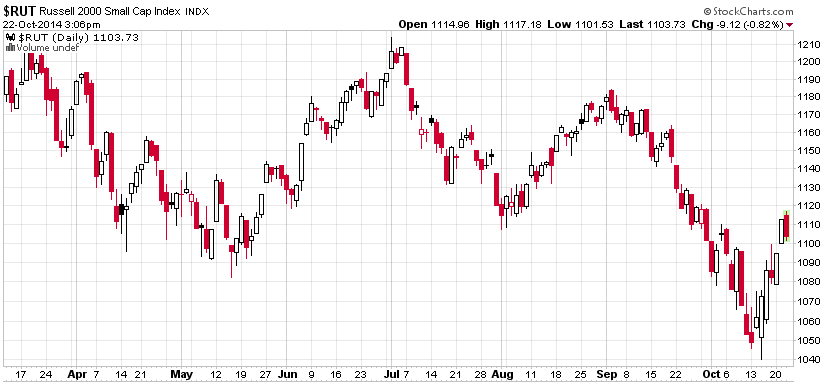
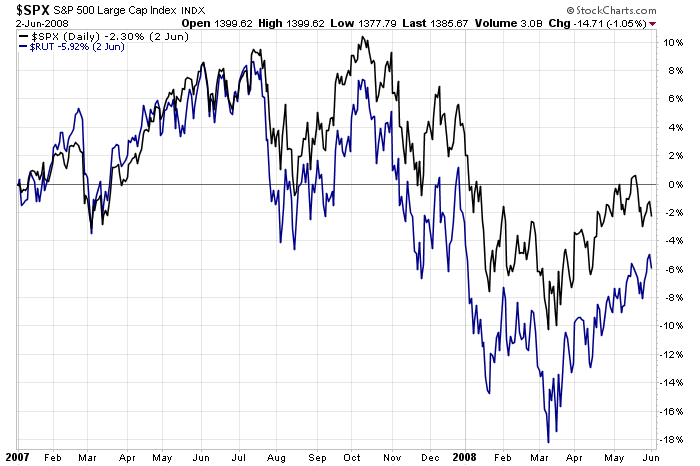
That may sound familiar as the stock market has done the same thing… and if your portfolio just tracks that market, so does your account. You may be “up” now, but that’s just because the market is “up”. What happens if the market goes down -50% again over the next few years? Will you have symmetry?

Image

Source: Nielsen Media Research