A Random Walker on Stock and Bond Valuation

Burton Malkiel is a passive buy and hold investor who believes markets are random. To believe markets are random is to believe there are no directional trends, or high or low valuations. He is the author of “A Random Walk Down Wall Street“.  But in today’s Wall Street Journal even the ” Random Walker” sees that stock valuations are high and future expected returns low, but believes if there is a bubble it’s in bonds.

By

BURTON G. MALKIEL

June 1, 2015 6:58 p.m. ET

“Stock valuations are well above their average valuation metrics of the past, and future returns are likely to be below historical averages. But even as Ms. Yellen talks of gradually ending the Fed’s near-zero interest rate policy, interest rates remain well below historical norms. If there is a market bubble today, it is in the bond market and the Fed is complicit in the “overvaluation.”

Source: http://www.wsj.com/articles/janet-yellen-is-no-stock-market-sage-1433199503

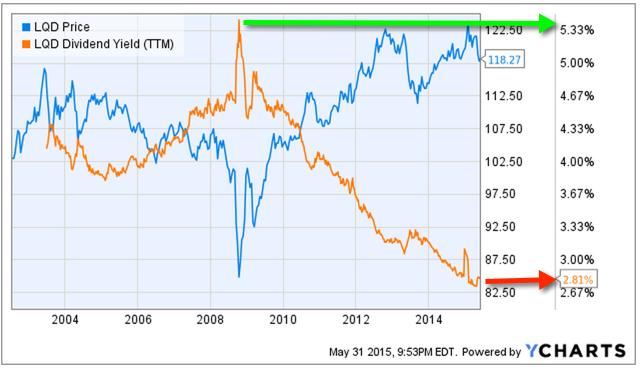
When someone invests in bonds for the long term they mainly intend to earn interest. So, bond investors want to buy bonds when yields are high. In the chart below, I show the iShares iBoxx $ Investment Grade Corporate Bond index ETF that seeks to track the investment results of an index composed of U.S. dollar-denominated, investment grade corporate bonds. The blue line is its price trend, the orange line is the index yield. We observe the highest yield was around 5.33% during a spike in 2008 when the price declined. Fixed income has interest-rate risk. Typically, when interest rates rise, there is a corresponding decline in bond values. Since 2008, interest rates and the yield of this bond index has declined. Clearly, the rate of “fixed income” from bonds depends on when you buy them. Today, the yield is only 2.8%, so for “long term allocations” bonds aren’t nearly as attractive as they where.

bond yield valuation bubble
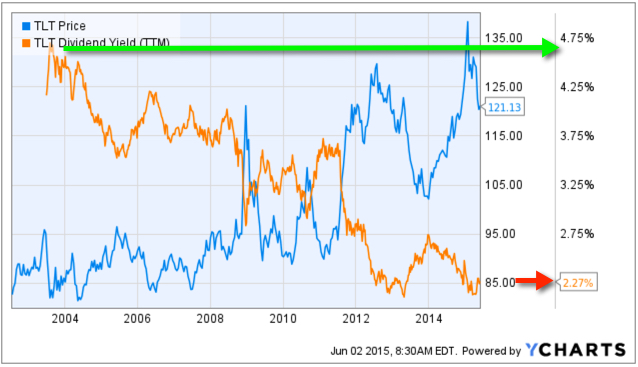
Another observation is the iShares 20+ Year Treasury Bond ETF, which seeks to track the investment results of an index composed of U.S. Treasury bonds with remaining maturities greater than twenty years. So, this index is long term government bonds. Below we see its yield was 4.75% a decade ago and is now only 2.27%. Buying it to get a 4.75% yield is a very different expected return than 2.27%.

Long term treasury yield valuation spreads asymmetry

However, that doesn’t mean we can’t tactically rotate between these bond markets trying to capture price trends rather than allocate to them.

Chart source: http://www.ycharts.com

Seasonal Alpha? The Real Probability and Expectation of “Sell in May and Go Away”

Here is the trouble with a seasonal strategy. According to Standard & Poors, the S&P 500 has gained 1.05 % in May, though it was a volatile month. So, “sell in May and go away” just missed out for no other reason other than it was May.

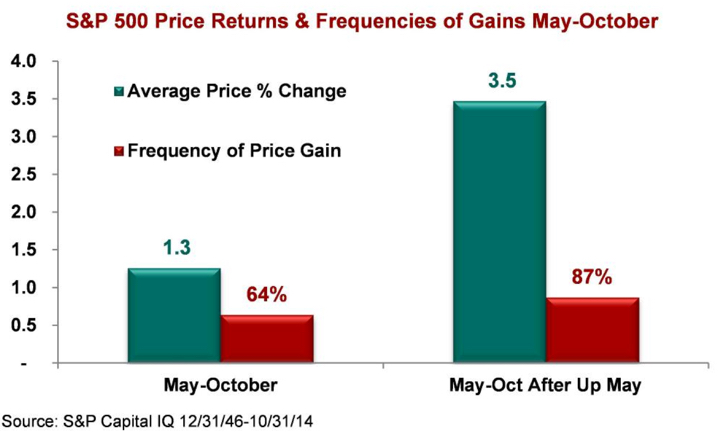
The second problem is best explained in the chart below. According to Standard & Poors, since 1946 (68 years) the S&P 500 has actually been positive during the “sell in May and go away” period May – October 64% of the time with an average gain of 1.3%. So, the expectation for the period is actually a positive return of .83% May to October.

Seasonal Sell in May and Go Away Strategy

Another interesting observation in the chart is after a positive “up” May, the May to October period tends to increase 87% of the time an average of 3.5%. So, the expectation is 3.04%. Based on the probability and expectation, we would expect 2% more through October. Of course, the trouble is this stock index is trading at 27 times EPS which is overvalued territory, so this time could instead be the 13% of the time it declines instead, but the probability and expectation is what it is and we want to invest with it, not against it. I would rather focus on the actual direction of trends rather than what month it is.

One month or series of months is an arbitrary time frame, which is why a strategy based on specific time frames like “Sell in May and Go Away” are arbitrary – no matter what story is told to make it sound good.

This May it turned out it most of the other global markets were down materially in May like the Emerging Markets index -4.1%, Commodity Index -2.17%, and even the iShares iBoxx $ Investment Grade Corporate Bond declined -1.12%. So, anyone who was globally positioned across multiple markets during May did experience declines. Those who shifted from the S&P 500 index to bonds at the beginning of May actually lost what the stock index gained…

I prefer to focus on the actual direction of global price trends, no matter when they are. You can see what that looks like here.

On Actively Managing Risk… and Persistence

Don't beg anyone to get on the ark just keep building and let everyone know the rain is coming

Source: https://image-store.slidesharecdn.com/c3d3d5ae-e2eb-4e80-9d4c-88e2344b5572-original.jpeg

I just keep doing what I do…

Where is the Inflation?

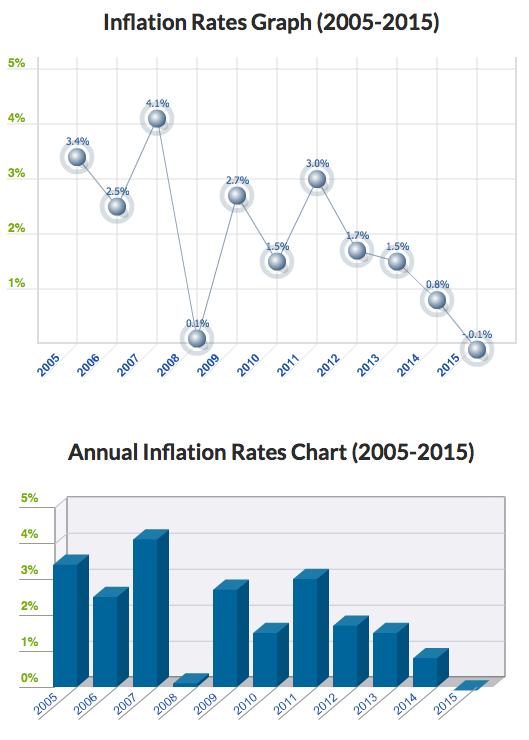
In How does monetary policy influence inflation and employment? and bond prices… I pointed out that even the Fed expected their monetary policy to eventually lead to inflation. The problem with economics and economist is they expect a cause and effect, and often their expectations don’t come true. Remember all those newsletters advising to buy gold the last several years? Gold trended up a while, then down. Applying a good trend system to gold may have made money from it, but buying and holding gold is probably a loser. Inflation was supposed to go up and gold was supposed to be a shelter. However, inflation has instead trended down: The U.S. Inflation Calculator  presents it best:

Current US Inflation Rates: 2005-2015

The latest inflation rate for the United States is -0.1% through the 12 months ended March 2015 as published by the US government on April 17, 2015. The next update is scheduled for release on May 22, 2015 at 8:30 a.m. ET. It will offer the rate of inflation over the 12 months ended April 2015.

The chart, graph and table below displays annual US inflation rates for calendar years 2004-2014. Rates of inflation are calculated using the current Consumer Price Index published monthly by the Bureau of Labor Statistics (BLS). For 2015, the most recent monthly data (12-month based) will be used in the chart and graph.

Historical inflation rates are available from 1914-2015. If you would like to calculate accumulated rates between different dates, the US Inflation Calculator will do that quickly.

Inflation Rate 2015-05-04_19-44-49

Source: http://www.usinflationcalculator.com/inflation/current-inflation-rates/

However, as you can see in the chart, like market prices, economic data trends directionally too. This trend of declining inflation may continue or it may reverse.

How does monetary policy influence inflation and employment? and bond prices…

Straight from the Federal Reserve website titled How does monetary policy influence inflation and employment?

In the short run, monetary policy influences inflation and the economy-wide demand for goods and services–and, therefore, the demand for the employees who produce those goods and services–primarily through its influence on the financial conditions facing households and firms. During normal times, the Federal Reserve has primarily influenced overall financial conditions by adjusting the federal funds rate–the rate that banks charge each other for short-term loans. Movements in the federal funds rate are passed on to other short-term interest rates that influence borrowing costs for firms and households. Movements in short-term interest rates also influence long-term interest rates–such as corporate bond rates and residential mortgage rates–because those rates reflect, among other factors, the current and expected future values of short-term rates. In addition, shifts in long-term interest rates affect other asset prices, most notably equity prices and the foreign exchange value of the dollar. For example, all else being equal, lower interest rates tend to raise equity prices as investors discount the future cash flows associated with equity investments at a lower rate.

In turn, these changes in financial conditions affect economic activity. For example, when short- and long-term interest rates go down, it becomes cheaper to borrow, so households are more willing to buy goods and services and firms are in a better position to purchase items to expand their businesses, such as property and equipment. Firms respond to these increases in total (household and business) spending by hiring more workers and boosting production. As a result of these factors, household wealth increases, which spurs even more spending. These linkages from monetary policy to production and employment don’t show up immediately and are influenced by a range of factors, which makes it difficult to gauge precisely the effect of monetary policy on the economy.

Monetary policy also has an important influence on inflation. When the federal funds rate is reduced, the resulting stronger demand for goods and services tends to push wages and other costs higher, reflecting the greater demand for workers and materials that are necessary for production. In addition, policy actions can influence expectations about how the economy will perform in the future, including expectations for prices and wages, and those expectations can themselves directly influence current inflation.

In 2008, with short-term interest rates essentially at zero and thus unable to fall much further, the Federal Reserve undertook nontraditional monetary policy measures to provide additional support to the economy. Between late 2008 and October 2014, the Federal Reserve purchased longer-term mortgage-backed securities and notes issued by certain government-sponsored enterprises, as well as longer-term Treasury bonds and notes. The primary purpose of these purchases was to help to lower the level of longer-term interest rates, thereby improving financial conditions. Thus, this nontraditional monetary policy measure operated through the same broad channels as traditional policy, despite the differences in implementation of the policy.

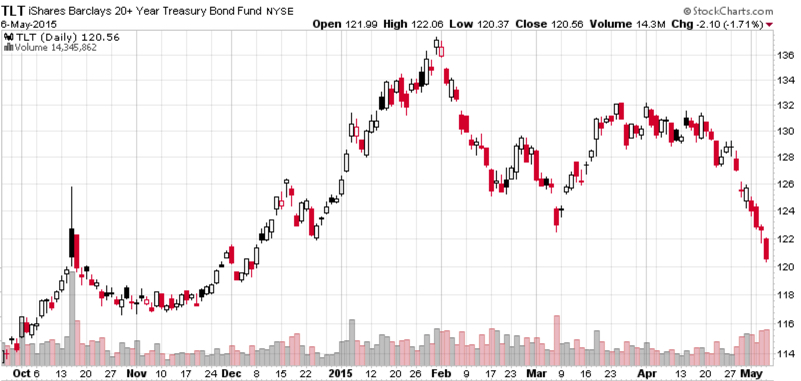
Up until now, the Long Term Treasury bond has typically gained in price on days the U.S. stock market is down. The recent price action may be a sign of changing inter-market dynamics between the Long Term Treasury and U.S. Stocks now that the Fed isn’t buying these bonds as they have for several years. As you can see in the chart below, the iShares Barclays 20+ Year Treasury Bond Index was down -1.7% today as stocks were also down. It’s also in a shorter term downtrend since January. This could be a sign that may not offer the “crutch” for falling stocks they have in the past. In the next bear market, bonds may go down too.

TLT long term treasury

Created with http://www.stockcharts.com


Recent Observations: Stock Market, Volatility, Absolute Returns

In case you missed them, here is a list of popular observations I’ve shared recently:

This is When MPT and VaR Get Asset Allocation and Risk Measurement Wrong

A Tale of Two Conditions for U.S. and International Stocks: Before and After 2008

Absolute Return: an investment objective and strategy

Asymmetric Nature of Losses and Loss Aversion

Why So Stock Market Focused?

What About the Stock Market Has Changed? A Look at Ten Years of Volatility

Diversification Alone is No Longer Sufficient to Temper Risk…

Top Traders Unplugged Interview with Mike Shell: Episode 1 & 2

Asymmetric Sector Exposure in Stock Indexes

My 2 Cents on the Dollar, Continued…

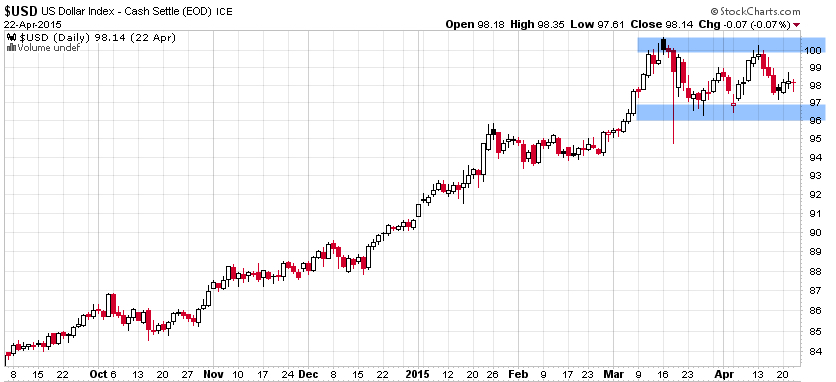
In My 2 Cents on the Dollar I explained how the U.S. Dollar is a significant driver of returns of other markets. For example, when the U.S. Dollar is rising, commodities like gold, oil, and foreign currencies like the Euro are usually falling. A rising U.S. Dollar also impacts international stocks priced in U.S. Dollars. When the U.S. Dollar trends up, many international markets priced in U.S. Dollars may trend down (reflecting the exchange rate). Many trend followers and global macro traders are likely “long the U.S. Dollar” by being long and short other markets like commodities, international stocks, or currencies.

Below was the chart from My 2 Cents on the Dollar last week to show the impressive uptrend and since March a non-trending indecisive period. After such a period, I suggested the next break often determines the next directional trend.

dollar trend daily 2015-04-23_16-05-04

Chart created by Shell Capital with: http://www.stockcharts.com

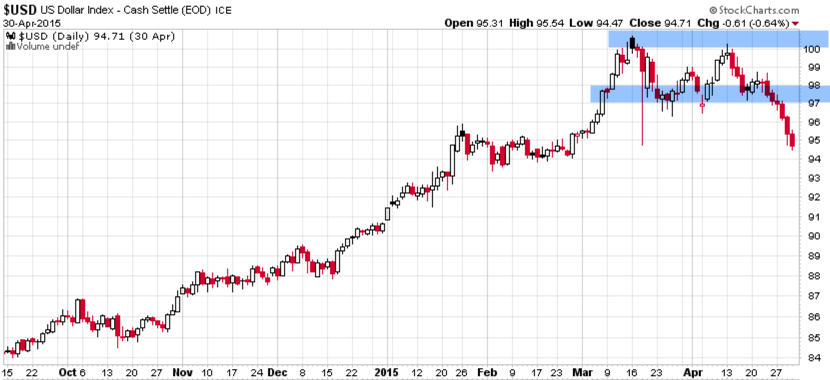
Keep in mind, this is looking closely at a short time frame within a larger trend. Below is the updated chart today, a week later. The U.S. Dollar did break down so far, but by my math, it’s now getting to an even more important point that will distinguish between a continuation of the uptrend or a reversal. This is the point where it should reverse back up, if it’s going to continue the prior uptrend.

U.S. Dollar

Chart created by Shell Capital with: http://www.stockcharts.com

This is a good example of understanding what drives reward/risk. I consider how long the U.S. Dollar I am (by being synthetically long/short other markets) and how that may impact my positions if the trend were to reverse. It’s a good time to pay attention to it to see if it breaks back out to the upside to resume the uptrend, or if it instead breaks down to end it.

That’s my two cents on the Dollar… How long are you?

Why So Stock Market Focused?

Most investors and their advisors seem to speak mostly about the stock market. When they mention “the market” and I ask “what market?” they always reply “the stock market”.

Why so stock market centric?

It must be that it gets the most media attention or stocks seem more exciting?. After all, other markets like bonds may seem boring and few know much about the many commodities markets or the foreign exchange markets. There are many different markets and two sides to them all.

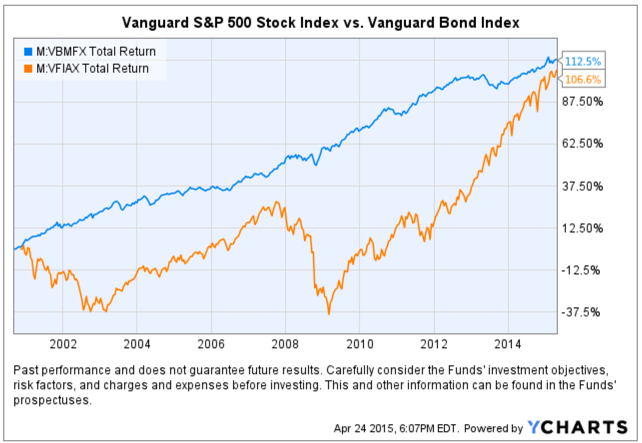
If it’s risk-adjusted returns you want, you may be surprised to find where you should have invested your money the past 15 years. To make the point, below is a comparison of the total return of the Vanguard S&P 500 stock index (the orange line) compared to the Vanguard Bond Index (the blue line). Yes, you are seeing that correctly. Using these simple index funds as a proxy, bonds have achieved the same total return as stocks, but with significantly less volatility and drawdowns. This is why we never look at just “average” return data without considering the path it took to get there. A total return percentage gain chart like this one presents a far more telling story. Take a close look at the path they took.

stocks vs. bonds

Created with http://www.ycharts.com

I showed the chart to one investment advisor who commented “It looks like the stock market is catching up”. If that’s what you think of when you view the chart, you may have a bias blind spot: ignoring the vast difference in the risk between the two markets.

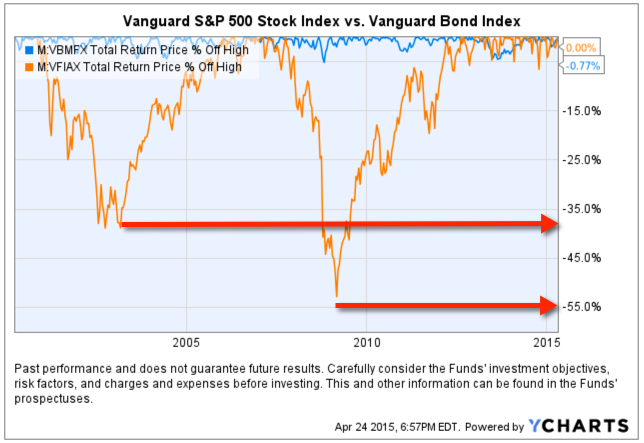
Looking at the total return over the period identifies the obvious difference in the path the two return streams took to achieve their results, but below we see the true risk difference. Drawdowns are declines from a higher value to a low value and a visual representation of how long it took to recover the lose of capital. When we observe a drawdown chart like the one below, it’s like a lake. These charts together also help illustrate the flaw of averages. The average return of the stock and bond index have ended at about the same level and have the same average return, but the bond index achieved it with much less drawdown. You wouldn’t know that if you only looked at average returns. If you tried to walk across the stock market lake, you may have drowned if you couldn’t handle swimming in 40′ of water for so long. If that one didn’t get you, the 55′ may have. The stock index declined about -40% from 2000 – 2002 and took years to recover before it declined -55%.

stock and bond market risk historical drawdowns

Created with http://www.ycharts.com

You have to be wondering: why didn’t you just invest in bonds 15 years ago? Maybe you were focused on the prior period huge average returns in stocks?

Before I continue, let me place a very bold disclaimer here: PAST PERFORMANCE DOES NOT GUARANTEE FUTURE RESULTS. Another way that is stated is that PAST PERFORMANCE IS NO ASSURANCE OF FUTURE RESULTS. One more version is PAST PERFORMANCE MAY NOT BE AN INDICATION OF FUTURE RESULTS. If you remember, the 1990’s were a roaring bull market in stocks. People focus on the past expecting it to continue. That’s probably why you never thought to invest in bonds instead of stocks.

Some of the largest and most successful hedge funds in the world have done that very thing over this period and longer. But, they didn’t just invest in bonds. They leveraged bonds. We’ve seen in this example that a bond index fund has achieved just as much total return as stocks. If you are a stock market centric investor: one that likes the stock market and makes it your focus, then you necessarily had to be willing to endure those -40% to -55% declines and wait many years to recover from the losses. If you are really willing to accept such risk, imagine if you had used margin to leverage bonds. The bond index rarely declined -10% or more. It was generally a falling interest rate period, so bonds gained value. If you were willing to accept -40% to -55% declines in stocks, you could have instead leveraged the bonds 400% or 500%. If you had done that, your return would be 4 or 5 times more with a downside more equal to that of stocks.

Why so stock centric?

Of course, at this stage, the PAST PERFORMANCE IS HIGHLY UNLIKELY TO REPEAT INTO THE FUTURE. Just as the roaring stocks of the 1990’s didn’t repeat. To see why, read Stage and Valuation of the U.S. Stock Market and Bonds: The Final Bubble Frontier?.

From my observations of investors performance and their advisors, most people seem to have poor results the past decade or so, even after this recent bull market. An investment management consultant told me recently that investors and their advisors who are aware of the current stage of stocks and bonds feel there is no place to turn. I believe it’s a very important time to prepare to row, not sail. For me, that means focus on actively managing risk and look for potentially profitable trends across a very global universe of markets; currency, bonds, stocks, commodities, and alternatives like volatility, inverse, etc . That’s my focus in ASYMMETRY® | Managed Accounts.

Stage and Valuation of the U.S. Stock Market

In The REAL Length of the Average Bull Market last year I pointed out different measures used to determine the average length of a bull market. Based on that, whether you believe the average bull market lasts 39 months, 50 months, or 68 months, it seems the current one is likely very late in its stage at 73 months. It’s one of the longest, ever.

I normally don’t consider valuations levels like P/E ratios, but they do matter when it comes to secular bull and bear markets (10 to 20 year trends). That’s because long-term bull markets begin at low valuation levels (10 or below) and have ended at historically high levels (around 20). Currently, the S&P 500 is trading at 27. That, along with the low dividend yield, suggests the expected return for holding that index going forward is low.

Ed Easterling of Crestmont Research explains it best:

The stock market gyrated since the start of the year, ending the first quarter with a minimal gain of 0.4%. As a result, normalized P/E was virtually unchanged at 27.3—well above the levels justified by low inflation and interest rates. The current status remains near “significantly overvalued.”

In addition, the forecast by Standard and Poor’s for 2015 earnings per share (EPS) recently took a nosedive, declining 17% during one week in the first quarter. Volatility remains unusually low in its cycle. The trend in earnings and volatility should be watched closely and investors should remain cognizant of the risks confronting an increasingly vulnerable market.

Source: The P/E Report: Quarterly Review Of The Price/Earnings Ratio By Ed Easterling April 4, 2015 Update

It’s always a good time to actively manage risk and shift between global markets rather than allocate to them. To see what that looks like, visit: http://www.asymmetrymanagedaccounts.com/global-tactical/

The Volatility Index (VIX) is Getting Interesting Again

In the last observation I shared on the CBOE Volatlity index (the VIX) I had been pointing out last year the VIX was at a low level and then later started trending up. At that time, many volatility traders seemed to think it was going to stay low and keep going lower – I disagreed. Since then, the VIX has remained at a higher average than it had been – up until now. You can read that in VIX® gained 140%: Investors were too complacent.

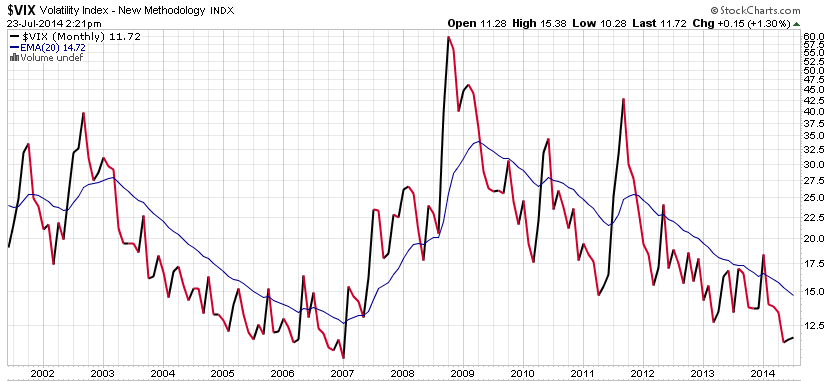
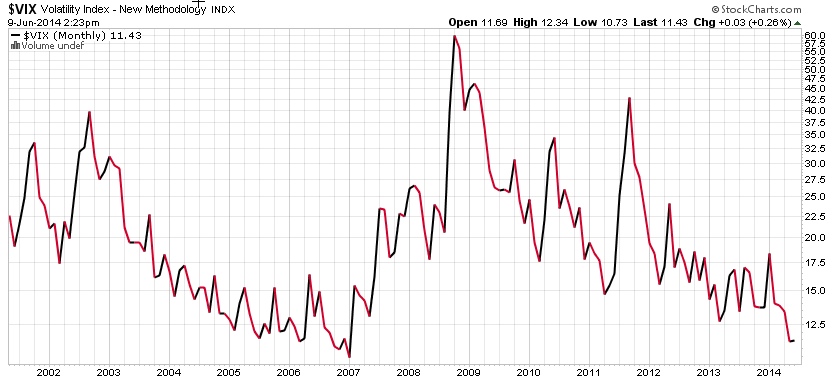
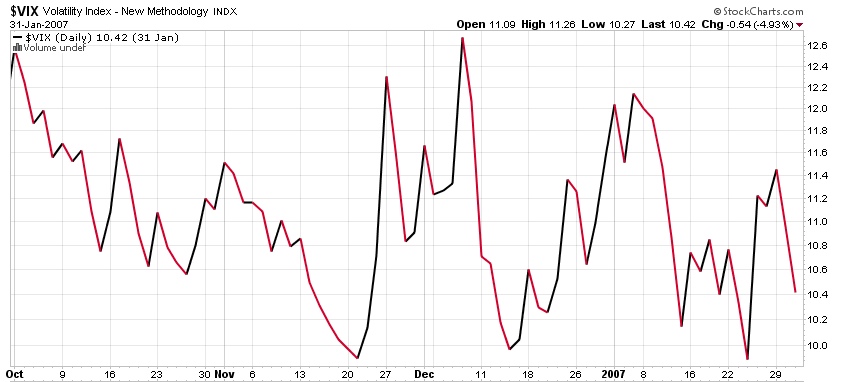
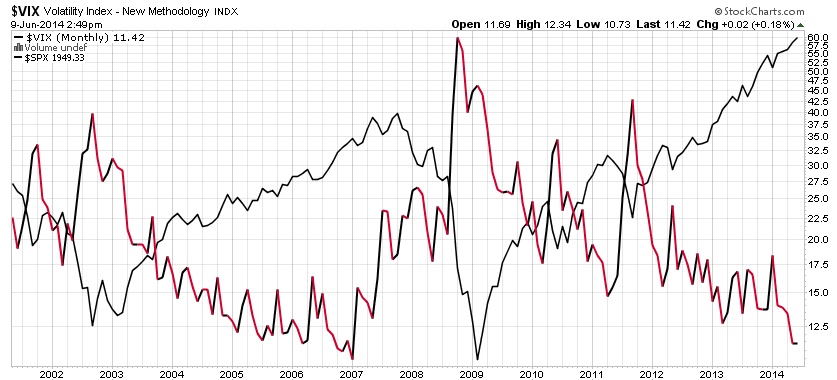
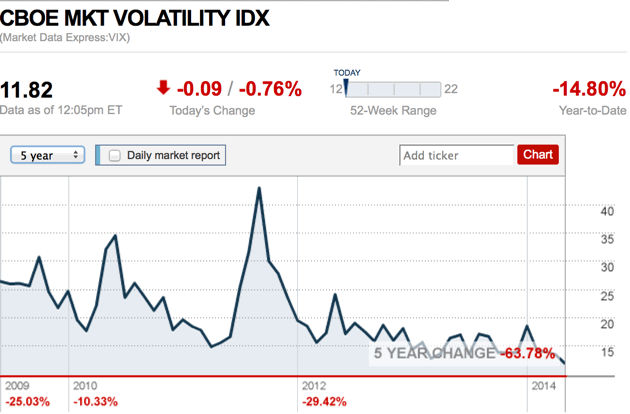
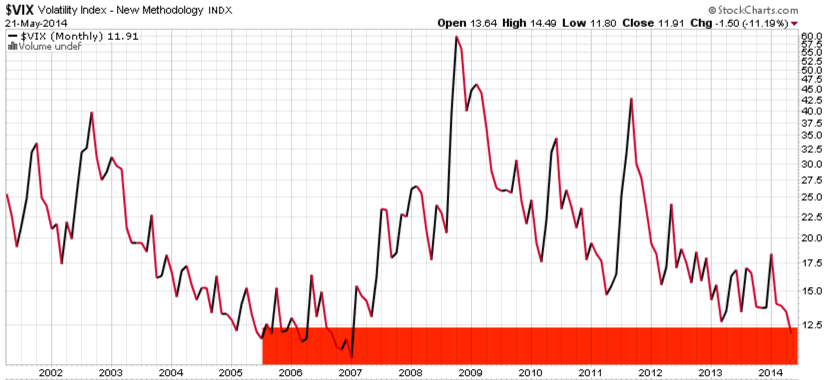
Here it is again, closing at 12.45 yesterday, a relatively low level for expected volatility of the S&P 500 stocks. Investors get complacent after trends drift up, so they don’t price in so much fear in options. Below we observe a monthly view to see the bigger picture. The VIX is getting down to levels near the end of the last bull market (2007). It could go lower, but if you look closely, you’ll get my drift.

Chart created by Shell Capital with: http://www.stockcharts.com

Next, we zoom in to the weekly chart to get a loser look.

Chart created by Shell Capital with: http://www.stockcharts.com

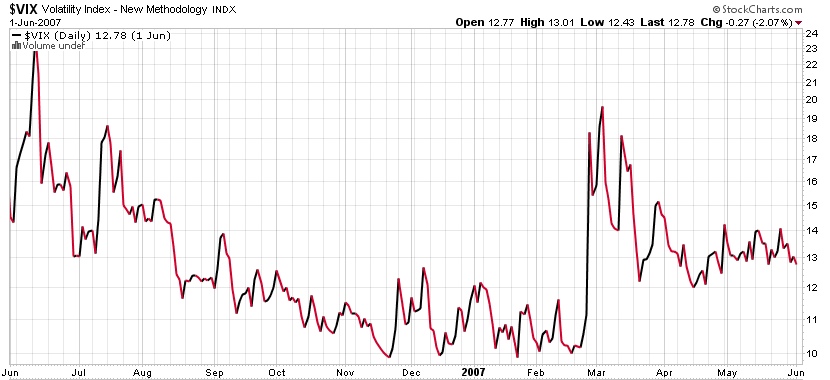
Finally, the daily chart zooms in even more.

Chart created by Shell Capital with: http://www.stockcharts.com

The observation?

Options traders have priced in low implied volatility – they expect volatility to be low over the next month. That is happening as headlines are talking about stock indexes hitting all time highs. I think it’s a sign of complacency. That’s often when things change at some point.

It also means that options premiums are generally a good deal (though that is best determined on an individual security basis). Rather than selling premium, it may be a better time to buy it.

Let’s see what happens from here…

My 2 Cents on the Dollar

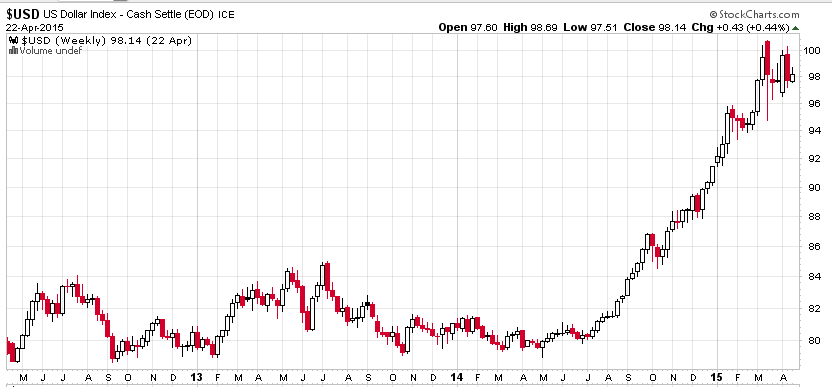
The U.S. Dollar ($USD) has gained about 20% in less than a year. We observe it first in the weekly below. The U.S. Dollar is a significant driver of returns of other markets. For example, when the U.S. Dollar is rising, commodities like gold, oil, and foreign currencies like the Euro are usually falling. A rising U.S. Dollar also impacts international stocks priced in U.S. Dollar. When the U.S. Dollar trends up, many international markets priced in U.S. Dollars may trend down (reflecting the exchange rate). The U.S. Dollar may be trending up in anticipation of rising interest rates.

dollar trend weekly 2015-04-23_16-04-40

Chart created by Shell Capital with: http://www.stockcharts.com

Now, let’s observe a shorter time frame- the daily chart. Here we see an impressive uptrend and since March a non-trending indecisive period. Many trend followers and global macro traders are likely “long the U.S. Dollar” by being long and short other markets like commodities, international stocks, or currencies.

dollar trend daily 2015-04-23_16-05-04

Chart created by Shell Capital with: http://www.stockcharts.com

This is a good example of understanding what drives returns and risk/reward. I consider how long the U.S. Dollar I am and how that may impact my positions if this uptrend were to reverse. It’s a good time to pay attention to it to see if it breaks back out to the upside to resume the uptrend, or if it instead breaks down to end it. Such a continuation or reversal often occurs from a point like the blue areas I highlighted above.

That’s my two cents on the Dollar…

How long are you? Do you know?

Conflicted News

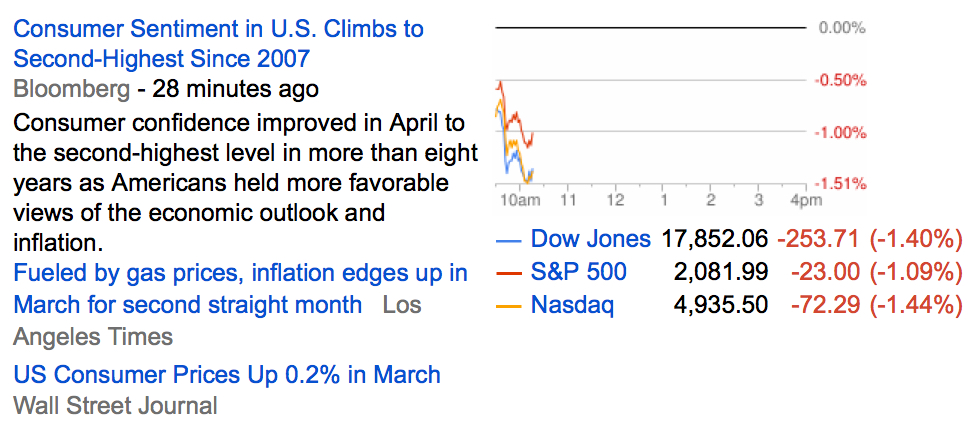
This is a great example of conflicted news. Which news headline is driving down stock prices today?

Below is a snapshot from Google Finance::

conflicted news 2015-04-17_10-21-43

Trying to make decisions based on news seems a very conflicted way, which is why I instead focus on the absolute direction of price trends.

Asymmetric Returns of World Markets YTD

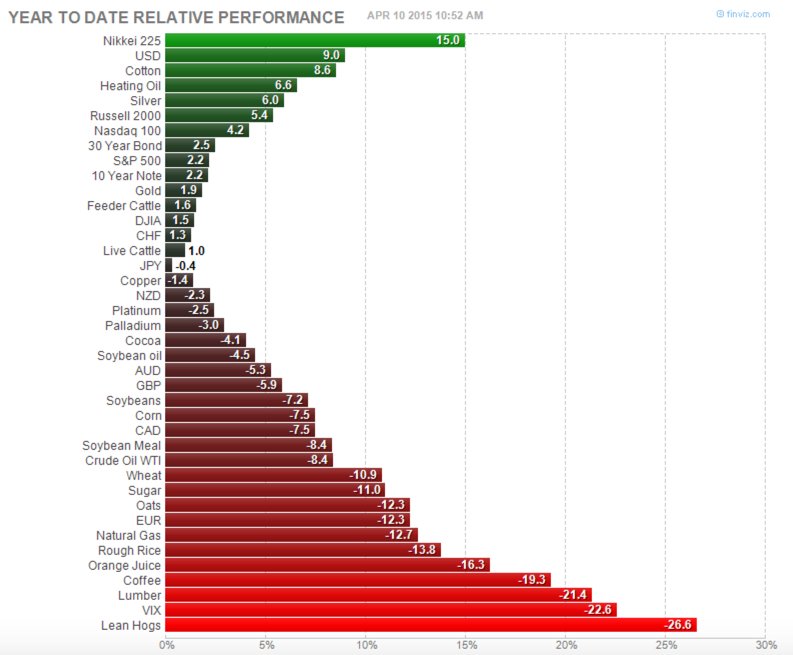
As of today, global stock, bond, commodity markets are generating asymmetric returns year to date. The graph below illustrates the asymmetry is negative for those who need these markets to go “up”.

Asymmetric Returns of World Markets 2015-04-10_10-52-47

source: http://finviz.com


Asymmetric Nature of Losses and Loss Aversion

Loss Aversion:

“In prospect theory, loss aversion refers to the tendency for people to strongly prefer avoiding losses than acquiring gains. Some studies suggest that losses are as much as twice as psychologically powerful as gains. Loss aversion was first convincingly demonstrated by Amos Tversky and Daniel Kahneman.”

For most people, losing $100 is not the same as not winning $100. From a rational point of view are the two things the same or different?

Most economists say the two are the same. They are symmetrical. But I think that ignores some key issues.

If we have only $10 to eat on today and that’s all we have, if we lose it, we’ll be in trouble: hungry.

But if we have $10 to eat on and flip a coin in a bet and double it to $20, we may just eat a little better. We’ll still eat. The base rate: survival.

They say rationally the two are the same, but that isn’t true. They aren’t the same. The loss makes us worse off than we started and it may be totally rational to feel worse when we go backward than we feel good about getting better off. I don’t like to go backward, I prefer to move forward to stay the same.

Prospect Theory, which found people experience a loss more than 2 X greater than an equal gain, discovered the experience of losses are asymmetric.

Actually, the math agrees.

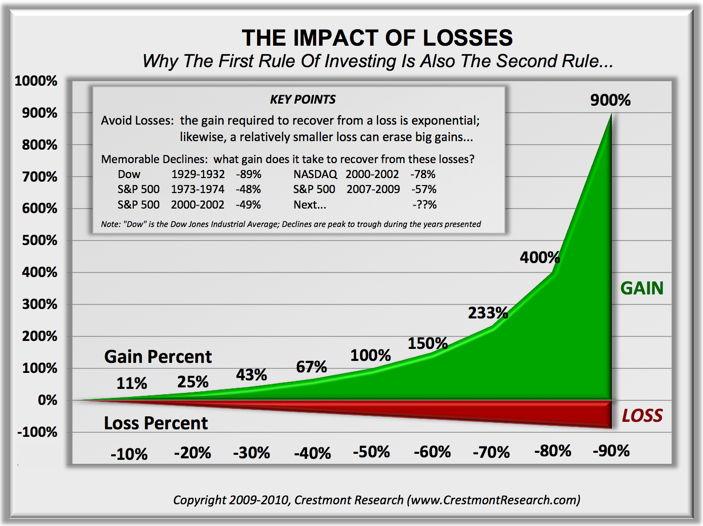
You see, losing 50% requires a 100% gain to get it back. Losing it all is even worse. Losses are indeed asymmetric and exponential on the downside so it may be completely rational and logical to feel the pain of losses asymmetrically. Experience the feeling of loss aversions seems to be the reason a few of us manage investment risk and generate a smoother return stream rather than blow up.

To see what the actual application of asymmetry to portfolio management looks like, see: Shell Capital Management, LLC.


asymmetry impact of loss

A Tale of Two Conditions for U.S. and International Stocks: Before and After 2008

In recent conversations with investment advisors, I notice their sentiment has shifted from “cautious and concerned” about world equity markets to “why have they underperformed”. Prior to 2013, most investors and investment advisors were concerned about another 2007 to 2009 level bear market. Now, it seems that caution has faded. Today, many of them seem to be focused on the strong trend of U.S. stocks since mid-2013 and comparing everything else to it.

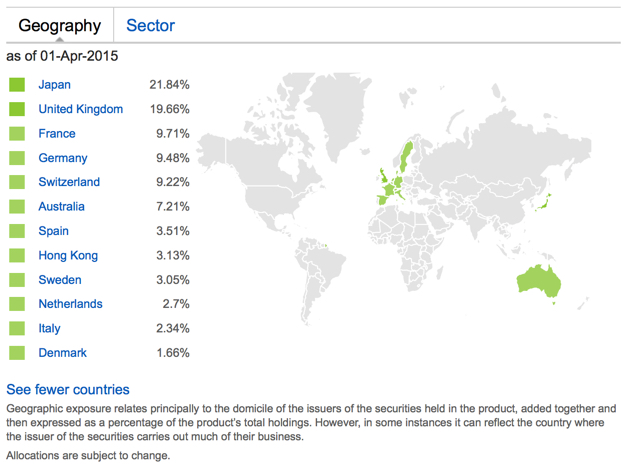
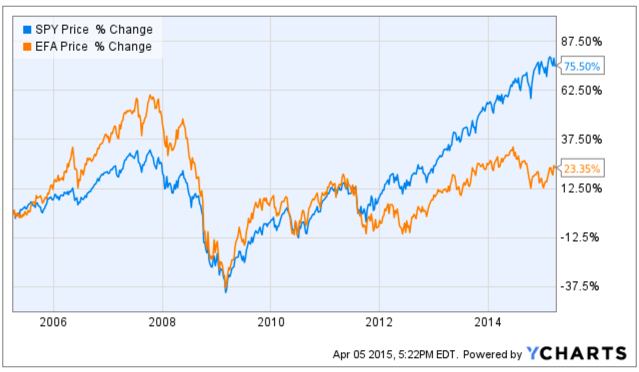
Prior to October 2007, International stocks were in significantly stronger positive directional trends than U.S. Stocks. I’ll compare the S&P 500 stock index (SPY) to Developed International Countries (EFA). We can visually observe a material change between these markets before 2008 and after, but especially after 2013. That one large divergence since 2013 has changed sentiment.

The MSCI EAFE Index is recognized as the pre-eminent benchmark in the United States to measure international equity performance. It comprises the MSCI country indices that represent developed markets outside of North America: Europe, Australasia and the Far East. For a “real life” example of its price trend, I use the iShares MSCI EAFE ETF (EFA). Below are the country holdings, to get an idea of what is considered “developed markets”.

iShares MSCI EAFE ETF Developed Markets exposure 2015-04-05_17-14-43

Source: https://www.ishares.com/us/products/239623/EFA

Below are the price trends of the popular S&P 500 U.S. stock index and the MSCI Developed Countries Index over the past 10 years. Many investors may have forgotten how strong international markets were prior to 2008. Starting around 2012, the U.S. stock market continued to trend up stronger than international stocks. It’s a tale of two markets, pre-2008 and post-2008.

Developed Markets International stocks trend 2015-04-05_17-22-22

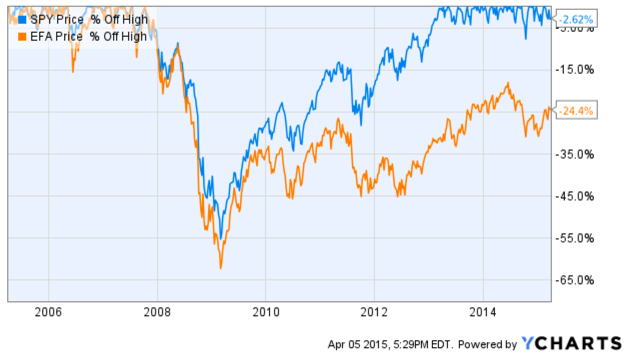
No analysis of a trend % change is complete without also examining its drawdowns along the way. A drawdown measures a drop from peak to bottom in the value of a market or portfolio (before a new peak is achieved). The chart below shows these indexes % off their prior highs to understand their historical losses over the period. For example, these indexes declined -55% or more. The International stock index nearly declined -65%. The S&P 500 U.S. stock index didn’t recover from its decline that started in October 2007 until mid-2012, 5 years later. The MSCI Developed Countries index is still in a drawdown! As you can see, EFA is -24% off it’s high reached in 2007. Including these international countries in a global portfolio is important as such exposure has historically provided greater potential for profits than just U.S. stocks, but more recently they have been a drag.

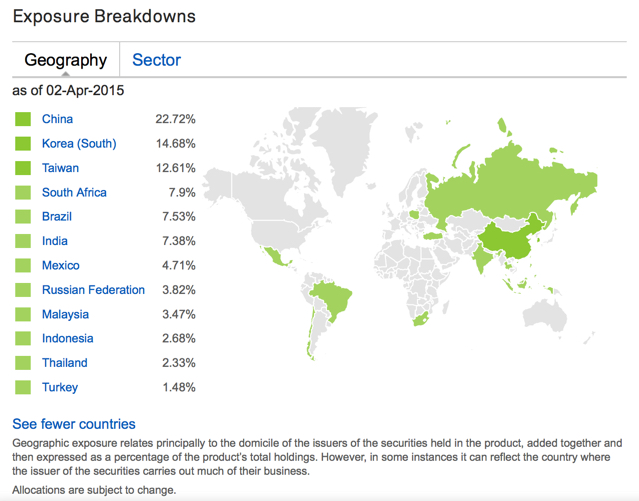
international markets drawdown 2015-04-05_17-30-00The International stock markets are divided broadly into Developed Markets we just reviewed and Emerging Countries. The iShares MSCI Emerging Markets ETF (EEM) tracks this index. To get an idea of which countries are considered “Emerging Markets’, you can see the actual exposure below.

emerging countries markets 2015-04-05_17-13-31

https://www.ishares.com/us/products/239637/EEM?referrer=tickerSearch

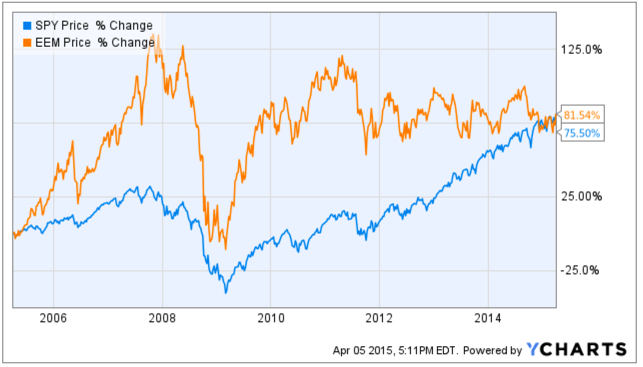
The Emerging Countries index has reached the same % change over the past decade, but they have clearly taken very different paths to get there. Prior to the “global crisis” that started late 2007, many investors may have forgotten that Emerging Markets countries like China and Brazil were in very strong uptrends. I remember this very well; as a global tactical trader I had exposure to these countries which lead to even stronger profits than U.S. markets during that period. Since 2009, however, Emerging Markets recovered sharply but as with U.S. stocks: they have trended up with great volatility. Since Emerging Markets peaked around 2011 they have traded in a range since. However, keep in mind, these are 10-year charts, so those swings up and down are 3 to 6 months. We’ll call that “choppy”. Or, 4 years of a non-trending and volatile state.

Emerging Markets trend 10 years 2015-04-05_17-21-06

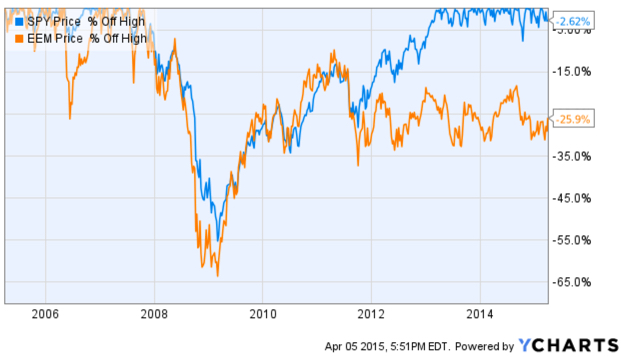
Once again, no analysis of a trend % change is complete without also examining its drawdowns along the way. A drawdown measures a drop from peak to bottom in the value of a market or portfolio (before a new peak is achieved). The chart below shows these indexes % off their prior highs to understand their historical losses over the period. For example, these indexes declined -55% or more. The Emerging Market stock index declined -65%. The S&P 500 U.S. stock index didn’t recover from its decline that started in October 2007 until mid-2012, 5 years later. The MSCI Emerging Countries index is still in a drawdown! As you can see, EFA is -26% off it’s high reached in 2007. As I mentioned before, it recovered sharply up to 2011 but has been unable to move higher in 4 years. Including these Emerging Markets countries in a global portfolio is important as such exposure has historically provided greater potential for profits than just U.S. stocks, but more recently they have been a drag.

emerging markets drawdown 2015-04-05_17-52-19

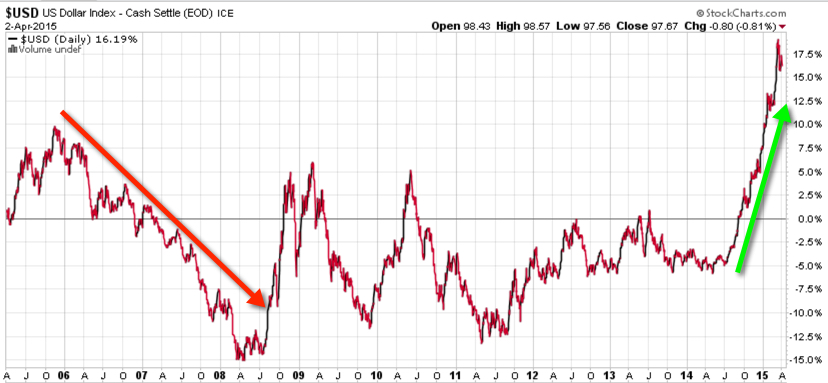
Wondering why the tale of two markets before and after 2008? The are many reasons and return drivers. One of them can be seen visually in the trend of the U.S. Dollar. Below is a 10-year price chart of the U.S. Dollar index. Before 2008, the U.S. Dollar was falling, so foreign currencies were rising as were foreign stocks priced in Dollars. As with most world markets, even the U.S. Dollar was very volatile from 2008 through 2011. After 2011 it drifted in a tighter range through last year and has since increased sharply.

Dollar impact on international stocks 2015-04-05_18-05-02

The funny thing is, I’ve noticed there are a lot of inflows into currency-hedged ETFs recently. Investors seem to do the wrong thing at the wrong time. For example, they’ll want to hedge their currency risk after it already happened, not before… It’s just like with options hedging: Investors want protection after a loss, not before it happens. Or, people will buy that 20 KW generator for their home after they lose power a few days, not before, and may not need it again for 5 years after they’ve stopped servicing it. So, it doesn’t start when they need it again.

You can probably see why I think it’s an advantage to understand how world markets interact with each other and it’s an edge for me.

Mike Shell is the Founder and Chief Investment Officer of Shell Capital Management, LLC, and the portfolio manager of ASYMMETRY® Global Tactical.

The observations shared on this website are for general information only and are not specific advice, research, or buy or sell recommendations for any individual. Investing involves risk including the potential loss of principal an investor must be willing to bear. Past performance is no guarantee of future results. The presence of this website on the Internet shall in no direct or indirect way raise an implication that Shell Capital Management, LLC is offering to sell or soliciting to sell advisory services to residents of any state in which the firm is not registered as an investment advisor. Use of this website is subject to its terms and conditions.

Absolute Return as an Investment Strategy

Absolute Return Investment Strategy Fund Manager

In “Absolute Return: The Basic Definition”, I explained an absolute return is the return that an asset achieves over a certain period of time. To me, absolute return is also an investment objective.

In “Absolute Return as an Investment Objective” I explained that absolute return is an investment objective is one that does not try to track or beat an arbitrary benchmark or index, but instead seeks to generate real profits over a complete market cycle regardless of market conditions. That is, it is focused on the actual total return the investor wants to achieve and how much risk the investor will willing to take, rather than a focus on what arbitrary market indexes do.

Absolute return as a strategy: absolute return is sometimes used to define an investment strategy. An absolute return strategy is a plan, method, or series of maneuvers aiming to compound capital positively and to avoid big losses to capital in difficult market conditions. Whereas Relative Return strategies typically measure their success in terms of whether they track or outperform a market benchmark or index, absolute return investment strategies aim to achieve positive returns irrespective of whether the prices of stocks, bonds, or commodities rise or fall over the market cycle.

Whether you think of absolute return as an objective or a strategy, it is a skill-based rather than market-based. That is, the absolute return manager creates his or her results through tactical decision-making as opposed to taking what the market is giving. One can employ a wide range of approaches toward an absolute return objective, from price-based trend following to fundamental analysis. In the ASYMMETRY® Managed Accounts, I believe price-based methods are more robust and lead to a higher probability of a positive expectation. Through my historical precedence, testing, and experience, I find that any fundamental type method that is based on something other than price has the capability to stray far enough from price to put the odds against absolute returns. That is, a manager buying what he or she believes is undervalued and selling short what he believes is overvalued can go very wrong if the position is on the wrong side of the trend. But price cannot deviate from itself. Price is the judge and the jury.

Of course, absolute return and the “All Weather” type portfolio sound great and seem to be what most investors want, but it requires incredible skill to execute. Most investors and advisors seem to underestimate the required skills and experience and most absolute return strategies and funds have very limited and unproven track records. There is no guarantee that these strategies and processes will produce the intended results and no guarantee that an absolute return strategy will achieve its investment objective.

For an example of the application of an absolute return objective, strategy, and return-risk profile,  visit http://www.asymmetrymanagedaccounts.com/

Asymmetric Sector Exposure in Stock Indexes

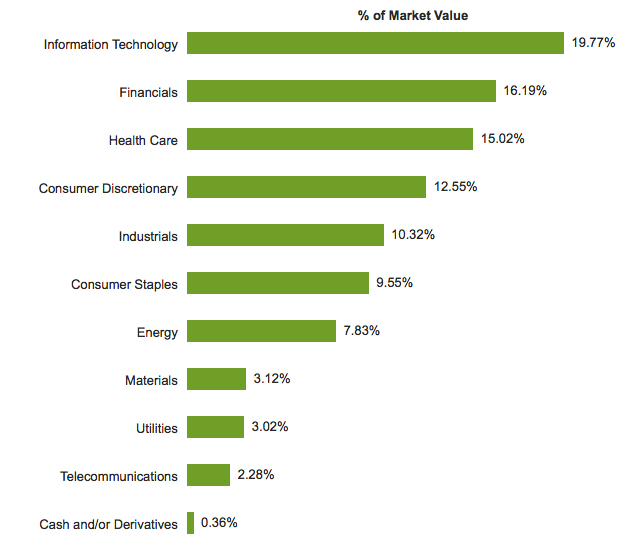
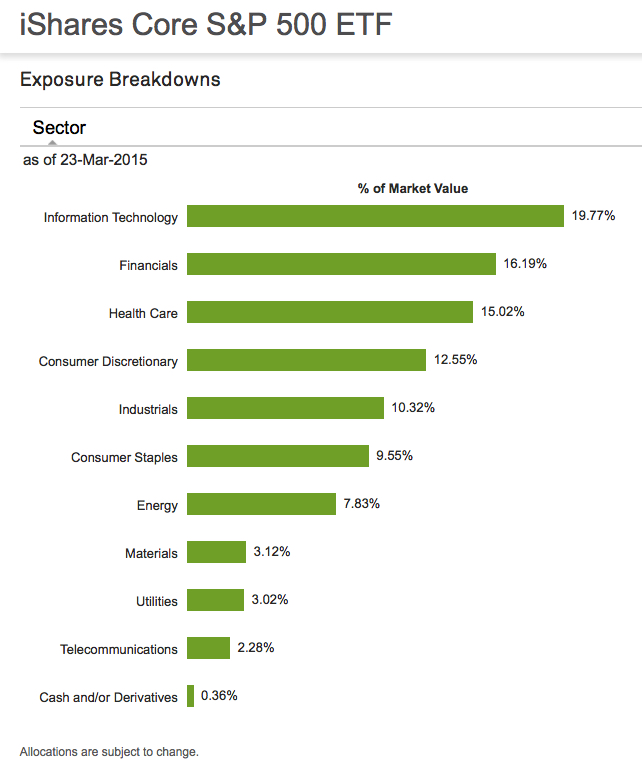
When you look at the table below and see the sector exposure percents, what do you observe? Do these allocations make sense?

asymmetric sector ETF expsoure S&P 500 2015-03-24_16-39-11

That is the sector exposure of the S&P 500 stock index: I used the iShares S&P 500 ETF for a real-world proxy. The source of each image is the index website on iShares, which you can see by clicking on the name of the index ETF.

  • Asymmetric is an imbalance. That is, more of one thing, less of another.
  • A sector is a specific industry, like Energy (Exxon Mobil) or Telecom (Verizon).
  • Exposure is the amount of the position size or allocation.

Most of the sector exposure in the S&P 500 large company stock index is Technology, Financials, Healthcare, and Consumer Discretionary. Consumer Staples, Energy, Materials, Utilities, and Telecommunications have less than 10% exposure each. Exposure to Materials, Utilities, and Telecommunications are almost non-existent. Combined, those three sectors are less than 10% of the index. Industrial has 10% exposure by itself.  But this index is 500 large companies, what about mid size and small companies?

asymmetric sector expsoure S&P 500 2015-03-24_16-39-11

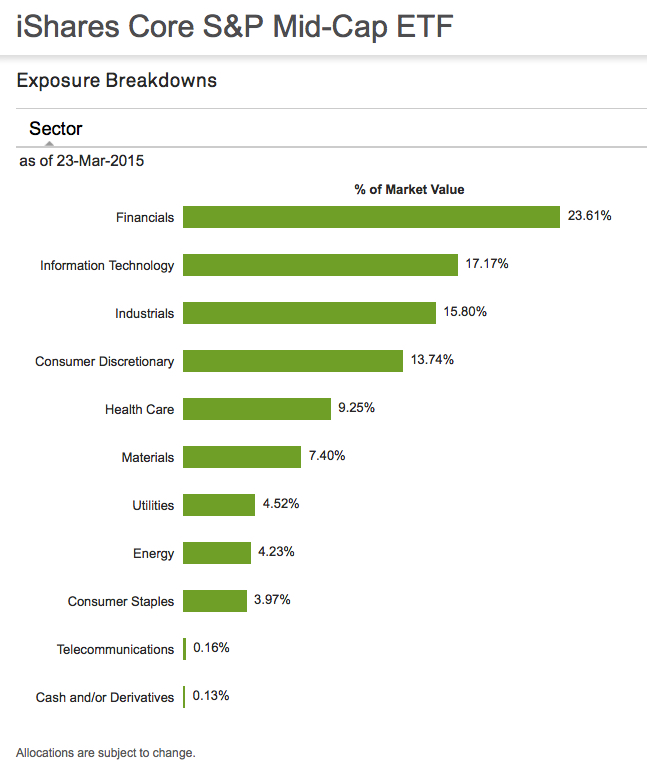
Below is the iShares Core S&P Mid-Cap ETF. Most of the sector exposure in the S&P Mid size stock index is Technology, Financials, Industrial. Healthcare, and Consumer Discretionary. Consumer Staples, Energy, Materials, Utilities, and Telecommunications have less than 10% exposure each. Exposure to Materials, Utilities, and Telecommunications are almost non-existent.

asymmetric sector exposure  S&P Mid-Cap ETF

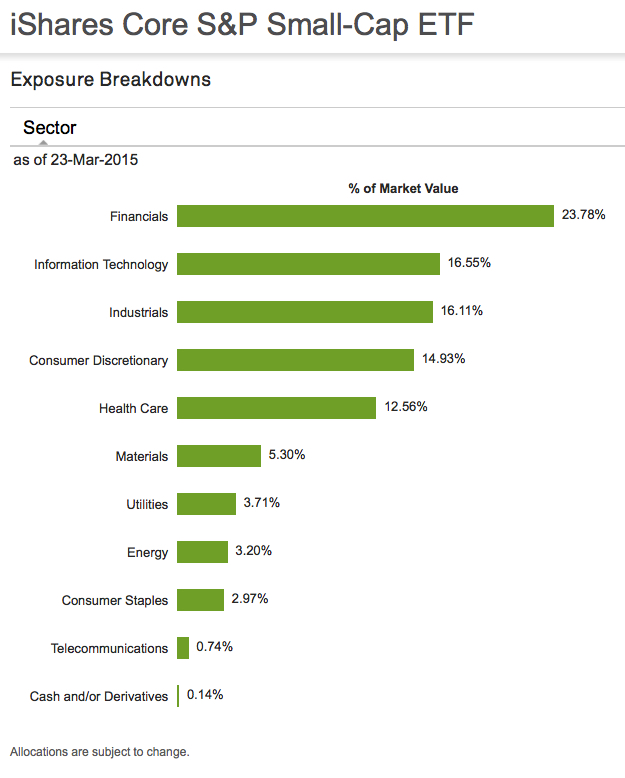
We see this same asymmetric sector exposure theme repeat in the iShares S&P Small Cap index. Half of the sectors are make up most of the exposure, the other very little.

asymmetric sector exposure S&P small cap

This is just another asymmetric observation… the next time you hear someone speak of the return of a stock index, consider they are really speaking about the return profile of certain sectors. And, these sector weightings may change over time.

US Government Bonds Rise on Fed Rate Outlook?

I saw the following headline this morning:

US Government Bonds Rise on Fed Rate Outlook

Wall Street Journal –

“U.S. government bonds strengthened on Monday after posing the biggest price rally in more than three months last week, as investors expect the Federal Reserve to take its time in raising interest rates.”

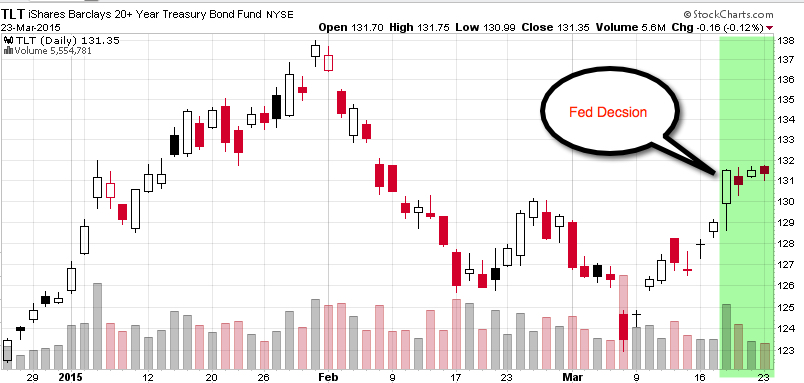
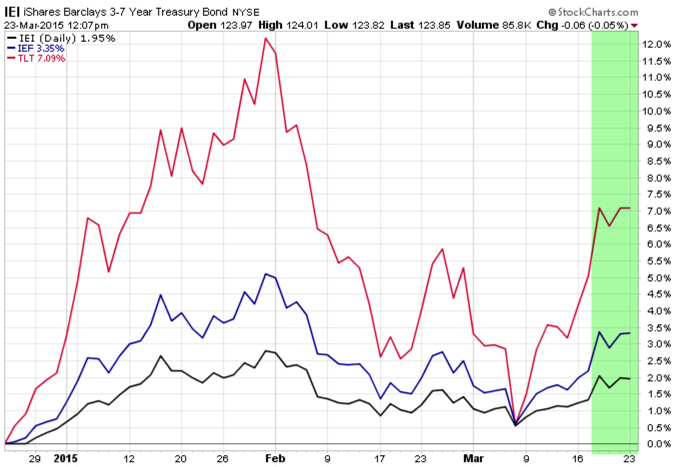
My focus is on directional price trends, not the news. I focus on what is actually happening, not what people think will happen. Below I drew a 3 month price chart of the 20+ Year Treasury Bond ETF (TLT), I highlighted in green the time period since the Fed decision last week. You may agree that most of price action and directional trend changes happened before that date. In fact, the long-term bond index declined nearly 2 months before the decision, increased a few weeks prior, and has since drifted what I call “sideways”.

fed decision impact on bonds
Charts created with http://www.stockcharts.com

To be sure, in the next chart I included an analog chart including the shorter durations of maturity. iShares 3-7 Year Treasury Bond ETF (IEI) and iShares 7-10 Year Treasury Bond ETF (IEF). Maybe there is some overreaction and under-reaction going on before the big “news”, if anything.

Government bonds Fed decision reaction
Do you still think the Fed news was “new information“?

Dazed and Confused?

Many investors must be dazed and confused by the global markets reaction to the Fed. I’m guessing most people would expect if the Fed signaled they are closer to a rate hike the stock and bond markets would fall. Rising interest rates typically drive down stocks along with bonds. Just the opposite has happened, so far.

Markets seems to have moved opposite of expectations, those people have to get on board (increasing demand).

A few things I wrote before and after the Fed decision:

A One-Chart Preview of Today’s Fed Decision: This is what economists are expecting

Fed Decision and Market Reaction: Stocks and Bonds

Trends, Countertrends, in the U.S. Dollar, Gold, Currencies

Trends, Countertrends, in the U.S. Dollar, Gold, Currencies

Trend is a direction that something is moving, developing, evolving, or changing. A trend is a directional drift, one way or another. When I speak of price trends, the directional drift of a price trend can be up, down, or sideways.

Trends trend to continue and are even more likely to continue than to reverse, because of inertia. Inertia is the resistance to change, including a resistance to change in direction. It’s an important physics concept to understand to understand price trends because inertia relates to momentum and velocity. A directional price trend that continues, or doesn’t change or reverse, has inertia. To understand directional price trends, we necessarily need to understand how a trend in motion is affected by external forces. For example, if a price trend is up and continues even with negative external news, in inertia or momentum is even more significant. Inertia is the amount of resistance to change in velocity. We can say that a directional price trend will continue moving at its current velocity until some force causes its speed or direction to change. A directional trend follower, then, wants keep exposure to that trend until its speed or direction does change. When a change happens, we call it a countertrend. A countertrend is a move against the prior or prevailing trend. A countertrend strategy tries to profit from a trend reversal in a directional trend that has moved to such a magnitude it comes more likely to reverse, at least briefly, than to continent. Even the best long-term trends have smaller reversals along the way, so countertrend systems try to profit from the shorter time frame oscillations.

“The one fact pertaining to all conditions is that they will change.”

                                    —Charles Dow, 1900

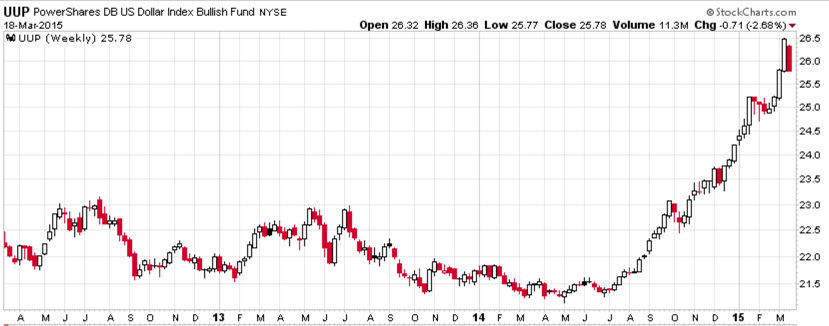
One significant global macro trend I noticed that did show some “change” yesterday is the U.S. Dollar. The U.S. Dollar has been in a smooth drift up for nearly a year. I use the PowerShares DB US Dollar Index Bullish (UUP). Below, I start with a weekly chart showing a few years so you can see it was non-trending up until last summer. Clearly, the U.S. Dollar has been trending strongly since.

u.s. dollar longer trend UPP

Next, we zoom in for a closer look. The the PowerShares DB US Dollar Index Bullish (UUP) was down about -2% yesterday after the Fed Decision. Notice that I included a 50 day moving average, just to smooth out the price data to help illustrate its path. One day isn’t nearly enough to change a trend, but that one day red bar is greater in magnitude and had heavy volume. On the one hand, it could be the emotional reaction to non trend following traders. On the other, we’ll see over time if that markets a real change that becomes a reversal of this fine trend. The U.S. Dollar may move right back up and resume it’s trend…

U.S. Dollar Trend 2015-03-19_08-21-35

chart source for the following charts: http://www.stockcharts.com

I am using actual ETFs only to illustrate their trends. One unique note about  PowerShares DB US Dollar Index Bullish Fund (Symbol: UUP) is the tax implications for currency limited partnership ETFs are subject to a 60 percent/40 percent blend, regardless of how long the shares are held. They also report on a K-1 instead of a 1099.

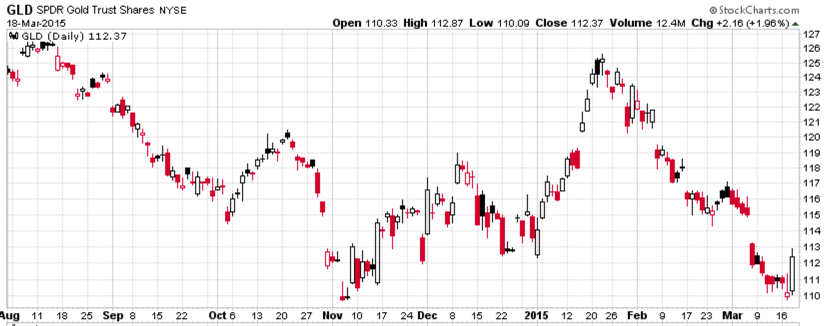
Why does the direction of the U.S. Dollar matter? It drives other markets. Understanding how global markets interact is an edge in global tactical trading. Below is a chart of Gold. I used the SPDR Gold Trust ETF as a proxy. Gold tends to trade the opposite of the U.S. Dollar.

gold trend 2015-03-19_08-22-41

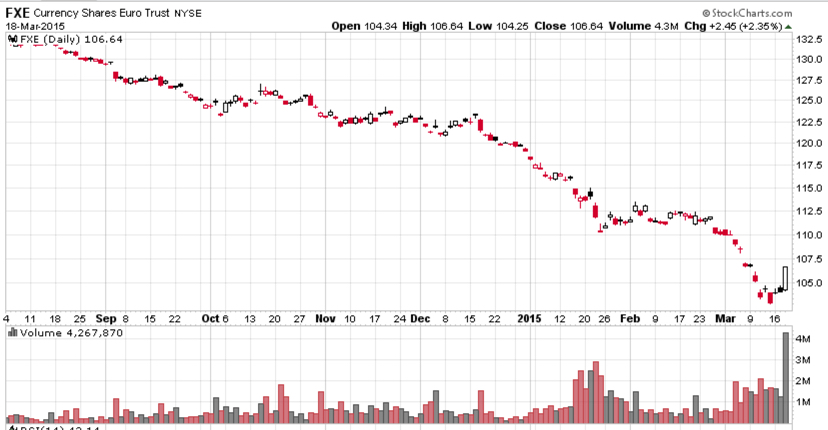
When the U.S. Dollar is trending up, it also has an inverse correlation to foreign currencies priced in dollars. Below is the CurrencyShares Euro ETF.

Euro currency trend 2015-03-19_08-23-03

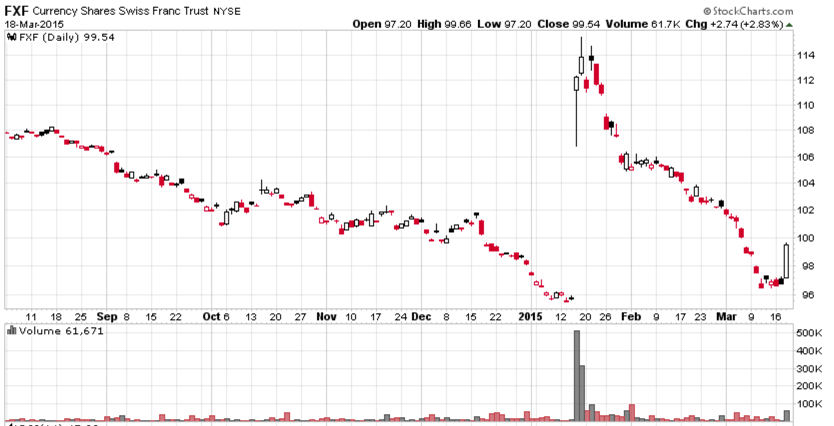
Foreign currencies can have some risk. In January, the Swiss Franc gaped up sharply, but has since drifted back to where it was. Maybe that was an over-reaction? Markets aren’t so efficient. Below is a chart of the CurrencyShares Swiss Franc to illustrate its trend and countertrend moves.

swiss franc trend 2015-03-19_08-23-23

None of this is a suggestion to buy or sell any of these, just an observation about directional trends, how they interact with each other, and countertrend moves (whether short term or long term). Clearly, there are trends…

To see how tactical decisions and understand how markets interacts results in my real performance, visit : ASYMMETRY® Managed Accounts

Fed Decision and Market Reaction: Stocks and Bonds

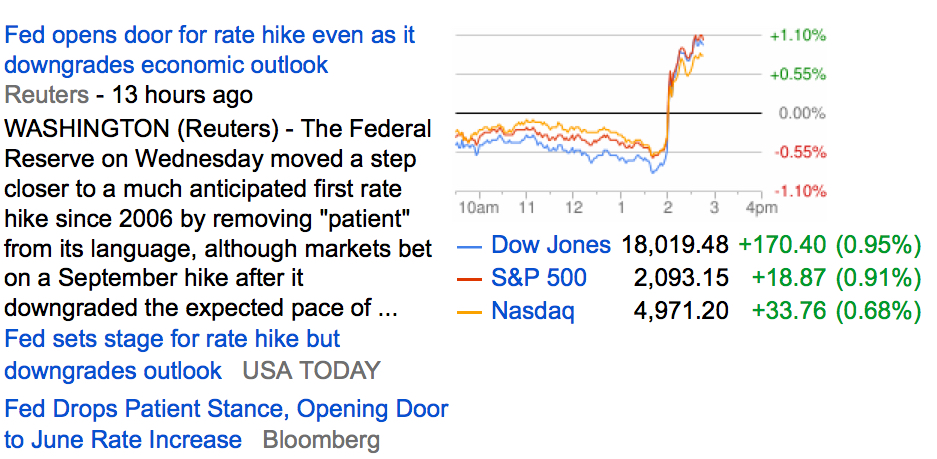
So, I’m guessing most people would expect if the Fed signaled they are closer to a rate hike the stock and bond markets would fall. Rising interest rates typically drive down stocks along with bonds. Not the case as of 3pm today. Stocks were down about -1% prior to the announcement, reversed, and are now positive 1%. Even bonds are positive. Even the iShares Barclays 20+ Yr Treas.Bond (ETF) is up 1.4% today.

So much for expectations…

Below is snapshot of the headlines and stock price charts from Google Finance:

Fed Decision and Reaction March 18 2015

Source: https://www.google.com/finance?authuser=2

A One-Chart Preview of Today’s Fed Decision: This is what economists are expecting

I can’t image what it must be like sitting around watching and reading the news trying to figure out what the Fed is going to do next. Even if they could know, they still don’t know how the markets will react. New information may under-react to the news or overreact. Who believed there would be no inflation? bonds would have gained so much? the U.S. dollar would be so strong? Gold and oil would be so low? Expectations like that are a tough way to manage a portfolio. I instead predefine my risk and identify the actual direction and go with it. Others believe it comes down to a single word…

Bloomberg says: Here’s a One-Chart Preview of Today’s Fed Decision: This is what economists are expecting

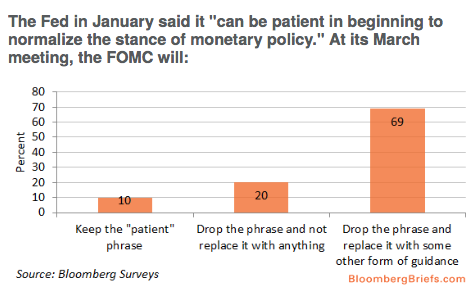
By far the biggest question is whether the Fed will drop the word “patient” from its statement. If it does drop the word, it creates the possibility of a June rate hike, and it will mark the first time since the financial crisis that the Fed is offering no specific forward guidance as to when rate hikes will come.

About 90 percent of economists surveyed by Bloomberg expect the Federal Reserve to drop the word “patience” in today’s announcement.

fed decision interest rates

source:http://www.bloomberg.com/news/articles/2015-03-18/here-s-a-one-chart-preview-of-today-s-fed-decision

Bear Markets Happen

WSJ has a nice chart of “Bear Markets” as defined as -20% drops in the Dow Jones Industrial Average. Click to enlarge.

Bear Markets Happen average bull bear market

Source: http://www.wsj.com/articles/how-to-prepare-for-a-bear-market-in-stocks-1425870192

Diversification Alone is No Longer Sufficient to Temper Risk…

That was the lesson you learned the last time stocks became overvalued and the stock market entered into a bear market.

In a Kiplinger article by Fred W. Frailey interviewed Mohamed El-Erian, the PIMCO’s boss, (PIMCO is one of the largest mutual fund companies in the world) he says “he tells how to reduce risk and reap rewards in a fast-changing world.” This article “Shaking up the Investment Mix” was written in March 2009, which turned out the be “the low” of the global market collapse.

It is useful to revisit such writing and thoughts, especially since the U.S. stock market has since been overall rising for 5 years and 10 months. It’s one of the longest uptrends recorded and the S&P 500 stock index is well in “overvalued” territory at 27 times EPS. At the same time, bonds have also been rising in value, which could change quickly when rates eventually rise. At this stage of a trend, asset allocation investors could need a reminder. I can’t think of a better one that this:

Why are you telling investors they need to diversify differently these days?

The traditional approach to diversification, which served us very well, went like this: Adopt a diversified portfolio, be disciplined about rebalancing the asset mix, own very well-defined types of asset classes and favor the home team because the minute you invest outside the U.S., you take on additional risk. A typical mix would then be 60% stocks and 40% bonds, and most of the stocks would be part of Standard & Poor’s 500-stock index.

This approach is fatigued for several reasons. First of all, diversification alone is no longer sufficient to temper risk. In the past year, we saw virtually every asset class hammered. You need something more to manage risk well.

But, you know, they say a picture is worth a thousand words.

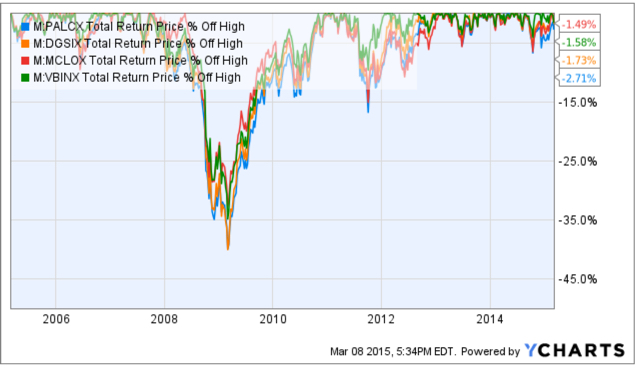
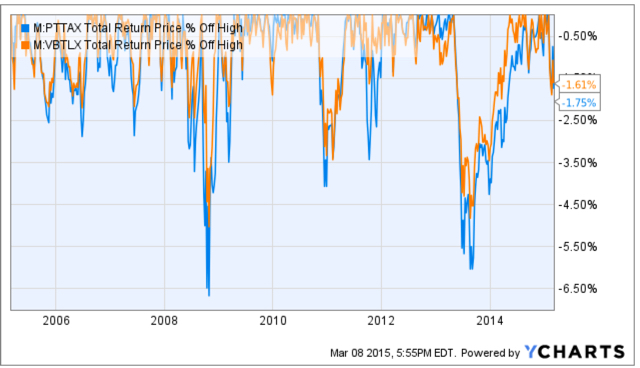
Since we are talking about downside risk, something that is commonly hidden when only “average returns” are presented, below is a drawdown chart. I created the drawdown chart using YCharts which uses total return data and the “% off high”. The decline you see from late 2007 to 2010 is a dradown: it’s when the investment value is under water. Think of this like a lake. You can see how the average of the data wouldn’t properly inform you of what happens in between.

First, I show PIMCO’s own allocation fund: PALCX: Allianz Global Allocation Fund. I include an actively managed asset allocation that is very large and popular with $55 billion invested in it: MALOX: BlackRock Global Allocation. Since there are many who instead believe in passive indexing and allocation, I have also included DGSIX: DFA Global Allocation 60/40 and VBINX: Vanguard Balanced Fund. As you can see, they have all done about the same thing. They declined about -30% to -40% from October 2007 to March 2009. They also declined up to -15% in 2011.

Vanguard DFA BlackRock PIMCO Asset Allcation

Charts are courtesy of http://ycharts.com/ drawn by Mike Shell

Going forward, the next bear market may be very different. Historically, investors consider bond holdings to be a buffer or an anchor to a portfolio. When stock prices fall, bonds haven’t been falling nearly as much. To be sure, I show below a “drawdown chart” for the famous actively managed bond fund PIMCO Total Return and for the passive crowd I have included the Vanguard Total Bond Market fund. Keep in mind, about 40% of the allocation of the funds above are invested in bonds. As you see, bonds dropped about -5% to -7% in the past 10 years.

PIMCO Total Return Bond Vanguard Total Bond

Charts are courtesy of http://ycharts.com/ drawn by Mike Shell

You may have noticed the end of the chart is a drop of nearly -2%. Based on the past 10 years, that’s just a minor decline. The trouble going forward is that interest rates have been in an overall downtrend for 30 years, so bond values have been rising. If you rely on bonds being a crutch, as on diversification alone, I agree with Mohamed El-Erian the Chief of the worlds largest bond manager:

“…diversification alone is no longer sufficient to temper risk. In the past year, we saw virtually every asset class hammered. You need something more to manage risk well.”

But, don’t wait until AFTER markets have fallen to believe it.

Instead, I apply active risk management and directional trend systems to a global universe of exchange traded securities (like ETFs). To see what that looks like, click: ASYMMETRY® Managed Accounts

Sectors Showing Some Divergence…

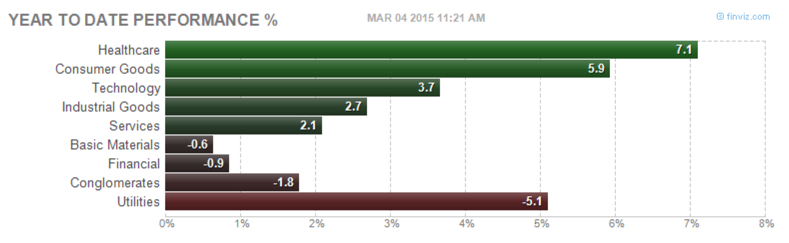
So far, U.S. sector directional price trends are showing some divergence in 2015.

Rather than all things rising, such divergence may give hints to new return drivers unfolding as well as opportunity for directional trend systems to create some asymmetry by avoiding the trends I don’t want and get exposure to those I do.

Sector ETF Divergence 2015-03-04_11-24-54

For more information about ASYMMETRY®, visit: http://www.asymmetrymanagedaccounts.com/global-tactical/


Chart source: http://www.finviz.com/groups.ashx


This is When MPT and VaR Get Asset Allocation and Risk Measurement Wrong

This is When MPT and VaR Get Asset Allocation and Risk Measurement Wrong

I was talking to an investment analyst at an investment advisory firm about my ASYMMETRY® Global Tactical and he asked me what the standard deviation was for the portfolio. I thought I would share with you how the industry gets “asset allocation” and risk measurement and management wrong.

Most people have poor results over a full market cycle that includes both rising and falling price trends, like global bull and bear markets, recessions, and expansions. Quantitative Analysis of Investor Behavior, SPIVA, Morningstar and many academic papers have provided empirical evidence that most investors (including professionals) have poor results over the long periods. For example, they may earn gains in rising conditions but lose their gains when prices decline. I believe one reason is they get too aggressive at peaks and then sell in panic after losses get too large, rather than properly predefine and manage risk.

You may consider, then, to have good results over a long period, I necessarily have to believe and do things very differently than most people.

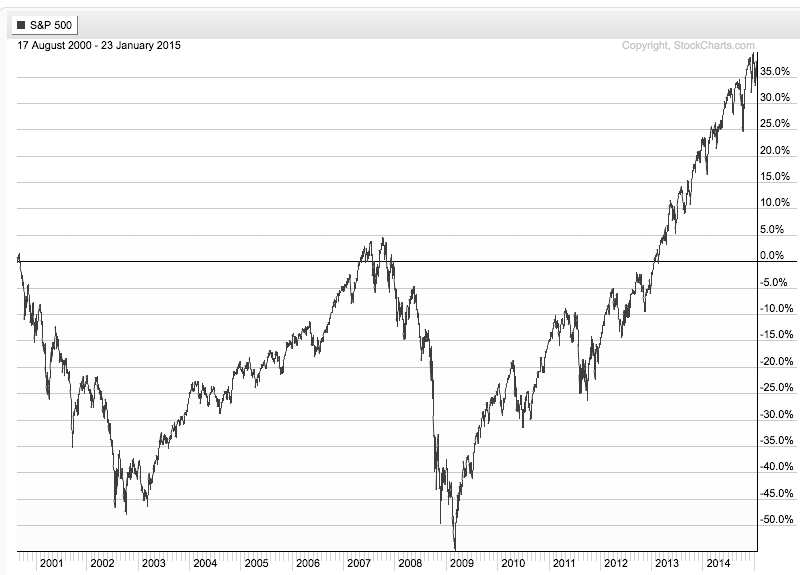
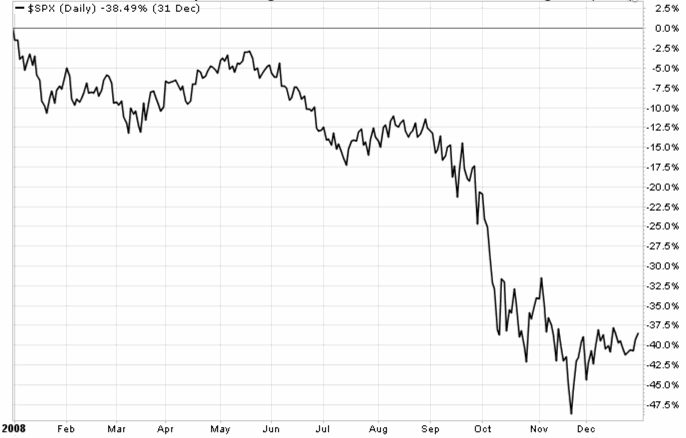
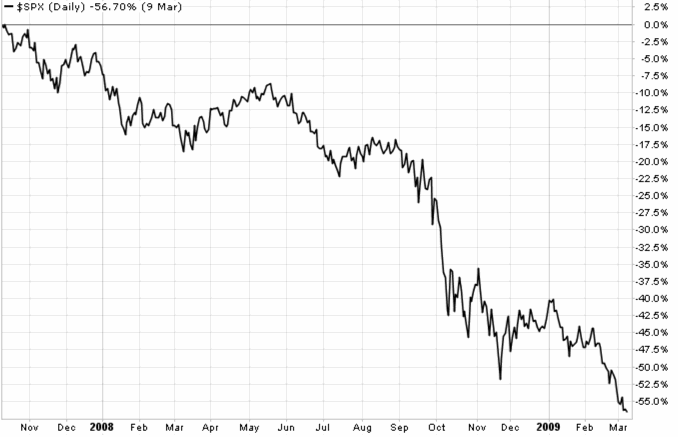
On the “risk measurement” topic, I will share with you a very important concept that is absolutely essential for truly actively controlling loss. The worst drawdown “is” the only risk metric that really matters. The risk is not the loss itself. Once we have a loss, it’s a loss. It’s beyond the realm of risk. Since risk is the possibility of a loss, how often it has happened in the past and the magnitude of the historical loss is the expectation. Beyond that, we must assume it could be even worse some day. For example, if the S&P 500 stock index price decline was -56% from 2007 to 2009, then we should expect -56% is the loss potential (or worse). When something has happened before, it suggests it is possible again, and we may have not yet observed the worst decline in the past that we will see in the future.

The use of standard deviation is one of the very serious flaws of investors attempting to measure, direct, and control risk. The problem with standard deviation is that the equation was intentionally created to simplify data. The way it is used draws a straight line through a group of data points, which necessarily ignores how far the data actually spreads out. That is, the standard deviation is intended to measure how far the data spreads out, but it actually fails to absolutely highlight the true high point and low point. Instead, it’s more of an average of those points. However, for risk management, it’s the worst-case loss that we really need to focus on. I believe in order to direct and control risk, I must focus on “how bad can it really get”. Not just “on average” how bad it can get. The risk in any investment position is at least how much it has declined in the past. And realizing it could be even worse some day. Standard deviation fails to reflect that in the way it is used.

Consider that as prices trend up for years, investors become more and more complacent. As investors become complacent, they also become less indecisive as they believe the recent past upward trend will continue, making them feel more confident. On the other hand, when investors feel unsure about the future, their fear and indecisiveness is reflected as volatility as the price swings up and down more. We are always unsure about the future, but investors feel more confident the past will continue after trends have been rising and volatility gets lower and lower. That is what the peak of a market looks like. As it turns out, that’s just when asset allocation models like Modern Portfolio Theory (MPT) and portfolio risk measures like Value at Risk (VaR) tell them to invest more in that market – right as it reaches its peak. They invest more, complacently, because their allocation model and risk measures tell them to. An example of a period like this was October 2007 as global stock markets had been rising since 2003. At that peak, the standard deviation was low and the historical return was at its highest point, so their expected return was high and their expected risk (improperly measured as historical volatility) was low. Volatility reverses the other way at some point

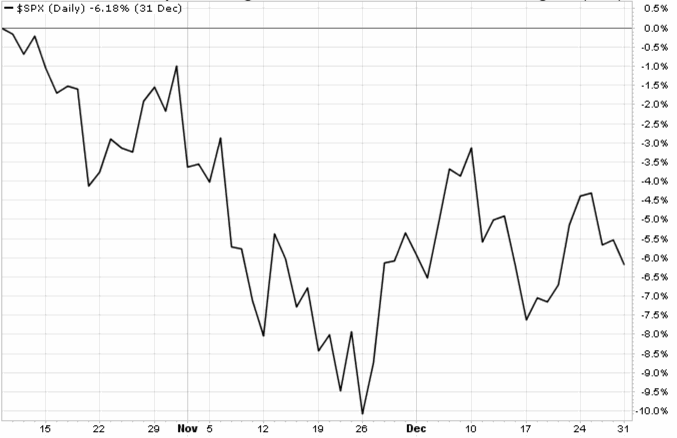
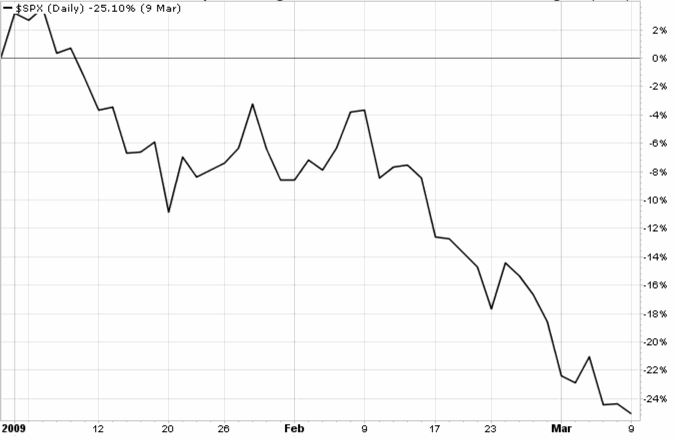
What happens next is that the market eventually peaks and then begins to decline. At the lowest point of the decline, like March 2009, the global stock markets had declined over -50%. My expertise is directional price trends and volatility so I can tell you from empirical observation that prices drift up slowly, but crash down quickly. The below chart of the S&P 500 is an example of this asymmetric risk.
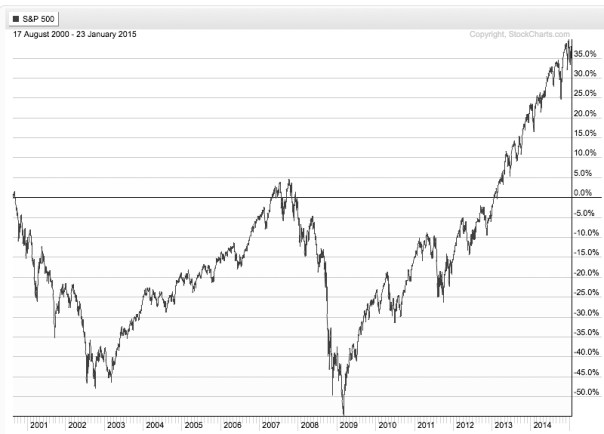
stock index asymmetric distribution and losses

At the lowest point after prices had fallen over -50%, in March 2009, the standard deviation was dramatically higher than it was in 2007 after prices had been drifting up. At the lowest point, volatility is very high and past return is very low, telling MPT and VaR to invest less in that asset. This is a form of volatility targeting: investing more at lower levels or historical volatility and less at higher levels.

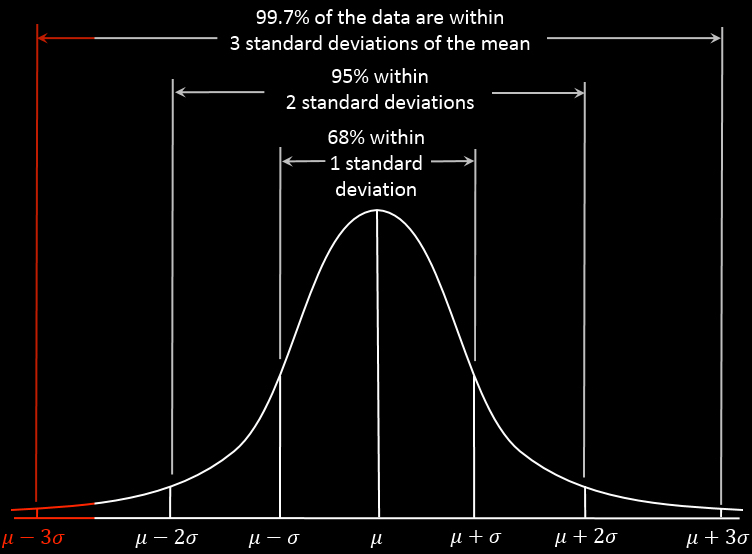
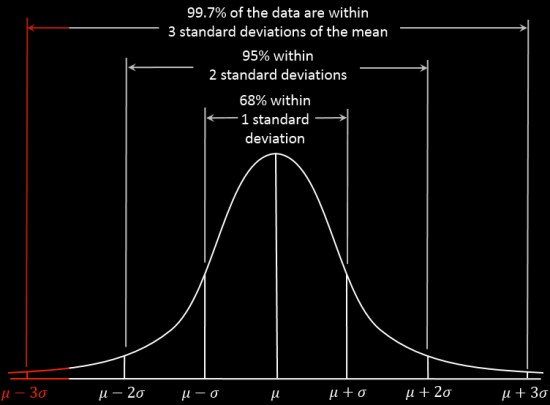
In the 2007 – 2009 decline in global markets, you may recall some advisors calling it a “6 sigma event”. That’s because the market index losses were much larger than predicted by a standard deviation. For example, if an advisors growth allocation had an average return of 10% in 2007 based on its past returns looking back from the peak and a standard deviation of 12% expected volatility, they only expected the portfolio would decline -26% (3 standard deviations) within a 99.7% confidence level – but the allocation actually lost -40 or -50%. Even if that advisor properly informed his or her client the allocation could decline -26% worse case and the client provided informed consent and acceptance of that risk, their loss was likely much greater than their risk tolerance. When they reach their risk tolerance, they “tap out”. Once they tap out, when do they ever get back in? do they feel better after it falls another -20%? or after it rises 20%? There is no good answer. I want to avoid that situation. I prefer to reduce my exposure to loss in well advance.

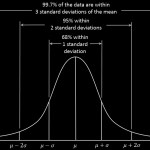
You can see in the chart below, 3 standard deviations is supposed to capture 99.7% of all of the data if the data is a normal distribution. The trouble is, market returns are not a normal distribution. Instead, stock market gains and losses present an asymmetrical return distribution. Market returns experience much larger gains and losses than expected from a normal distribution – the outliers are critical. However, those outliers don’t occur very often: historically it’s maybe every 4 or 5 years, so people have time to forget about the last one and become complacent.
symmetry normal distribution bell curve black

Source: http://en.wikipedia.org/wiki/68%E2%80%9395%E2%80%9399.7_rule

My friends, this is where traditional asset allocation like Modern Portfolio Theory (MPT) and risk measures like Value at Risk (VaR) get it wrong.

These methods are the most widely believed and used . You can probably see why most investors do poorly and only a very few do well – an anomaly.

I can tell you that I measure risk by how much I can lose and I control my risk by predefining my absolute risk at the point of entry and my exit point evolves as the positions are held. That is an absolute price point, not some equation that intentionally ignores the outlier losses.

As the stock indexes have now been overall trending up for 5 years and 9 months, the trend is getting aged. In fact, according to my friend Ed Easterling at Crestmont Research, at around 27 times EPS the stock index seems to be in the range of overvalued. In his latest report, he says:

“The stock market surged over the past quarter, adding to gains during 2014 that far exceed underlying economic growth. As a result, normalized P/E increased to 27.2—well above the levels justified by low inflation and interest rates. The current status is approaching “significantly overvalued.”

At the same time, we shouldn’t be surprised to eventually see rising interest rates drive down bond values at some point. It seems from this starting point that simply allocating to stocks and bonds doesn’t have an attractive expected return.

I believe a different strategy is needed, especially form this point forward.

In ASYMMETRY® Global Tactical, I actively manage risk and shift between markets to find profitable directional price trends rather than just allocate to them.


Mike Shell is the Founder and Chief Investment Officer of Shell Capital Management, LLC, and the portfolio manager of ASYMMETRY® Global Tactical.

The observations shared on this website are for general information only and are not specific advice, research, or buy or sell recommendations for any individual. Investing involves risk including the potential loss of principal an investor must be willing to bear. Past performance is no guarantee of future results. The presence of this website on the Internet shall in no direct or indirect way raise an implication that Shell Capital Management, LLC is offering to sell or soliciting to sell advisory services to residents of any state in which the firm is not registered as an investment advisor. Use of this website is subject to its terms and conditions.
 

“There is always a disposition in people’s minds to think that existing conditions will be permanent …

“There is always a disposition in people’s minds to think the existing conditions will be permanent,” Dow wrote, and went on to say: “When the market is down and dull, it is hard to make people believe that this is the prelude to a period of activity and advance. When the prices are up and the country is prosperous, it is always said that while preceding booms have not lasted, there are circumstances connected with this one, which make it unlike its predecessors and give assurance of permanency. The fact pertaining to all conditions is that they will change.”  – Charles Dow, 1900

Source: Lo, Andrew W.; Hasanhodzic, Jasmina (2010-08-26). The Evolution of Technical Analysis: Financial Prediction from Babylonian Tablets to Bloomberg Terminals (Kindle Locations 1419-1423). Wiley. Kindle Edition.

You can probably see from Dow’s quote how trends do tend to continue, just because enough people think they will. However, price trends can continue into an extreme or a “bubble” just because people think they will continue forever. I like to ride a trend to the end when it bends and then be prepared to exit when it does finally reverse, or maybe reduce or hedge off some risk when the probability seems high of a change.

idowcha001p1

Image source: Wikipedia

Charles Henry Dow; November 6, 1851 – December 4, 1902) was an American journalist who co-founded Dow Jones & Company. Dow also founded The Wall Street Journal, which has become one of the most respected financial publications in the world. He also invented the Dow Jones Industrial Average as part of his research into market movements. He developed a series of principles for understanding and analyzing market behavior which later became known as Dow theory, the groundwork for technical analysis.

Stock Investors Even More Bullish While Japan Falls into Surprise Recession

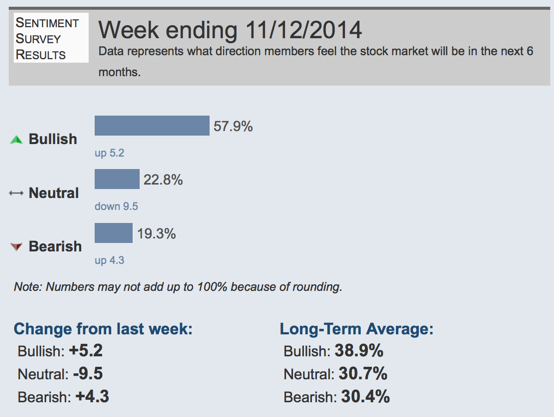
Following up with Are investors getting overly optimistic again? I pointed out that investor sentiment as measured by the AAII Investor Sentiment Survey had shifted to a point of unusually high bullishness.

After prices trend up, investors get more optimistic as they extrapolate higher prices into the future, assuming that existing trends will continue. Interestingly, they get more bullish as prices are more “overvalued”. As more and more investors become optimistic about stocks in the months ahead, you have to wonder who will continue the buying needed to push stocks higher. A good trend follower knows that trends do indeed often continue, until the demand runs out. Since supply and demand is the driver of all things traded in an auction market, we can observe demand shifts and how it drives prices.

Since I wrote Are investors getting overly optimistic again? less than two weeks ago, the latest AAII Investor Sentiment Survey shows bullishness is even higher.

investor sentiment and asymmetric risk

source: http://www.aaii.com/sentimentsurvey?adv=yes

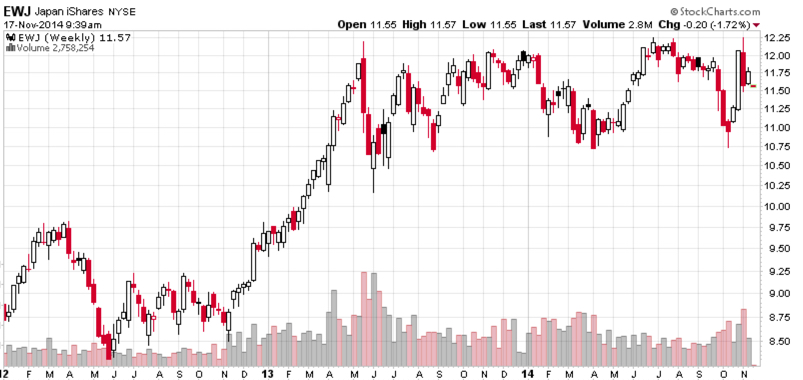
In the mean time, Fox Business reports this morning “Japan’s economy unexpectedly slipped into recession in the third quarter”. That shouldn’t be a big surprise. If you take a look at the weekly chart of the Japan stock index (priced in Dollars) below, it’s been suggesting something for the past year. I am seeing similar trends (or choppy non-trends) in many global stock markets.

Japan stock market recession

Courtesy of http://www.stockcharts.com

It will be interesting to watch how it all unfolds.

Small vs. Large Stocks: A Tale of Two Markets (Continued)

A quick follow up to my recent comments about the down trend in smaller company stocks in Playing with Relative Strength and Stock Market Peak? A Tale of Two Markets below is a chart and a few observations:

Rusell 2000 Small Caps vs S&P 500 large caps

Source: Bloomberg/KCG

A few observations of the trend direction, momentum, and relative strength.

  • The S&P 500 index (the orange line) of large company stocks has been  in a rising trend of higher highs and higher lows (though that will not continue forever).
  • The white line is the Russell 2000 small company index has been in a downtrend of lower highs and lower lows, though just recently you may observe in the price chart that it is at least slightly higher than its August high. But it remains below the prior two peaks over the past year. From the time frame in the chart, we could also consider it a “non-trending” and volatile period, but its the lower highs make it a downtrend.
  • The green chart at the bottom shows the relative strength between S&P 500 index of large company stocks and the Russell 2000 small company index. Clearly, it hasn’t taken all year to figure out which was trending up and the stronger trend.
  • Such periods take different tactical trading skills to be able to shift profitability. When markets get choppy, you find out who really knows what they’re doing and has an edge. I shared this changing trend back in May in Stock Market Peak? A Tale of Two Markets.

If you are unsure about the relevance of the big picture regarding these things, read Playing with Relative Strength and Stock Market Trend: reverse back down or continuation? and Stock Market Peak? A Tale of Two Markets.


Stock Market Trend: reverse back down or continuation?

I normally don’t comment here on my daily observations of very short-term directional trends, though as a fund manager I’m monitoring them every day. The current bull market in stocks is aged, it’s lasted much longer than normal, and it’s been largely driven by actions of the Fed. I can say the same for the upward trend in bond prices. As the Fed has kept interest rates low, that’s kept bond prices higher.

Some day all of that will end.

But that’s the big picture. We may be witnessing the peaking process now, but it may take months for it all to play out. The only thing for certain is that we will only know after it has happened. Until then, we can only assess the probabilities. Some of us have been, and will be, much better at identifying the trend changes early than others.

With that said, I thought I would share my observations of the very short-term directional trends in the stock market since I’ve had several inquiring about it.

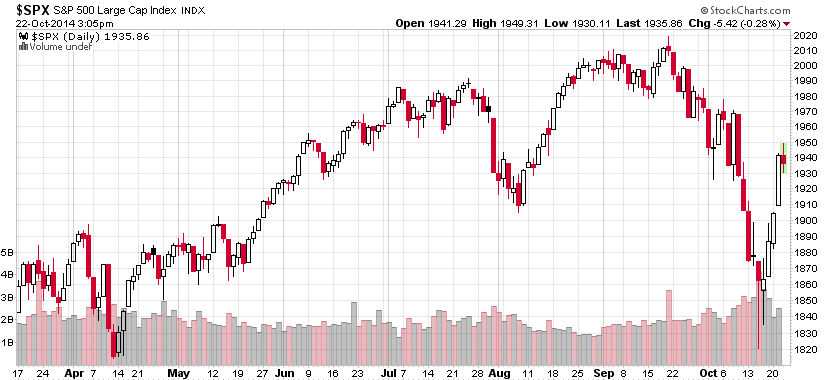
First, the large company stock index, the S&P 500, is now at a point where it likely stalls for maybe a few days before it either continues to trend up or it reverses back down. In “Today Was the Kind of Panic Selling I Was Looking For” I pointed out that the magnitude of selling that day may be enough panic selling to put in at least a short-term low. In other words, prices may have fallen down enough to bring in some buying interest. As we can see in the chart below, that was the case: the day I wrote that was the low point in October so far. We’ve since seen a few positive days in the stock index.

stock index 2014-10-22_15-06-14

All charts in this article are courtesy of http://www.stockcharts.com and created by Mike Shell

Larger declines don’t trend straight down. Instead, large declines move down maybe -10%, then go up 5%, then they go down another -10%, and then back up 7%, etc. That’s what makes tactical trading very challenging and it’s what causes most tactical traders to create poor results. Only the most experienced and skilled tactical decision makers know this. Today there are many more people trying to make tactical decisions to manage risk and capture profits, so they’ll figure this out the hard way. There isn’t a perfect ON/OFF switch, it instead requires assessing the probabilities, trends, and controlling risk.

Right now, the index above is at the point, statistically, that it will either stall for maybe a few days before it either continues to trend up or it reverses back down. As it all unfolds over time, my observations and understanding of the “current trend” will evolve based on the price action. If it consolidates by moving up and down a little for a few days and then drifts back up sharply one day, it is likely to continue up and may eventually make a new high. If it reversed down sharply from here, it will likely decline to at least the price low of last week. If it does drift back to last weeks low, it will be at another big crossroads. It may reverse up again, or it may trend down. Either way, if it does decline below low of last week, I think we’ll probably see even lower prices in the weeks and months ahead.

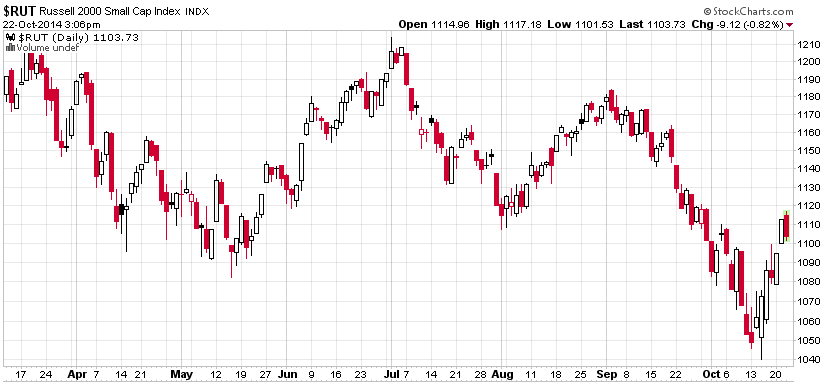
Though I wouldn’t be surprised if the stock index does make a new high in the coming months, one of my empirical observations that I think is most concerning about the stage of the general direction of the stock market is that small company stocks are already in a downtrend. Below is a chart of the Russell 2000 Small Cap Stock Index over the same time frame as the S&P 500 Large Cap Stock Index above. Clearly, smaller companies have already made a lower low and lower highs. That’s a downtrend.

small company stocks 2014 bear market

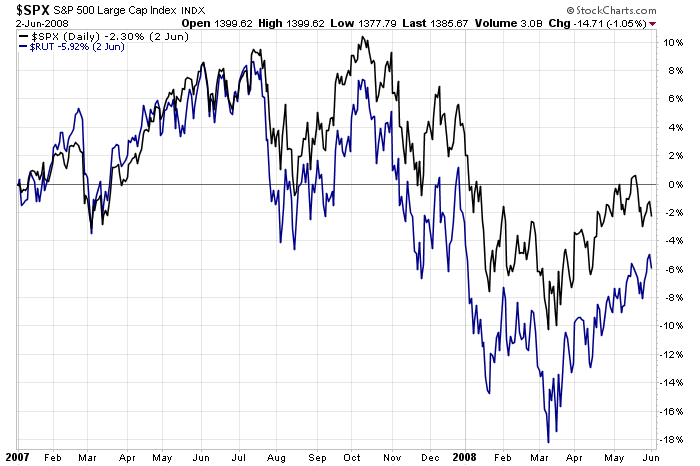
Smaller company stocks usually lead in the early stage of bear markets. There is a basic economic explanation for why that may be. In the early stage of an economic expansion when the economy is growing strong, it makes sense that smaller companies realize it first. The new business growth probably impacts them in a more quickly and noticeable way. When things slow down, they may also be the first to notice the decline in their earnings and income. I’m not saying that economic growth is the only direct driver of price trends, it isn’t, but price trends unfold the same way. As stocks become full valued at the end of a bull market, skilled investors begin to sell them or stop investing their cash in those same stocks. Smaller companies tend to be the first. That isn’t always the case, but you can see in the chart below, it was so during the early states of the stock market peak in 2007 as prices drifted down into mid 2008. Below is a comparison of the two indexes above. The blue line is the small stock index. In October 2007, it didn’t exceed its prior high in June. Instead, it started drifting down into a series of lower lows and lower highs. It did that as the S&P 500 stock index did make a prior high.

small stocks fall first in bear market

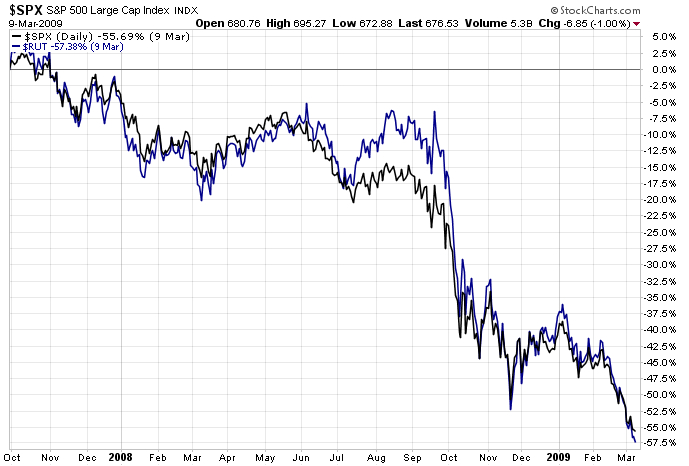
But as you see, both indexes eventually trended down together.

As a reminder to those who may have forgotten, I drew the chart below to show how both of these indexes eventually went on to lower lows and lower highs all the way down to losses greater than -50%. I’m not suggesting that will happen again (though it could) but instead I am pointing out how these things look in the early stages of their decline.

2008 bear market

If you don’t have a real track record evidencing your own skill and experience dealing with these things, right now is a great time to get in touch. By “real”, I’m talking about an actual performance history, not a model, hypothetical, or backtest. I’m not going to be telling you how I’m trading on this website. The only people who will experience that are our investors.


How is the market doing? Global Deflation

How are the markets doing this year?

Well, it depends on what market you mean. So far 2014 has had only a few gains in world markets: coffee, cattle, cocoa, pork bellies, 30 year treasury bond, the U.S. Dollar,. The Dow Jones Industrial average is flat.

Most commodities prices have fallen materially. It looks like “global deflation”, which means prices are falling. I bet it’s getting the Feds attention. Deflation isn’t a good thing.

global deflation

Chart courtesy of FINVIZ

VIX® gained 140%: Investors were too complacent

Several months ago I started sharing some of my observations about the VIX ( CBOE Volatility Index). The VIX had gotten to a level I considered low, which implied to me that investors were too complacent, were expecting too low future volatility, and option premiums were generally cheap. After the VIX got down to levels around 11 and 12 and then started to move up, I pointed out the VIX seemed to be changing from a downward longer term trend to a rising trend.

As I was sharing my observations of the directional trend and volatility of VIX that I believed was more likely to eventually go up than down, it seemed that most others were writing just the opposite. I know that many volatility traders mostly sell volatility (options premium), so they prefer to see it fall.

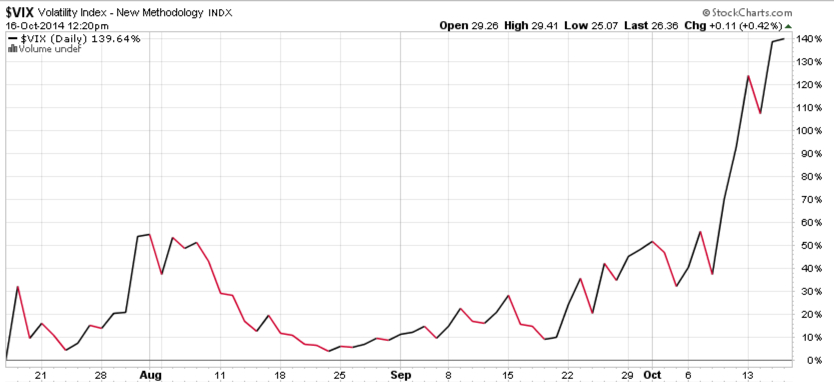
As you can see in the chart below, The VIX has increased about 140% in just a few weeks.

VIX october

Chart courtesy of http://www.stockcharts.com

For those who haven’t been following along, you may consider reading the previous observations:

A VIX Pop Then Back to Zzzzzzzz? We’ll see

Asymmetric VIX

VIX Shows Volatility Still Low, But Trending

VIX Back to Low

The VIX is Asymmetric, making its derivatives an interesting hedge

Is the VIX an indication of fear and complacency?

What does a VIX below 11 mean?

What does the VIX really represent?

The VIX, my point of view

The VIX, as I see it…

Volatility Risk Premium

Declining (Low) Volatility = Rising (High) Complacency

Investors are Complacent


Today Was the Kind of Panic Selling I Was Looking For

I mentioned in “Fear is Driving Stocks Down, or is Declining Stocks Driving Fear?” that falling prices could lead to panic selling and it may require some panic selling to push prices low enough to bring in new buying demand. Of course, to have cash to buy you had to have previously sold before the decline.

Today we’ve observed just that. The headlines today “Dow Plunging 460 points” is what I was talking about. Big down days rid weak holders of their positions they held too long, so they fear losing more money. Those of us who already sold early enough to have cash for new entries can wait for prices to get to a low enough point to make the risk/reward attractive enough to take a chance.

Although we could be observing the early stages of a much larger downside bear market that unfolds in the months ahead, they don’t drift straight down. Instead, they cycle down 10%, up 7%, down 10%, etc. When they’ve moved down, one potential sign of a reversal back up is when the worst performing areas of the markets reverse back up. I usually observe the things that were trending down the most get oversold and are the first to shift back up, at least temporarily.

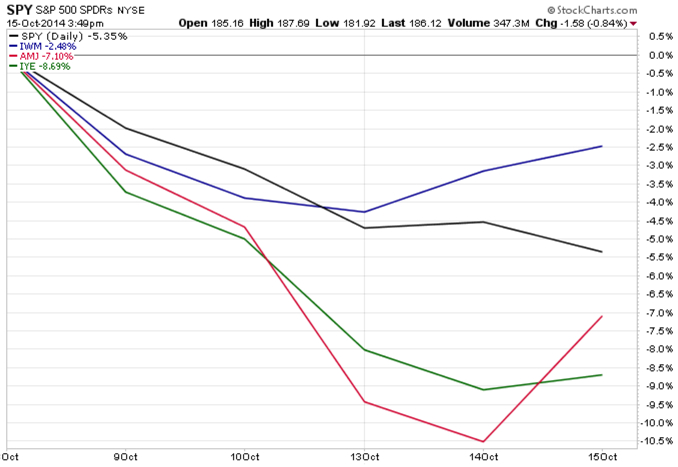
The chart below is the past 2 days of the S&P 500 (SPY), Russell 2000 Small Company stocks (IWM), the Energy Sector (IYE), and Energy MLPs (AMJ). As I’ve pointed out lately, smaller companies and energy have declined the most and on today’s big down day for stocks, you can see below those weakest areas are drifting up. It’s a positive sign in the days ahead IF that continues…

small caps energy rebounding

Chart courtesy of http://www.stockcharts.com

The way directional trends unfold is they sometimes get to a point like they are now and reverse back up, if prices have gotten low enough to attract enough new buying, that buying ends to fall. But if that doesn’t happen, this is what the early stage of how even more panic selling begins. I believe everyone has an exit point. Even those who say they are passive and “buy and hold” eventually panic when their losses get too large. Stock indexes have only fallen about -9% from their peak a few weeks ago, so that probably isn’t yet enough to drive too many out  who are 100% invested, but you can probably see how as their losses get larger and larger many of them do eventually exit.

I think everyone has an exit, an “uncle point”, it can either be an earlier predefined exit like mine are, or after their losses get so large they can’t take it anymore (-20% or 30%) or to the point it begins to change their life plans (like -40% or 50%).

Let’s see how it all unfolds…

If you are an investment adviser or individual investor and don’t have a strong track record of active risk management, now is a good time to get in touch.

Fear is Driving Stocks Down, or is Declining Stocks Driving Fear?

The last time I pointed out a short-term measure of extreme investor sentiment was August 4, see “Extreme Fear is Now the Return Driver“. At that time, popular stock indexes had declined -3% or more and as prices fell, investor fear measures increased.

As stocks rise, investors get complacent and brag about their profits. After prices fall, investor fear measures start to rise.

Since I pointed out “Extreme Fear is Now the Return Driver”, the Dow Jones Industrial Average went on to trend back up 5% by mid September. Below is a price chart for the Dow year to date. I marked August 4th with a red arrow. You can see how the price trend had declined sharply, driving fear of even lower prices, then it reversed back up. Fear increases after a decline and when fear gets high enough, stocks often reverse back up in the short term. They get complacent and greedy after prices rise to the point there are no buyers left to keep bidding prices up, then prices fall. Investors oscillate between the fear of missing out and the fear of losing money.

dow jones stock index year to date

Source: http://www.stockcharts.com

Since mid September, the price trend has drifted back down over 4% from the peak. As you can see, the Dow has made no gain for the year 2014. It is no surprise that investor sentiment readings are now at “Extreme Fear” levels, as measured by the Fear & Greed Index below.

Fear and Greed Index

Source: Fear & Greed Index CNN Money

So, the last time investor fear levels got this high, stocks reversed back up in the weeks ahead. However, it doesn’t always work out that way. These indicators are best used with other indications of trend direction and strength to understand potential changes or a continuation. For example, we commonly observe 4% to 5% swings in stock prices a few times a year. That is a normal range and should be expected. However, eventually prices will decline and investors will continue to fear even more losses. As prices fall, investors sell just because they’re losing money. Some sell earlier in the decline, some much later. You may know people who sold after they were down -50% in 2008 or 2002.  The trouble with selling out of fear is: when would they ever get back in? That’s why I manage risk with predefined exit points and I know at what point I would reenter.

My point is: fear always has the potential to become panic selling leading to waterfall declines. Panic selling can take weeks or months to drive prices low enough that those who sold earlier (and avoided the large losses and have cash available) are willing to step in to start buying again. Those who stay fully invested all the time don’t have the cash for new buying after prices fall. It’s those buy and hold (or re-balance) investors who also participate fully in the largest market losses.  It’s those of us who exit our losers soon enough, before a large decline, that have the cash required to end the decline in prices.

Selling pressure starts declines, new buying ends them.

We’ll see in the weeks ahead if fear has driven prices to a low enough point that brings in new buying like it has before or if it continues into panic selling. There is a chance we are seeing the early stages of a bear market in global stocks, but they don’t fall straight down. Instead, declines of 20% or more are made up of many cycles of 5 – 10% up and down along the way. So, we shouldn’t be surprised to see stock prices drift up 5% again, maybe even before another -10% decline.

Declining stocks drive fear, but fear also drives stocks down.

Let’s see how it all unfolds…

Trend Change in Dollar, International Stocks, Gold?

Directional trends tend to persist. When a price is trending, it’s more likely to continue than to reverse. A directional trend is a drift up or down. For example, we can simply define a uptrend by observing a price chart of higher highs and higher lows. A downtrend is an observation of lower highs and lower lows. For a trading system, we need to be more precise in defining a direction with an algorithm (an equation that mathematically answers the question). The concept that directional trends tend to persist is called “momentum“. Momentum is the empirically observed tendency for rising prices to rise further. Momentum in price trends have been exploited for decades by trend following traders and its persistence is now even documented in hundreds of academic research papers. Momentum persists, until it doesn’t, so I can potentially create profits by going with the trend and then capturing a part of it.

But all trends eventually come to an end. We never know in advance when that will be, but we can determine the probability. Sometimes a trend reversal (up or down) is more likely than others. If you believe markets are efficient and instead follow a random walk, you won’t believe that. I believe trends move in one direction, then reverse, then trend again. When I look at the charts below, I see what I defined previously as “a trend”. I have developed equations and methods for defining the trend and also when they may bend at the end. More importantly, I observe them when they do bend. For example, to capture a big move in a trend, say 20% or more, we can’t get out every time it drops -2%, because it may do that many times on its way to that 20%. So, trend following means staying with the trend until it really bends. Counter-trend trading is trying to profit from the bends by identifying the change in the trend. Both are somewhat the opposite, but since my focus is these trends I observe them both.

Inertia is the resistance to change, including a resistance to change in direction. I could say then, that it takes inertia to keep a trend going. If there is enough inertia, the trend will continue. Trends will almost always be interrupted briefly by shorter term trends. For example, if you look at a monthly chart of a market first, then view a weekly chart, then a daily chart, you’ll see different dimensions of the trend and maybe left with a different observation than if you just look at one time frame.

Below I drew a monthly charge going back nearly 12 years. As you can see, the U.S. Dollar ($USD) has been “down” as much as -40% since 2002. It’s lowest point was 2008 and using my definition for trend, it’s been rising since 2008 though with a lot of volatility from 2008 to 2011. We could also say it’s been “non-trending” generally since 2005, since it has oscillated up and own since then without any meaning breakout.

All of charts are courtesy of http://www.stockcharts.com

Next we observe the weekly price trend. In a weekly chart we see the non-trending period, but ultimately over this time frame the Dollar gained 9%. The Dollar has been at a relatively low price range during this time. For those who want to understand why a trend occurs: A low currency is a reflection of the U.S. debt burden and lack of economic growth. We can only say that in hindsight. Most of the time we don’t actually know why a trend is a trend when it’s trending – and I don’t need to know.

You can probably begin to see how “the trend” is a function of “the time frame”. The most recent trend is observed in a daily chart going back less than a year. Here we see the U.S. Dollar is rising since July. I pointed out in “Interest Rates and Dollar Rising, Commodities Falling” how the Dollar is driving other markets.

The Dollar is now at a point that I mathematically expect to see it may reverse back down some. Though a trend is more likely to persist and resist change (inertia), trends don’t move straight up or down. Instead, they oscillate up and down within their larger trend. If you look at any of the price trend charts above, you’ll see smaller trends within them. It appears the Dollar is now likely to change direction at least briefly, though maybe not very much. As I mentioned in “Interest Rates and Dollar Rising, Commodities Falling”, it seems that rising interest rates are probably driving the Dollar higher. The market seems to be anticipating the Fed doing things to increase interest rates in the future. Let’s look at some other trends that seem to be interacting with the Dollar and interest rates.

The MSCI EAFE Index is an index of developed countries. You can observe the trend below. International stocks tend to decline when the Dollar rises, because this index is foreign country stocks priced in Dollars.

Below is the MSCI Emerging Markets index, which are smaller more emerging countries. MSCI includes countries like Russia, Brazil, and Mexico as “emerging”, but some may be surprised to hear they also consider China an emerging market. The recent rising Dollar (from rising rates) has been partly the driver of falling prices.

Another market that is directly impacted by the trend in the Dollar is commodities. Below we see the S&P/GSCI Commodity Index.

I am sharing observations about global macro trends and trend changes. We previously saw that the Dollar was generally in a downtrend and at a low level for years. When the Dollar is down, commodities priced in Dollars may be up. One commodity that became very popular when it was rising was Gold. When the Dollar was falling and depressed, Gold was rising. Below is a more recent price trend of gold.

I wouldn’t be surprised to see the Dollar trend to reverse back down some in the short-term and that could drive these other markets to reverse their downtrends at least briefly. Only time will tell if it does reverse in the near future and by how much.

In the meantime, let’s watch it all unfold.

Global Market Trends and Returns 3rd Quarter 2014

The end of a quarter is a popular time for investors to review what happened over the past three months. Below we review some three-month price trends to get an idea of the direction and magnitude of return streams for a wide range of world market indexes.

In the chart below, we see the U.S. Dollar ($USD) was in the strongest rising directional trend and increased smoothly. The second most increasing trend in magnitude was U.S. Long Term Treasury Bonds (TLT), though it made its move in just the past two weeks. The popular large company stock index, the Dow Jones Industrial Average ($INDU) and the broad-based bond index Barclay Aggregate Bond Index (AGG) lost a little during the quarter. Small company stocks, the Russell 2000 ($RUT), and the commodities indexes ($USD and GSG) lost over -9%. As I pointed out in “Interest Rates and Dollar Rising, Commodities Falling” interest rates started drifting up, driving up the U.S. Dollar, which then drove down many commodities. The decline in small company stocks is probably more a sign of an aging bull market in stocks.

Charts courtesy of: http://www.stockcharts.com ©StockCharts.com

Looking closer within the U.S. stock market at its individual sectors, the Healthcare and Technology sectors ended the quarter with the largest gains of around 3%. Energy was by far the largest losing sector over the past three-months with a decline of nearly -10%. Other weakness was Industrial and Utilities. That may be suggesting something about the markets anticipation of the economy.

I also include a bar chart below of the sectors for a different visual of the advance and decline within sectors. The trouble with only looking at the quarter end result is that it ignores what happened along the way. For example, in the line charts above we can see how the trends unfold.

I pointed out in “Interest Rates and Dollar Rising, Commodities Falling” that interest rates started drifting up, driving up the U.S. Dollar. When the Dollar and interest rates rise it can directly impact other markets like commodities, international stocks priced in Dollars, and interest rate sensitive markets like real estate and utilities. In the next chart I include the U.S. Dollar again to show its steady increase the past three months. Then we see that commodities like Gold (GLD), interest rate sensitive markets like Utilities (IDU), U.S. Real Estate REITs (IYR), and Mortgage REITs (REM) all declined materially. International stocks in Developed Countries (EFA) and Emerging Markets (EEM) also declined around 5 to 7%. None of these three-month price trends are permanent, but for those of us who tactically rotate between these world markets it is useful to understand how they all interact with each other.

You may notice when I speak of these trends I use past tense. The past tense is a grammatical tense whose principal function is to place an action or situation in past time. When I speak of trends, I’m always speaking of the past trend, never the future. These charts are created by looking back three months. It is not possible to draw a chart of realized trends looking forward three months. If we could do that, we would only need to do it once. If we could know for sure what just one of these trends would do in the future we could leverage a large bet, take the profit, pay the tax, and be done forever. Instead, we only have past price trends to study and draw inference from. Past data is all we have. As it turns out, that’s all I need.


Global Market Returns Year to Date 2014

After yesterday, stock indexes haven’t made much progress in the first seven months of 2014. At the beginning of the year everyone seemed to talk about how much the Dow Jones Industrial Average had gone up, almost as if they could buy it after the fact and get what it did. This year the Dow (DIA in the chart) has gained 1.06%. Interestingly, small company stocks as measured by the Russell 2000 Index (IWM) are down 3%. In Stock Market Peak? A Tale of Two Markets back in May I pointed out the divergence between large company stocks as measured by the Dow Jones Industrial Average and small company stocks. At this late stage of a bull market, the recent negative trend of small company stocks may be an early warning a major peak for stocks could be near. Many are probably surprised that bonds have gained the most so far this year.

global market returns 2014

source: http://www.stockcharts.com

In fact, U.S. Long Term Treasuries (TLT) have gained so much more than other global markets that I show it as a separate chart below. Here I drew the same chat as above, but added U.S. Long Term Treasuries (TLT).


Long Term Treasuries TLT


VIX Shows Volatility Still Low, But Trending

It seemed that many of the commentators who write and talk about the VIX started talking as though it would stay down a long time. Of course, that’s as much a signal as anything that the trend could instead change.

Below is a chart of the CBOE Volatility Index (VIX) since I observed “VIX Back to Low” on July 3. It says to me that volatility, is, well, volatile. It trended up as much as 34% and then retraced much of that.

cboe volatility index vix pop

source: http://www.stockcharts.com

CBOE VOLATILTY INDEX VIX

Looking back the past several months, we can see since the beginning of July it has started to make higher highs and higher lows. Volatility (and therefore some options premiums) are still generally cheap by this measure, but from the eyes of a trend follower I wonder if this may be the very early stage of higher vol. We’ll see…

Either way, whether it stays low or trends back up, the monthly chart below shows the implied volatility in options is “cheaper” now than we’ve seen in 7 years, suggesting exposures with options strategies may be a “good deal”.

long term vix

Global Market Trends Mid Year 2014

I’m not one to put much emphasis on judging trends across arbitrary time frames like “mid year” or a specific calendar year, but it’s still interesting to see how global trends are playing out relative to how people perceive they are. At the end of last year the Dow Jones Industrial Average (DIA) was all the talk since it was the biggest gainer. So far in 2014 that DIA has gained only 2.54%. So, we could say that, though its range of motion and swings (volatility) has calmed down lately. Over the past 6 months the Dow stocks have lost their momentum. Those who only listen to financial news about stocks may be surprised to hear the 30 year U.S. Treasuries as measured by TLT have been the biggest gainer this year at 12%. Gold (GLD) and Emerging Markets (EEM) have had the largest range of swings. The broad-based bond index (AGG), Commodities (GSG), and Developed Countries (EFA) have trended similar to the Dow. I included $VIX, the CBOE Volatility Index to point out several observations. Notice how it has generally trended down and is down -15% over the first half of the year, you may also notice how much more it spikes up and down. That is, volatility is volatile.

Global market trend returns mid year 2014

Source: http://www.stockcharts.com

It’s important to understand that no intelligent person investors all their capital in stocks or in U.S. Treasuries or in Gold. Instead, they either allocate to many markets or rotate between them. The trouble with allocation to markets is they sometimes all go down at the same time, so diversification through just allocation may fail when you want it the most. That is why we rotate, instead of allocate, hoping to capture some of the good, and avoid most of the bad. No market trends up all the time and no strategy trends perfectly all the time, but the overall risk / reward profile is what matters. If someone can handle 50% declines and willing to wait 5 or more years to reach prior values, maybe they could invest all their money in stocks. We could say the same for commodities, real estate, and bonds. That is why we rotate, instead of allocate.

Have a great 4th of July!


The VIX, as I see it…

The CBOE Volatility Index (VIX) reached a low point last week not seen since 2007 as evidenced by the chart below.

CBOE VOLATILITY INDEX HISTORY

To see a closer view of the last period, below I included the last time the VIX was at such a low value. I show this to point out that the VIX oscillated between 9% and 12% for about 4 months before it finally spiked up to 20. Such a trend reversal (or mean reversion if you prefer) can take time. Imagine if the VIX stays this low for the next 4 months before a spike. Or, it could happen very soon. You may notice the VIX reached the level it is now at its lowest level in early 2007. If we believed these trends repeat perfectly, that absolute level would matter. Trends are more like snowflakes: no two are exactly the same. But in relative terms, the fact that today’s level is as low as the lowest point in early 2007 is meaningful if you care about the risk level in stocks and the stage of the market cycle.

CBOE VOLATILITY INDEX VIX Low levels

The best way to examine a trend is to zoom in. Start with a broader view to see the big picture, then zoom in closer and closer. When people focus too much on the short-term, they miss the forest for the trees. Below is the last time the VIX was below 12. You may notice that is does oscillate up and down in a range.

VIX BELOW 12

The level and directional trend of the VIX matters because of the next chart. You may see a trend if you look closely. The black line is the S&P 500 stock index. The black and red line is the VIX CBOE Volatility Index. You may notice the two tend to drift in opposite directions. Not necessarily on a daily basis, but overall they are “negatively correlated”. When the stock index is rising, the volatility is often falling or already at a low level. When the stock index is falling, volatility rises sharply. It isn’t a perfect opposite, but it’s there.

VIX and S&P 500 correlation and trend

If you are interested in stock trends and the trend in volatility, and specifically the current state of those cycles,  you may want to follow along in the coming days. I plan to publish a series on this topic about the VIX, as I see it. Over the last week or so I have written several ideas that I intended to publish as one large piece. Since I haven’t had time to tie it together that way, I thought I would instead publish a series.

When a trend reaches an extreme level like this, it may be useful to spend some time with it.

Stay tuned…

if you haven’t already, you may want to click on “Follow” to the right to get updates by email to follow along. This will likely be several informal notes in the coming days.


Declining (Low) Volatility = Rising (High) Complacency

When we speak of trends, we want to recognize a trend can be rising or declining, high or low. These things are subjective, because there is infinite ways to define the direction of a trend, its magnitude, speed, and absolute level. So, we can apply quantitative analysis to determine what is going on with a trend.

Below we see a quote for the CBOE Market Volatility Index (VIX). The VIX is a measure of the 30 day implied volatility of S&P 500 index options. It is a measure of how much premium options traders are paying on the 500 stocks included in the S&P 500. So, it is a measure of implied or expected volatility based on how options are priced, rather than a measure of actual historical volatility based on a past range of prices. Without going into a more detailed discussion of the many factors of VIX, I’ll add that the VIX is a fine example of an index that is clearly mean reverting. That is, the VIX oscillates between high and low ranges. Once it gets to a high level or low-level, it eventually reverts to its average. Said another way, it’s an excellent example of an index we can apply countertrend systems instead of trend following systems, because the VIX swings up and down rather than trending up or down for years.

The VIX has a long-term average of about 20 since its inception. At this moment, it is 11.82. It’s important to realize the flaw of averages here, because the VIX doesn’t actually stay around 20 – it instead averages 20 as it swings higher and lower.

VIX CBOE Market Volatility below 12


I used the above image from CNNMoney because it shows the rate of change in the VIX over the past 5 years on the bottom of the chart. Notice that over the past 5 years (an arbitrary time frame) market volatility as measured by VIX has declined -63.78%. To get an even better visual of the decline and price action of the VIX, below is a chart of the volatility index going back to 2001.

Do you see a trend? Do you see high and low points?

VIX Long term average high and low

We observe the current level is low by historical measures. In fact, it’s about as low at it has been. The last time the volatility index was this low was 2006 – 2007. That was just before it spiked as high as it has been during the 2007 – 2009 market crash. You can probably see what I mean by “mean reversion” and “countertrend”. When the stock market is rising, volatility gets lower and lower as investors become more complacent. Most investors actually want to get more aggressive and buy more stocks after they have already risen a lot for years, rather than realizing the higher prices go the more risky they become. We love trends, but they don’t last forever. What I think we see above is an indication that investors have become complacent, option premiums are cheap, because options traders aren’t factoring in high volatility exceptions. However, we also see that the VIX is just now down below 12.5, and area the last bull market reached in 2006 and that low volatility stayed low for over a year before it reversed sharply. Therein lies the challenge with counterrend trading: we don’t know exactly when it will reverse and trends can continue longer than we expect. And, there are meaningful shorter term oscillations of 20% or more in the VIX.

I also want to point out how actual historical volatility looks. Recall that the VIX is an index of market volatility based on how options are priced, so it implies the expected volatility over the next 30 days. When we speak of historical volatility, there are different measures to quantify the historical range prices have traded. Volatility speaks of the range of prices, so a price that averaged 100 but trades as high as 110 and low as 105 is less volatile than if it trades from 130 and 70. Below I charted the price chart of the S&P 500 since 2002. The first chart below it is ATR, which is Average True Range. ATR considers the historical high and low prices to determine the true range. A common measure is the standard deviation of historical returns. Standard deviation is charted below as STDDEV below the ATR. Below Standard Deviation is the VIX.

VIX and S&P 500 historical market volatility

Notice that the measures of volatility, both historical and implied, increase when stock prices fall and decrease when stock prices rise. Asymmetric Volatility is the phenomenon that volatility is higher in declining markets than in rising markets. You can see why I say that volatility gets lower and lower as prices move higher and higher for several years. Then, observe what happens next. Right when investors are the most complacent, the trend changes. Prices fall, volatility spikes up. They feel more sure about things after prices have been rising, so there is less indecision reflected in the range of daily trading. When investors feel more uncertain, they become indecisive, so the range of prices spread out.

Based on these empirical observations, we conclude with the title of this article.

The VIX is an unmanaged index, not a security, so it cannot be invested in directly. We can gain exposure to the VIX through derivatives futures or options. This is not a recommendation to buy or sell VIX derivatives. To determine whether or not to take a long or short position in the VIX requires significantly more analysis than just making observations about its current level and direction. For example, we would consider the term structure and implied volatility vs. historical volatility and the risk/reward of any options combinations.


Stock Market Peak? A Tale of Two Markets

One of the early warning signs that a bull market in stocks is nearing its end is increasing selectivity. As more investors begin to believe a peak may be near based on statistical analysis or valuation, they may get positioned more defensively. Eventually we observe some stocks participating in a rising trend as others trend down early. Over the past several weeks we have observed a material divergence between large company stocks like those in the Dow Jones Industrial Average (DIA) vs. small company stocks like those in the Russell 2000 Index (IWM). As you can see below, the Russell 2000 index has declined nearly 9% while the Dow Jones Industrial has gained about 2%. Since the Dow Jones Industrial is more popularly quoted in the media, most investors probably believed “the market was still rising”. But unless you only have positions in the largest company stocks, you’re noticing that isn’t the case in terms of the broad market. Small company stocks tend to lead on the downside, so we shouldn’t be surprised if we see the larger companies follow them down at some point. You can probably see how this basic observation leads to further study of market breadth: looking at what percent of stocks are rising vs. falling.

Is this the “tail” of two markets?

stock market peak small cap large company stocks

Data: http://www.stockcharts.com

Of course, the direction of the overall market is interesting to monitor, but it only matters what positions we have at risk.

Leading stocks are lagging

As another example of the observation I pointed out in Adapting to Change… and Volatility, below are today’s stock index price changes.

stock market losses 2014-04-04_15-15-53

Below are the price changes for the top 10 highest ranked stocks. Clearly, leading stocks are dropping more. And, such an increase in volatility is more common now days.

ibd 50 top ten losses 2014-04-04_15-15-31

The new normal is a roller coaster of one bubble bursting after another.

Neural networks are computer systems inspired by an animals’ central nervous system that is capable of machine learning and pattern recognition. Neural networks can be very powerful systems for identifying and classification of things. If we are developing neural networks to categorize and recognize patters we necessarily have to teach it what a pattern looks like. A simple way to understand is to think of letters in the alphabet. The first letter of my last name can appear very different, depending on what font we use.

S neural network example

You can probably see how a program designed to recognize the pattern to classify a letter would necessarily need several variations – a range of possibilities. In other words, if it required perfection and we defined the perfect “S” as the first one, it would miss the other two.

I use this as an example for common errors in identifying and classifying chart patterns. Not all price trends unfold the exact same way, so there is some subjectivity about identifying and classifying them. If we required them to be too exact, we miss those that aren’t. But patterns don’t always play out as expected, either. Just because the stock market index broke out to a new high doesn’t mean it must continue its inertia in that direction. It’s probabilistic, never a sure thing. We the people have trouble with that – people hate uncertainty, even though that’s all we ever have.

Now that we’ve added some tolerance to our thinking for a moment, let’s take a look at an interesting chart someone passed along in my inbox recently. Below is the S&P 500 stock index from the HS Dent Foundation. Harry Dent probably needs no introduction. As you can see, he has labeled the chart to classify the peaks and troughs with A, B, C, D, and E. At this point, the price trend is at the “E” stage. He draws a dotted line that shows the trend eventually reversing down from a higher high at “E” to a lower low, which I guess will be labeled “F”. That’s why they call it a megaphone. What happens after “E” is not yet known, but you can probably see the line of thinking.

Dent S&P 500 Megaphone chart

The article someone passed along is an interview with Dent. Below is the part that referenced the chart:

HD: Investors must realize that there is a new normal. Stocks will not be growing at 12%/year. Bonds will not yield 5–6%. The new normal is not even the expectation of 4% on stocks and 2% on bonds that people like Bill Gross from PIMCO suggest. The new normal is a roller coaster of one bubble bursting after another.

Investors have to get away from the traditional concepts of diversification and asset allocation for the next decade or so. When bubbles burst, everything goes down. In 2008, real estate, oil, commodities, gold and silver crashed. The U.S., European and emerging markets crashed.

With each bubble, the market has gone to a slightly new high and to a slightly new low when the bubble bursts. We call it a megaphone pattern.

“The new normal is a roller coaster of one bubble bursting after another” isn’t as much a prediction as it is a reality, as evidenced by the actual history of the chart. The problem is, it seems, according to Dent the peak at “E” was supposed to play out in 2013. So, many people now criticize his forecast.

Someone asked what I thought about it, so I’ll share two things.

1. He was wrong in his precise prediction that this top would be 2013. We can only say that because 2013 has passed. The problem with predictions and forecasts such as this is that no one really knows for sure what’s going to happen next, much less the precise date. Even if it were probabilistic based on sound logic and math, which implies there is some chance it may be wrong.

2. What I like about the chart is that it can be useful as a reminder to actively manage risk. What if it does play out that way? Because of #1, it may not be wise to exit to 100% cash and wait for it to happen – it may not. Instead, you may use it as a motivation to know what you’ll do if that does play out. If you do nothing at all, how will a -70% decline in stocks impact you? Will you have time to wait for the 233% gain required to recover the loss? When would that be? If you wish to instead avoid such a decline, how will you do that? Such declines don’t go straight down quickly, but usually more of series of advances and declines making it very difficult to navigate. For example, -10%, +8, -15%, +9, -20%, +17%, etc. Every time it moves up, people get excited and wished they’d picked the bottom. If they get in, and it reverses back down, they are in a loss trap again. When they are down even more, they panic out, it reverses back up, they wish they were in. If they are a new portfolio manager with no prior experience in such a period, they’ll have investors feedback coming in with the wrong sentiment at the wrong time. If you are unsure about what I mean by people oscillating between the fear of missing out and the fear of losing money, you’ll understand after you experience it if this chart plays out.

I’m sure he provides all kinds of fundamental and economic reasons for why a new low for stocks could be reached in the years ahead. Those things can have the power to convince you if it will happen, nor not. What you believe is always true for you. Let it serve as a reality check for the current stage U.S. stocks may be in if you find yourself feeling giddy like the crowd. My focus is on a range of possibilities and being prepared with systems designed from experience to deal with them, not just hypotheticals and back-tests.

It doesn’t matter if it will happen, it only matters if it does. And if it does, how we respond to it is what creates our own outcomes. The thing about patterns is they don’t have to be perfect… just because one person expects it to be Arial doesn’t mean it won’t be Century Gothic.

Enter your email address to subscribe to this blog and receive notifications of new posts by email.

Global Macro: Russia was already a bear market

On Monday, the Russia stock market, as measured by the MSCI Russia Capped Index, declined over -8% with the headlines filled with news about their military actions. Based on that index of stocks, the Russian stock market was already in a bear market. Big down days often occur when selling pressure is already present. That’s how good price trend systems can avoid waterfall declines. Selling pressure causes prices to fall and falling prices lead to “serial correlation”. That is, prices decline because people are selling because prices are falling. There isn’t a requirement for a fundamental or economic reason. The reason is behavior: people who experience the decline you see in the chart below get to a point that they “tap out”. They tap out just because they are losing money and they have reached their “Uncle!” point. On Monday, the decline didn’t just stop at -4% because people wanted to cut their losses and that selling pressure pushes the price even lower.

russia stock market bear market

Global Macro: Heavy Losses in Russia

Looking around the globe, the downward drift seems to be in Russia today. Egypt is a close second.

global macro losses in russia stock market

data source: http://www.etf.com

Trajectory and Directional Price Trends

Thinking about the meaning of trajectory and how it relates to directional price trends.

A trajectory is the path followed by a projectile flying or an object moving under the action of given forces. For example, the curved path along which something (such as a bullet or rocket) moves through the air. In thinking of directional price trends, you may consider how the beginning of the trajectory is steep sloping as it gains velocity and then it loses momentum and begins to level off and eventually drifts downward (if it doesn’t hit something along the way).

trajectory RiflemansRule.svg

Oh seven, eight, and nine: Remembering the Last Bear Market

I’ve been working on a report for our clients about the current conditions of global markets and how we’ll know when it changes from positive to negative. I’m calling it something like “What a Market Top Looks Like”. It’s actually a working document; something I’ve added to since 2001. I haven’t sent a piece like this to our clients since late summer of 2007 when I believed global markets were getting closer to a significant peak.

The current bull market in U.S. stocks is now about 58 months old. As I explained in The REAL Length of the Average Bull Market, bull markets have averaged about 39 months and bear markets about 17 months. A full market cycle (average bull + bear) is 56 months. The current bull market, then, is longer than the historical average full market cycle. Probably driven by the Fed’s QE experiment, the advancing part of this cycle is 20 months longer than average. So, it seems to make sense to start watching for signs the topping process has started and remind our investors what that looks like and how we deal with it. Most people will become more and more complacent the higher and longer it goes – I’ll do just the opposite.

As I’ve been thinking about this lately, it occurred to me that, if anything, most thoughts seem more focused on the “bear market” period than they are what a market topping process looks like. Clearly, what is today known as the “Global Financial Crisis” or “Great Recession” will be forever imprinted in people’s memory – especially those who held on to losing stocks and bonds to large losses.

Someone was recently telling me of a strategy that “made money in 08”, but when I looked at it, they left out that it had declined -20% just before 2008. For many investors, that -20% may be just enough to cause them to exit the strategy, so it wouldn’t have mattered what it “did” the next year. Losses as large as -20% turn $1,000,000 into $800,000 or $10 million into $8 million. Whether it’s rational or not, investors start to perceive such losses as permanent. The more they think about it the more they may start to experience disappointment from the dreams of what they could have done with all that money they once had – but is lost. But, while our money is invested in a market and exposed the possibility of a loss – a gain is the markets money until we take it.

When people talk about the last bear market, they call it “2008”. They remember “2008” or “08” pronounced “oh – eight”. When we talk to investors about our investment programs they say “How did it do in 08?”. But, the trend wasn’t just 2008.

Below is a total return price chart of the S&P 500 stock index during the calendar year 2008. It declined -38.49% during the calendar year 2008. However, at one point it was down -48%.

S&P 500 stock index 2008 return

That was just the calendar year 2008. The stock market decline actually started October 10, 2007. Below is a chart of that date through year-end 2007. The S&P 500 stock index had already declined -10% at one point and the -6.18% adds to the total decline.

S&P 500 2007 beginning of bear market

You may start to notice how different the result can seem depending on when you look at it. As it turned out, 2008 was just the middle of the bear market. As we saw in the first chart, October 2008 was the first low. It seems people may call the bear market “Oh eight” because 2009 ended “up”, but the bear market actually continued into 2009. In fact, 2009 was some of the steepest part of the waterfall. Below is the bear market continuation into 2009, an additional  -25% decline.

Bear market continuation 2009

The full bear market was 2007, 2008, and 2009. It was a -56% decline in total.

Full bear market from 2007 to 2009

You can probably see how studying trends closely, we begin to realize that arbitrary time frames, like a calendar year, can be misleading about the bigger picture.

But, what may be more useful today is a strong understanding of the price trends leading up to all the historical bear markets.

Is the Bull Topping Process Starting?

There are several things that unfold as a market begins the topping process. While large cap indexes may continue to make new highs, the market becomes more and more selective. We’ll see that in breadth indicators like bullish percent indexes, Advance Decline Lines, etc. As the market finds fewer and fewer stocks attractive, it becomes more selective, so fewer stocks remain in positive trends.

The current bull market in stocks is about 58 months old. As I explained in The REAL Length of the Average Bull Market the bull markets have averaged about 39 months and bear markets about 17 months. A full market cycle (average bull + bear) is 56 months. The current bull market, then, is longer than the historical average full market cycle. So, it makes a lot of sense to start watching for signs the topping process has started. It’s important to understand a bull markets end with a process of churning up and down and with fewer stocks participating in the last stage of advances.

Below is an example of fewer stocks participating. The S&P 500 Bullish Percent Index shows a composite of the 500 stocks in the S&P 500 index that are in a positive trend. The lower highs made over the past year is beginning to show fewer of those stocks are making buy signals as the S&P 500 index has made new highs. It appears the selectivity is in its early stage as the percent of stocks on a buy signal is still around 70%, but it’s falling. This is just one example of the kind of things I observe when watching for a topping process.

NYSE Bullish Percent

Source: https://stockcharts.com/def/servlet/SC.pnf?c=$BPSPX,P

Below I list a table of several other bullish percent’s for stock indexes. Using Point & Figure terminology,  they are either a Bull Top (the chart is falling (in a column of Os) but above 70%) or Bear Confirmed (chart is falling (column of O’s) below 70% and has generated a P&F sell signal). I wouldn’t be surprised to see these get a lot lower in the months ahead. However, what makes it difficult for most people is the process is made up of advances and declines, not usually just a straight down move. The whipsaws up and down is what causes the most trouble.

Index Bullish% Status Status Change
Russell 2000 64.03% Bear Alert 30-Aug-13
Dow Industrials 63.33% Bear Confirmed 31-Jan-14
NASDAQ 100 65.00% Bear Confirmed 29-Jan-14
NYSE 61.55% Bear Confirmed 27-Jan-14
Optionable Stocks 67.60% Bear Confirmed 31-Jan-14
S&P SmallCap 600 67.55% Bear Confirmed 31-Jan-14
AMEX 63.31% Bull Confirmed 2-Jan-13
NASDAQ Composite 62.68% Bull Confirmed 2-Jan-13
Wilshire 5000 66.29% Bull Confirmed 2-Aug-13
S&P 100 70.71% Bull Top 13-Dec-13
S&P 500 68.41% Bull Top 24-Jan-14
S&P Composite 1500 70.30% Bull Top 28-Jan-14
S&P MidCap 400 72.64% Bull Top 27-Jan-14

The Fed: What Happened Next…

A month ago in “The Fed: What’s going to happen next? I suggested that you might consider that it doesn’t matter what the Fed does – it only matters how the drivers of price react to it. I went on to explain that we don’t need to know what the Fed would do but instead how the market responds to it. And, the market may not respond the way you expect. Trying to figure out what to do next based on what you think the Fed is going to do is a tough way to make portfolio management decisions. Prior to the announcement, it seemed the worry about it was based on what they would do, but all that really matters is how the price trends evolve of the positions you hold.

Most market participants didn’t seem to expect a taper. And, if a taper were announced, most seemed to expect stock prices would decline. After all, this Quantitative Easing program has been going off and on for several years now and when they’ve stopped it, stock indexes quickly dropped 10 – 20%. You may recall those declines in 2010, 2011, and 2012. Based on that historical precedent, it seemed to suggest stocks could be expected to fall when the Fed finally begins to unwind it’s massive bond-buying program to stimulate the economy. And, at some point it could even be a very significant decline since it appears this QE program has been a driver of stock prices since the 2009 low.

Later that day, the Fed announced that it would indeed begin to “taper” its bond-buying program. Although, The Federal Reserve’s $10 billion taper announcement doesn’t seem a significant cut in the central bank’s massive bond-purchasing plan. It’s still a taper and a taper is what those who talk on TV and write about it seemed to be afraid of. In fact, I mentioned in Fear is beginning to drive stock trends that investor sentiment measures shifted to fear and prices had dropped about -3% leading up to the Fed announcement. It seemed the market had anticipated some negative news and their fear “priced it in”.

Yet, the stock market index actually rose on the announcement instead of down. Maybe they overreacted leading up to the news and prices drifted back up.

stock market rally since fed taper announcement

In the chart below, we show a chart of global market prices since the taper announcement. Clearly, most global markets actually drifted up including the S&P 500 stock index ($SPX), U.S. Dollar ($USD), Developed Country International stocks (EFA), and even Long Term U.S. Treasuries (TLT).

global market returns since fed taper announcement

Commodities like the GSCI Commodities Index (GSG) and Gold (GLD) immediately declined, since commodities and gold typically trend inversely to the U.S. Dollar. And, Emerging Markets countries (EEM) have trended down – maybe because many of them are commodity producers.

Things don’t always turn out the way you expect, so having strong expectations about what’s going to happen next can make portfolio management very difficult. In fact, having strong expectations that reach the point of convictions lead to overconfidence and ego issues that causes one to stay with their losing positions. When you stay with losing positions, hoping they’ll turn around and prove your right, you get caught in a loss trap. That’s how you lose a lot of money.
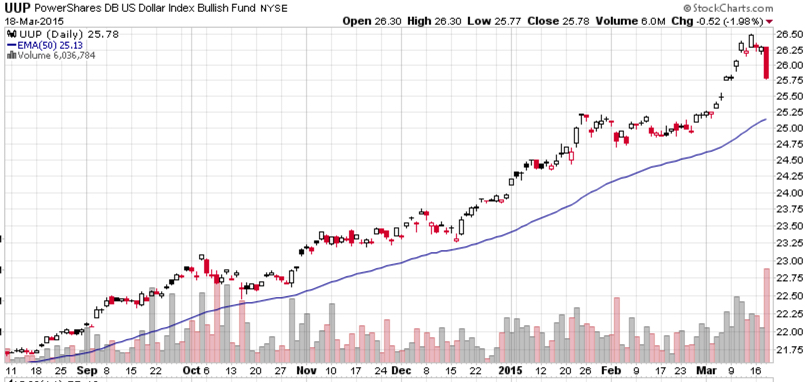
I find an edge in going with the flow, the current trend, what is actually happening. It seems if we do that, we can never be wrong for too long. It’s OK to be wrong; it’s staying on the wrong side of the trend that becomes a problem. And doing that starts with too much beliefs and expectations about what’s going to happen next and being unable to reverse it.

Flow… just go with it.

When we know in advance what we’ll do next, we don’t have to try to predict in advance what’s going to happen next.