ASYMMETRY® Observations are Mike Shell’s observations of investor behavior causing directional price trends, global macro, tactical ETF trading, momentum stock trading, hedging, volatility trading, and risk management that creates asymmetric investment returns. An asymmetric return profile is a risk/reward profile with a positive asymmetry between profit and loss. Mike Shell is the founder of Shell Capital Management, LLC and the portfolio manager of ASYMMETRY® Global Tactical
Nassim Nicholas Taleb argues that most so-called “alpha” isn’t real because it ignores the most important variable in investing: survival through time. Strategies that look impressive based on historical averages often conceal a small probability of catastrophic loss. For investors compounding wealth over decades—especially after a liquidity event like selling a business or retirement—those rare losses matter far more than smooth long-term averages. True alpha must endure volatility, uncertainty, and adverse regimes without risking permanent capital impairment.
Most investment frameworks still assume markets are driven by rational actors optimizing long-term averages.
They aren’t.
Markets are driven by how humans perceive gains, losses, and risk in real time—and that perception is systematically distorted under pressure.
This isn’t speculation. It’s formalized in Prospect Theory, the Nobel Prize-winning framework developed by Daniel Kahneman and Amos Tversky that explains how people actually behave when real money is on the line.
The asymmetry is structural
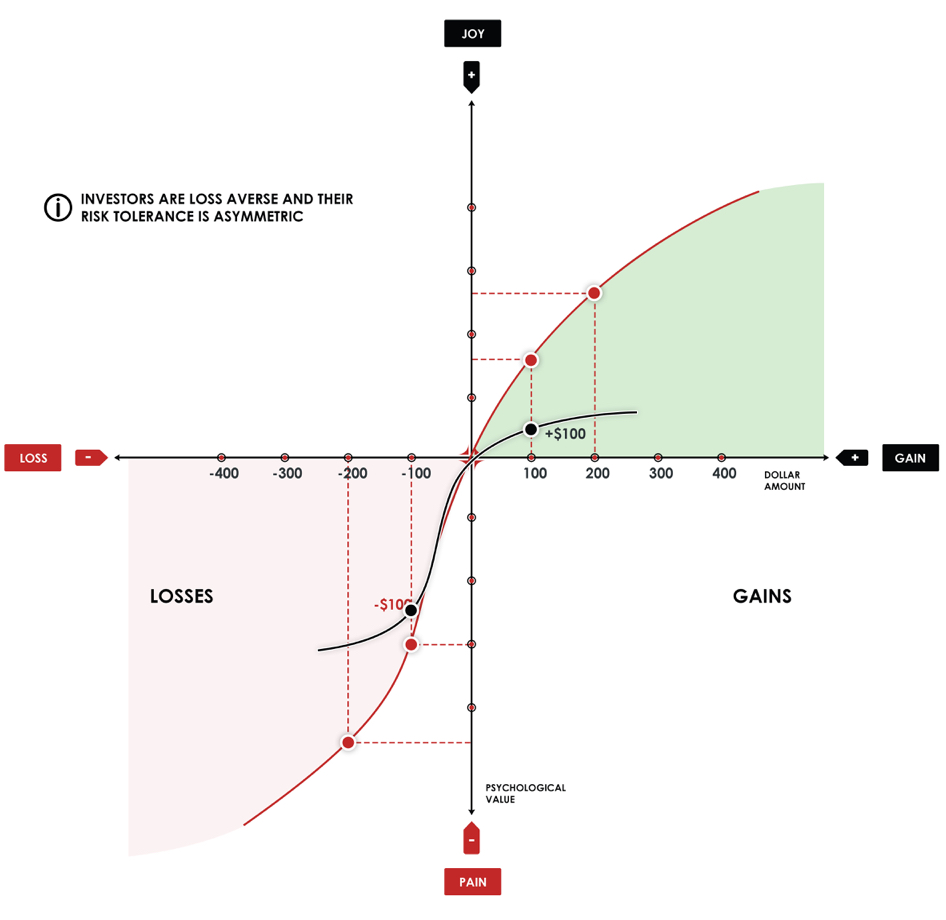
Prospect Theory demonstrates investors are:
Risk-averse when they’re winning
Risk-seeking when they’re losing
Far more sensitive to losses than to equivalent gains
This creates a non-linear value function centered around a reference point—usually “break-even.”
In markets, that behavioral asymmetry shows up as:
Upside trends that persist longer than expected
Downside moves that accelerate faster than models assume
Volatility that clusters rather than distributes smoothly
Averages don’t explain that. Behavior does.
Where wealth gets destroyed
Here’s the problem most investors don’t see coming:
The gap between how portfolios are constructed and how humans actually behave under pressure is where wealth gets destroyed.
Not by market risk. By behavioral risk.
Modern Portfolio Theory assumes you’ll hold through any drawdown. Prospect Theory explains why you won’t—and why trying to force yourself to will likely make things worse.
Loss aversion intensifies as drawdowns deepen. Investors lock in gains too early when winning and hold losses too long trying to “get back to even.” The discipline you think you have evaporates precisely when you need it most.
That’s not a character flaw. It’s human wiring.
From behavior to process
Prospect Theory doesn’t predict what markets will do next. It explains how people react once markets move.
That distinction is critical.
At Shell Capital, we design systems around that reality:
Downside risk is defined in advance, before loss aversion takes over
Exits to limit losses are systematic, not emotional
Upside is allowed to compound when trends persist
Position sizing reflects asymmetry, not averages
We don’t optimize for theoretical means. We manage the path—how returns are experienced over time.
Because the path is what determines whether you stay invested or tap out.
The practical reality
You can’t behavior-modify your way out of loss aversion. You can only design around it.
Markets aren’t driven by averages—they’re driven by how humans perceive gains, losses, and risk under pressure.
Our systems are built to harness that asymmetry while protecting against the behavioral traps that destroy even well-intended investment plans.
That’s where disciplined risk management begins.
Does your portfolio account for behavioral risk?
At best, portfolios may be stress-tested for market scenarios—2008, COVID, rate shocks.
Almost none are stress-tested for the investor.
One of the many parts of ASYMMETRY® is a behavioral risk diagnostic that maps allocations against asymmetries that emerge under pressure:
Where loss aversion is likely to override discipline
Which positions create unintended behavioral exposure
How your exit strategy (or lack of one) amplifies downside risk
Whether your position sizing reflects asymmetry or just diversification
If you want to see how your portfolio holds up under behavioral stress, contact us and we’ll send you the framework and walk you through how we apply it to your current holdings.
 ASYMMETRY® Observations
You must be logged in to post a comment.